In a world full of hazards—natural disasters, terror threats, emergencies—the need for valor outside declared wars is real. India’s Ashoka Chakra is the nation’s highest peacetime gallantry award, recognizing acts of extraordinary bravery when no formal war is underway. It reminds us that heroism lives in the everyday fight for life, dignity, and protection.
1. Origins & Evolution
Birth of the Award
The Ashoka Chakra was instituted in 1952 to honor courageous acts in non-warfare conditions. Originally, it was classified as Class I, II, III, but in 1967, the nomenclature was simplified to Ashoka Chakra, Kirti Chakra, and Shaurya Chakra to make the system clearer to the public.
Relationship with Wartime Awards
Although the Param Vir Chakra is the highest wartime gallantry medal, in peacetime the Ashoka Chakra is its equivalent in prestige. In the official order of precedence, the Ashoka Chakra ranks just below the Param Vir Chakra, but in spirit and weight for non-war actions, it’s India’s pinnacle.
2. Who Can Earn It?
Inclusive Eligibility
The Ashoka Chakra is open to all citizens, whether military personnel, police and paramilitary forces, or ordinary civilians who display exceptional valor. Nursing staff and support personnel in the armed forces are also eligible.
Civilians & Uniformed Heroes
Some of the best-known Indian recipients have been civilians—Neerja Bhanot, who defended passengers during a hijacking, is a powerful example. Uniformed heroes too, in counterterror operations or disaster relief, are frequently honored under this award.
3. Design & Symbolism
The Medal
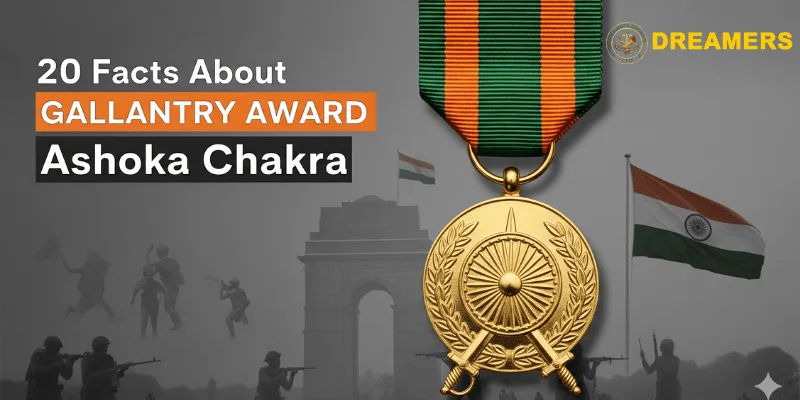
The medal is gold gilt, circular, with the Ashoka Chakra (wheel) at its center, surrounded by a lotus wreath. On the reverse side, the words “Ashoka Chakra” appear in Devanagari (Hindi) at top, and in English at bottom, separated by lotus motifs.
The Ribbon & Wearing
The ribbon is dark green with a saffron stripe in the center. Recipients wear the medal on the left chest, following strict rules of precedence and protocol.
Philosophical Symbolism
The Ashoka Chakra (wheel) derives from the Dharmachakra—a symbol of righteousness, the “wheel of the law.” The 24 spokes in the wheel are often interpreted to stand for 24 virtues—justice, courage, empathy, integrity, and more—reminding citizens that life must keep moving forward and with purpose. In the national flag, the same wheel sits at the center of the white band, conveying that there is life in movement, and death in stagnation.
4. Criteria & Process
What Acts Qualify
The Ashoka Chakra is awarded for “most conspicuous bravery or self-sacrifice” in situations other than declared war—terror attacks, hostage crisis, natural disasters, emergencies. The bravery must be above and beyond normal duty, with risk to life, and result in saving others or altering critical outcomes.
Recommendation & Vetting
The process begins at the unit or precinct level (military or police), with eyewitness testimony, reports, and documentation. It moves upward—through formation-level commands, service headquarters, and finally to the central government for approval. This multi-tier scrutiny ensures the award retains its sanctity and is not given lightly.
Multiple Awards
If someone performs another act worthy of the same honor, they receive a Bar instead of a second medal. This maintains the exclusivity of the decoration.
5. Statistics & Recent Developments
Number of Recipients
As of 2025, there have been 86 total recipients of the Ashoka Chakra. Of these, 68 were awarded posthumously. Only 17 recipients have been civilians so far.
A few unique facts:
-
The first Air Force officer to receive it was Flight Lieutenant Suhas Biswas, who survived a critical in-flight emergency and made a safe forced landing, saving lives.
-
Only two women have ever been honored: Neerja Bhanot (1987) and Constable Kamlesh Kumari (2001).
-
Two non-Indians—cosmonauts Gennadi Strekalov and Yuri Malyshev—were honored in 1984 for their joint mission with India’s first spaceman, Rakesh Sharma.
Recent Memorials
In 2025, a memorial event was held in Kochi on the 60th birth anniversary of Colonel Jojan Thomas, an Ashoka Chakra recipient who eliminated terrorists in a high-risk operation. Events like these keep alive the spirit of gallantry.
Allowances & Benefits
Recipients receive a monthly stipend and other government benefits. The central and state governments often provide ex-gratia payments, pensions, and family support to honor the sacrifice of the recipients and their families.
6. Living Legacy & Relevance
Stories That Live On
Each citation—whether of a civilian or soldier—tells a story of split-second decisions, selflessness, and resolve under pressure. These stories are studied in training academies, leadership courses, and even in civil society discussions on duty and courage.
Training Tomorrow’s Heroes
Institutions like Doon Defence Dreamers (best defence academy in dehradun) play a key role in connecting modern youth to this legacy. By introducing aspirants to real-life case studies, mindset training, and value-based leadership, they help embed the spirit behind the Ashoka Chakra into future officers and citizens.
Unity Through Courage
The Ashoka Chakra cuts across lines of region, religion, language, or rank. It says: courage is universal, and valor belongs to humanity—not just to armies or uniforms.
7. How to Read & Learn from Citations
When you come across a gallantry citation, treat it as both a story and a lesson:
-
Context: What was happening—threat, chaos, risk?
-
Action: What the person did—initiative, rescue, attack, defense?
-
Effect: What changed—were lives saved, disaster prevented, attackers neutralized?
This lens turns a formal citation into a practical guide on leadership, crisis response, and moral courage.
8. Why It Still Matters Today
In an era of unpredictable threats—natural, technological, terror—the Ashoka Chakra reminds us that war isn’t the only stage for courage. It elevates ordinary individuals who stand between danger and others, often paying the ultimate price.
It provides moral ballast: courage guided by ethics (the Ashoka wheel symbolism), not recklessness. And finally, it continually inspires new generations—people affiliated with Doon Defence Dreamers, other training institutions, or simply citizens who choose to act when others hesitate.
Conclusion
The Ashoka Chakra is not merely a medal: it is a living testament to India’s faith in courage, self-sacrifice, and moral resolve. From civilians who defied hijackers to soldiers who charged into collapsing buildings or terrorist dens, recipients show us that heroism is not exclusive—it’s possible every day.
As India evolves, as threats change, the principles of the Ashoka Chakra remain constant: prepare well, act decisively, protect others, and never forget that true bravery is rooted in empathy and service. Organizations like Doon Defence Dreamers help carry this torch forward—connecting the past to the young minds ready to serve tomorrow.