
The diversity of life on Earth is the greatest strength of nature. Wildlife—whether elephants roaming through forests, sharks swimming in the oceans, or rare medicinal plants—are not merely sources of aesthetic value for human civilization, but form the backbone of ecological balance. However, over the past few centuries, excessive human exploitation, poaching, and unregulated international trade have pushed numerous species to the brink of extinction.
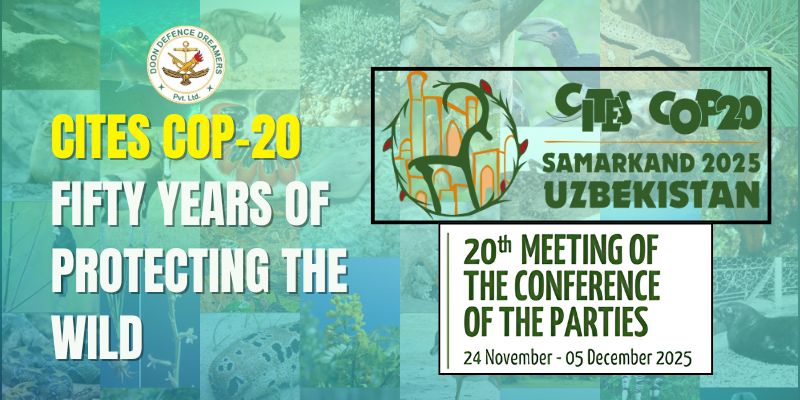
To address this growing crisis, the global community gave rise to agreements such as CITES (Convention on International Trade in Endangered Species of Wild Fauna and Flora). The completion of 50 years of CITES around 2023–25 and the convening of CoP-20 (Conference of the Parties) have brought this convention into global headlines. This moment is not merely one of celebration, but also of reflection and of charting the future course.
CITES: Origin and Historical Background
By the mid-20th century, it had become clear that the wildlife crisis was no longer confined to any single nation. The trade in ivory, rhino horn, rare birds, reptiles, and medicinal plants had spread across national boundaries. Even where strong conservation laws existed within countries, international markets continued to undermine these efforts.
Against this backdrop, CITES was adopted in Washington, D.C. in 1973 and came into force in 1975. Its fundamental objective was:
“To ensure that international trade in specimens of wild animals and plants does not threaten their survival.”
CITES was not conceived as a convention imposing absolute bans, but rather as a system based on regulation and balance, where conservation objectives and livelihood concerns could be addressed together.
Functioning and Structure of CITES
The success of CITES lies in its strong scientific and legal framework. The convention classifies species into three Appendices:
| Appendix | Status | Trade Regulation |
|---|---|---|
| Appendix I | Species threatened with extinction | Trade almost completely prohibited |
| Appendix II | Species not yet threatened but at risk | Regulated, permit-based trade |
| Appendix III | Species protected at the request of a country | Limited controls |
This system, for the first time, linked international wildlife trade to scientific data and a formal permit mechanism.
CoP (Conference of the Parties): The Core of Decision-Making
Within CITES, the most important institutional body is the Conference of the Par ties (CoP). All member countries participate in it, where:
-
New species are listed or reclassified
-
Conservation rules are amended
-
Strategies to combat illegal wildlife trade are formulated
So far, 19 CoPs have been held, and CoP-20 is considered the most historic milestone in this series.
Why Is CoP-20 Special?
CoP-20 is exceptional because it coincides with fifty years of the CITES journey. For the first time in half a century, the global community is collectively asking:
-
Has CITES truly succeeded in saving species?
-
Which policies have worked, and which have failed?
-
How should CITES be adapted to meet the challenges of the 21st century?
Thus, this conference is not merely a review of the past, but a blueprint for the future.
Fifty Years of CITES: Achievements and Impact
Over the past five decades, CITES has achieved several historic successes. Regulation of the ivory trade contributed to African elephant conservation; certain crocodile and whale species have recovered; and trade in rare birds has significantly declined—each standing as testimony to the effectiveness of CITES.
Additionally, CITES has:
-
Made wildlife conservation a subject of global diplomacy
-
Integrated scientific research into policy-making
-
Recognized illegal wildlife trade as a form of organized transnational crime
Why Does the Crisis Still Persist?
Despite these achievements, the global wildlife crisis continues to intensify. Several factors are responsible:
- First, illegal wildlife trade has evolved into a multi-billion-dollar global crime, increasingly linked with organized criminal and terrorist networks.
- Second, online platforms and social media have facilitated covert and hard-to-track wildlife trade.
- Third, climate change has destroyed natural habitats, rendering species even more vulnerable.
India and CITES: An Active Partnership
India has been a strong supporter of CITES from the very beginning. The Wildlife Protection Act, 1972 has been amended in alignment with CITES provisions. India has played a significant role in the conservation of tigers, Asian elephants, the Ganges river dolphin, and several medicinal plant species.
India’s approach goes beyond mere prohibition; it emphasizes making local communities active partners in conservation.
Why Is CoP-20 in the News Today?
CoP-20 has drawn global attention because:
-
It marks the completion of 50 years of CITES
-
Proposals exist to list several new species, particularly sharks, marine life, and medicinal plants
-
For the first time, there is extensive global discussion on illegal online wildlife trade
-
Greater emphasis is being placed on financial and technical support for developing countries
This conference will determine the direction of wildlife conservation policies for the coming decades.
The Road Ahead: From Conservation to Co-existence
It has now become evident that laws alone are insufficient. Future wildlife trade and conservation policies are likely to be guided by the following principles:
-
Sustainable wildlife trade, wherever feasible
-
Greater use of technology—DNA forensics and e-permits
-
Participation of local and indigenous communities
-
A balanced approach between conservation and development
Conclusion
Fifty years of CITES and the convening of CoP-20 represent more than an international conference; they reflect a deep introspection of the relationship between humanity and nature. They remind us that if wildlife is not secure, the future of humankind cannot be secure either.
The message of CoP-20 is clear — the time has come to view wildlife not merely as a resource, but as a partner in our shared future.
Frequently Asked Questions (FAQs)?
1. What is CITES and why was it created?
CITES is an international agreement adopted in 1973 to regulate global trade in wild animals and plants so that such trade does not threaten their survival.
2. What are the three Appendices under CITES?
CITES classifies species into three Appendices based on their conservation status, ranging from almost complete trade prohibition (Appendix I) to regulated and controlled trade (Appendix II and III).
3. Why is CoP-20 considered a historic milestone?
CoP-20 is historic because it marks 50 years of CITES and serves as a platform to review achievements, address gaps, and set the future direction of wildlife conservation.
4. What have been the major achievements of CITES over five decades?
Over the years, CITES has reduced illegal wildlife trade, supported species recovery like elephants and crocodiles, and strengthened global cooperation against wildlife crime.
5. Why does illegal wildlife trade still remain a challenge?
Illegal wildlife trade continues due to organized criminal networks, the rise of online trafficking, and increasing habitat destruction caused by climate change and development.