Clearing a written examination and SSB interview does not automatically guarantee entry into the Army, Navy or Air Force. Every recommended candidate must also meet the prescribed Indian Armed Forces medical standards before joining a training academy or military establishment.
The medical examination is conducted to determine whether a candidate can safely handle military training, operational duties, difficult terrain, extreme weather and prolonged physical and mental stress. Unlike an ordinary health check-up, the defence medical examination focuses on a candidate’s long-term suitability for military service.
The standards explained in here are based on the Joint Order Manual of Medical Standards for Entry into Armed Forces, issued under the Headquarters Integrated Defence Staff, Ministry of Defence. The Joint Order was issued in August 2025 and brought the medical examination framework of the three Services under a more uniform system while retaining certain Service- and branch-specific requirements. Therefore, candidates appearing for defence entries in 2026 should understand these rules carefully.
The Indian Armed Forces medical standards apply to categories, including:
- Officer entries such as NDA, CDS, TES, TGC, NCC and JAG
- Army, Navy and Air Force candidates
- JCOs, Other Ranks and Agniveers
- AFMC and Armed Forces medical-service entries
- Flying and aviation-related branches
- Male and female candidates
However, the exact requirement may differ according to the Service, entry, branch, age and nature of duty.
Medical Examination Process for Defence Candidates
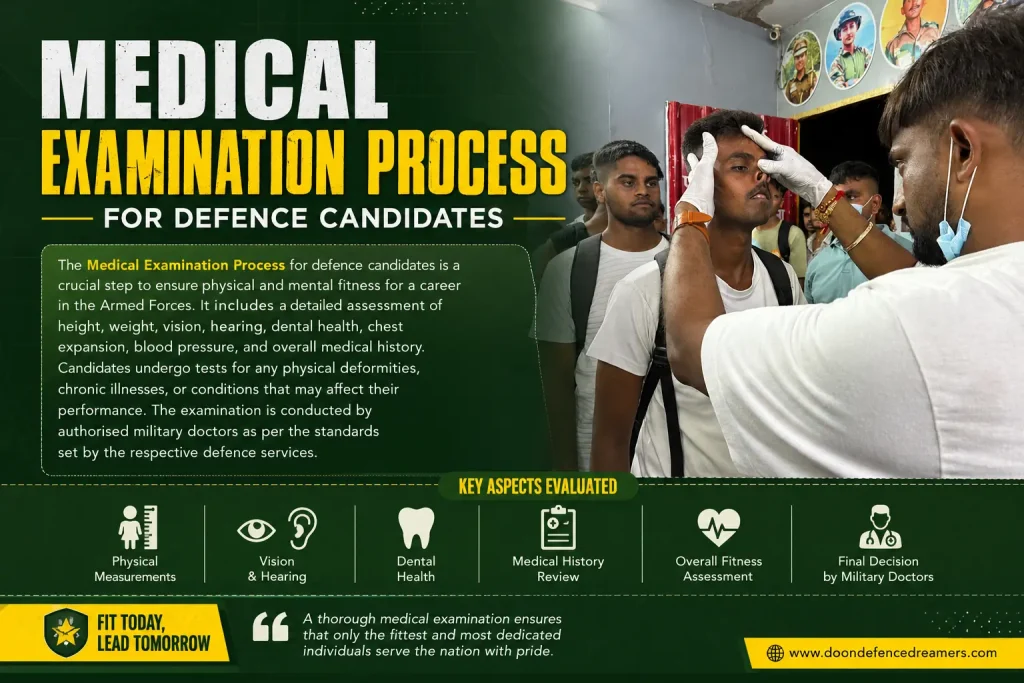
Candidates recommended after the selection process usually undergo a detailed medical examination at a designated military hospital. The Indian Armed Forces medical standards provide three important stages for officer-entry medical cases.
| Medical Board | Purpose | Important point |
|---|---|---|
| Special Medical Board | Initial complete medical examination | Candidate is declared fit or unfit for the relevant Service or entry |
| Appeal Medical Board | Re-examination after an unfit finding | Generally examines the disability for which the candidate was declared unfit |
| Review Medical Board | Review after an AMB unfit decision | Granted only on the merits of the case and is not an automatic right |
Special Medical Board
The Special Medical Board, commonly called SMB, conducts the initial medical assessment. It checks all major body systems and does not normally stop after finding only one disability. The board completes the examination before giving the final decision. An SMB is generally Service-specific. A candidate may therefore receive separate fitness endorsements such as:
- Fit for Army
- Fit for Navy
- Fit for Air Force
The manual states that a medical board for an undergraduate entry such as NDA or TES is not automatically valid for graduate-level entries such as TGC, NCC, SSC Tech or JAG. However, medical validity may be considered for certain parallel entries according to the prescribed conditions.
Appeal Medical Board
A candidate declared unfit by the SMB may apply for an Appeal Medical Board. According to the manual, the candidate must report for the appeal examination within the prescribed period of 42 days from the SMB.
The AMB normally reassesses the condition responsible for the original unfit decision. If the candidate does not report within the permitted period, the case may be marked “unfit in absentia.”
Review Medical Board
If the AMB also declares the candidate unfit, the candidate may request a Review Medical Board. The request must be made within the prescribed time. However, an RMB is not a matter of right. It is granted at the discretion of the competent medical authority when the challenge appears to have sufficient merit.
General Physical Standards for Army, Navy and Air Force
The Indian Armed Forces medical standards require candidates to have physical development and functional fitness. Medical officers assess whether the body is proportionate, healthy and capable of undergoing military training.
The general assessment may include:
- Height and weight
- Body build and physical development
- Posture and gait
- Chest and respiratory movement
- Limbs, joints and spine
- Evidence of old injuries or operations
- Physical capacity and movement
- Signs of congenital or acquired deformities
The manual contains separate height-weight charts for the Army, Navy and Air Force. It also provides separate Air Force charts for male and female candidates. Therefore, candidates should not assume that one common height or weight rule applies to every entry.
Some standards differ because the working environment of each Service is different. For example, aviation, submarine, naval and specialised operational duties may demand stricter anthropometric or functional requirements.
Candidates should focus on maintaining a healthy weight instead of attempting unsafe weight loss or rapid weight gain shortly before the medical examination.
Eyesight, Hearing and Dental Fitness Standards
Eyesight and hearing are among the most important parts of the Indian Armed Forces medical standards. The permitted limits depend on the Service, branch and nature of duty.
Eyesight examination
The ophthalmic assessment may cover:
- Distant and near vision
- Refractive error
- Colour perception
- Night blindness
- Ocular muscle balance
- Eye alignment
- Cornea, lens and retina
- History of eye disease or surgery
The manual contains specific visual standards for the Indian Air Force and additional ocular muscle-balance requirements for flying duties. Flying branches generally require stricter standards because even a minor visual limitation may affect operational safety.
Candidates must not rely only on the power mentioned in their spectacles. Final fitness is decided after a complete eye examination and according to the standard applicable to the selected branch.
Hearing and ENT assessment
The ears, nose and throat are examined for:
- Hearing ability
- Ear infection or discharge
- Eardrum condition
- Nasal obstruction
- Sinus-related problems
- Throat and voice disorders
- Balance-related conditions
A temporary infection and a permanent hearing defect may be assessed differently. The final opinion depends on severity, treatment response and operational impact.
Dental fitness
The Indian Armed Forces medical standards also require adequate dental health. The dental examination checks whether the candidate has enough healthy teeth for proper chewing and whether there is any active disease likely to create difficulty during training or deployment.
Untreated cavities, severe gum disease, infection and poor oral hygiene may require attention. Candidates should complete a dental check-up well before reporting for the medical board.
Medical Assessment of Major Body Systems
The medical examination is not limited to height, weight and eyesight. It includes a structured assessment of several body systems.
| Body system | Common areas assessed |
|---|---|
| Cardiovascular | Heart sounds, pulse, blood pressure and suspected cardiac conditions |
| Respiratory | Lungs, breathing pattern and respiratory disease |
| Gastrointestinal | Abdomen, liver, digestive disorders and hernia-related conditions |
| Musculoskeletal | Spine, bones, joints, limbs, posture and physical capacity |
| Nervous system | Coordination, reflexes and neurological disorders |
| Dermatological | Chronic skin disease, infection and conditions affecting duty |
| Urogenital | Kidney, urinary and reproductive-system conditions |
| Endocrine and blood | Hormonal disorders, anaemia and blood-related abnormalities |
The purpose of the Indian Armed Forces medical standards is primarily screening. The military medical board determines fitness for a particular entry; it is not intended to provide complete treatment or long-term diagnosis for every medical condition.
Candidates should declare previous illnesses, surgeries, injuries and ongoing treatment honestly. Concealing medical history may create serious issues if the condition is detected later.
Entry-Specific Medical Standards for Defence Aspirants
Although the general method of examination is similar, every candidate is assessed according to the entry and Service selected.
Officer entries
NDA, CDS, TES, TGC, NCC, JAG and SSC candidates are examined for commissioning and pre-commission training. The board assesses whether the candidate can withstand academy training and future officer duties.
Agniveers, JCOs and Other Ranks
The manual has a separate section covering medical examination, mandatory standards, baseline investigations and common visual standards for JCOs, Other Ranks and Agniveers.
AFMC and medical-service entries
Separate provisions apply to AFMC Pune, College of Nursing, Armed Forces Medical Services, Army Dental Corps and certain postgraduate or specialist candidates joining Armed Forces teaching hospitals.
Flying and aviation duties
Aviation candidates undergo additional evaluation. This may include aircraft-aircrew anthropometric compatibility and specialised assessment for aviation duties. These requirements are stricter because the candidate must safely operate in a complex aviation environment.
Therefore, the Indian Armed Forces medical standards should always be read together with the notification and instructions for the concerned entry.
Key Takeaways
- Medical fitness is compulsory even after clearing the written examination and SSB.
- The current standards are based on the Joint Order issued in August 2025 and are relevant for 2026 entries unless officially revised.
- Army, Navy and Air Force requirements are not identical in every category.
- The examination covers all major body systems, not only height and eyesight.
- Candidates declared unfit by the SMB may use the AMB process within the prescribed period.
- An RMB is discretionary and is not available as an automatic right.
- Flying, aviation and specialised entries may have stricter physical and visual requirements.
- Candidates should undergo a preventive health, eye and dental check-up before their official medical examination.
Frequently Asked Questions (FAQs)?
1. Are the Indian Armed Forces medical standards the same for Army, Navy and Air Force?
The basic medical examination method is broadly common, but certain height, weight, eyesight, anthropometric and branch-specific requirements differ due to operational needs.
2. Can a candidate appeal after being declared medically unfit?
Yes. A candidate declared unfit by the Special Medical Board may apply for an Appeal Medical Board and must report within the prescribed period, normally 42 days from the SMB.
3. Is a Review Medical Board guaranteed after an AMB unfit decision?
No. A Review Medical Board is not a matter of right. It may be granted by the competent authority after considering the merits of the candidate’s request.
4. Does being fit for NDA make a candidate automatically fit for every defence entry?
No. Undergraduate medical boards are not automatically valid for graduate or postgraduate entries. Limited validity may apply to certain parallel entries according to the rules.
5. Do all defence candidates need the same eyesight?
No. Eyesight requirements vary by Service, branch and role. Flying and certain specialised duties generally have more specific visual and ocular standards.