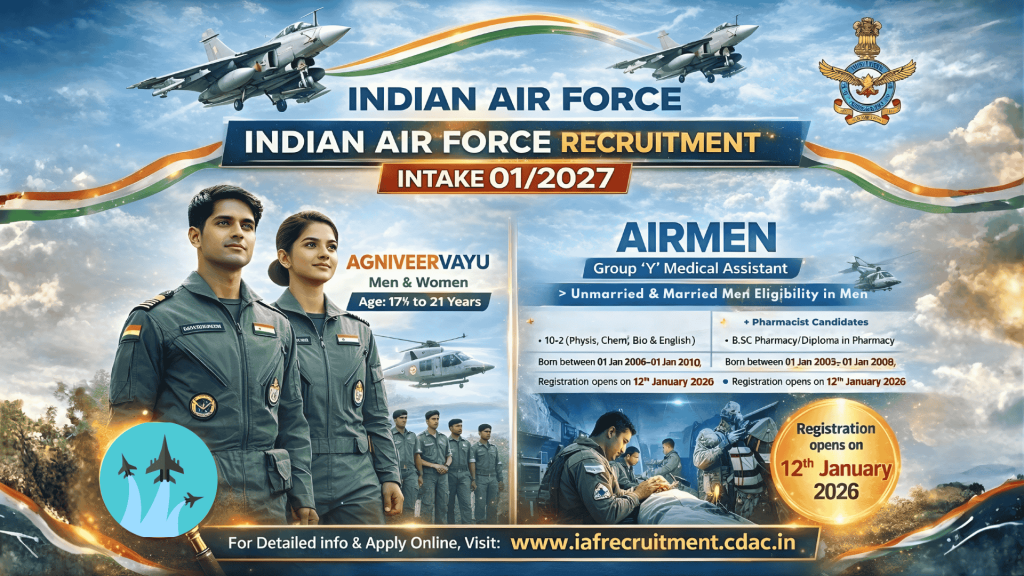
The release of the Indian Air Force (IAF) notification for Intake 01/2027 marks a watershed moment in the landscape of Indian defense recruitment. For the youth of this nation, specifically the community at ‘Doon Defence Dreamers‘, this is not merely a job advertisement; it is a clarion call to national service and professional excellence. The 01/2027 cycle is unique, presenting a dual-track opportunity that caters to two distinct aspirations: the adrenaline-fueled, high-tempo engagement of the Agniveervayu under the Agnipath Scheme, and the stable, technically specialized career of the Medical Assistant trade.
Navigating this recruitment landscape requires more than just knowing the dates. It demands a deep, nuanced understanding of the evolving Human Resource methodology of the Indian Armed Forces. The 01/2027 intake crystallizes the IAF’s strategic shift towards a younger, more tech-savvy fighting force while acknowledging the critical need for permanent, specialized support staff in healthcare. This report serves as an exhaustive manual, dissecting every clause of the notification, every physical standard, and every syllabus topic to provide a roadmap that transforms a dreamer into an air warrior. By adhering to the principles of Experience, Expertise, Authoritativeness, and Trustworthiness (E-E-A-T), this document ensures that your preparation is grounded in verified fact and strategic insight.
In the following comprehensive analysis, we will journey through the intricate details of eligibility, the psychological demands of the adaptability tests, the physiological science behind the physical fitness test, and the long-term career trajectories of both entry pathways. We will explore why the application window from 12 January 2026 to 01 February 2026 is the most critical period of your early year and how the examinations scheduled for March 2026 will test not just your intellect, but your character.
Indian Air Force Recruitment Basic Details
Before diving into the detailed strategy, here is the essential snapshot of the Intake 01/2027 recruitment. Use the direct links below to access the official portals.
| Feature | Details |
| Recruiting Body | Indian Air Force (IAF) |
| Intake Name | Intake 01/2027 (Agniveervayu & Medical Assistant) |
| Application Mode | Online Only |
| Application Dates |
12 January 2026 to 01 February 2026 |
| Exam Date |
30 March 2026 Onwards |
| Application Fee |
Rs. 550/- + GST |
| Apply Link (Agniveer) | Click Here to Apply (iafrecruitment.edcil.co.in) |
| Apply Link (Med. Asst) | Click Here to Apply (iafrecruitment.edcil.co.in) |
| Age Limit (Agniveer) |
Born between 01 Jan 2006 – 01 July 2009 |
| Age Limit (Med. Asst) |
10+2: 01 Jan 2006 – 01 Jan 2010
Diploma/Pharmacy: 01 Jan 2003 – 01 Jan 2008 |
Section I: The Strategic Landscape of Intake 01/2027
To understand the opportunity, one must first understand the architecture of the recruitment. The Intake 01/2027 is not a singular event but a synchronized mobilization of two parallel streams.
The Agnipath Paradigm: Agniveervayu Intake 01/2027
The induction of Agniveervayu under the ‘Agnipath Scheme’ represents a paradigm shift in military recruitment, aimed at lowering the average age profile of the Indian Armed Forces. For Intake 01/2027, the IAF invites unmarried Indian male and female candidates to experience the military way of life for a tenure of four years.
The underlying philosophy here is “Tour of Duty.” The objective is to harness the youth’s energy and technological adaptability. Aspirants must understand that this is a high-performance environment. As noted in multiple sources, only 25% of the Agniveers from each batch will be enrolled in the regular cadre of the IAF after their four-year engagement. This introduces a competitive element that persists even after recruitment. The 01/2027 intake is the gateway to this high-stakes environment where every day is a test of merit.
From a socio-economic perspective, the Agniveervayu route offers a unique value proposition. It provides a bridge between adolescence and the professional world. The “Seva Nidhi” package, a corpus fund accumulated over four years, provides a financial launchpad for those who exit, while the skills acquired discipline, teamwork, technical proficiency are invaluable in the civilian sector.
The Permanent Commission: Medical Assistant Trade
Parallel to the Agniveer intake is the recruitment for the Medical Assistant trade in Group ‘Y’ (Non-Technical). This entry remains a bastion of the traditional “Permanent Commission” structure. Unlike the four-year tenure of Agniveers, Medical Assistants are enrolled for an initial period of 20 years, which can be extended up to the age of 57 years.
This distinction is crucial for aspirants to grasp. The Medical Assistant role is specialized. It demands specific educational backgrounds (Physics, Chemistry, Biology, and Pharmacy) and offers immediate job security, pensionable service, and a distinct career progression. The simultaneous release of notifications for both Agniveervayu and Medical Assistant for the 01/2027 intake allows eligible candidates—specifically those with a Science (Biology) background—to hedge their bets. They can apply for the stability of the Medical Assistant role while simultaneously competing for the Agniveer entry, maximizing their chances of donning the blue uniform.
Strategic Synchronization of Timelines
The IAF has synchronized the administrative timelines for both entries in this cycle, streamlining the logistics for the Central Airmen Selection Board (CASB).
| Event | Dates for Intake 01/2027 | Strategic Implication |
| Notification Release | January 2026 | Signals the start of the recruitment year; aligns with the final phase of academic board preparations for students. |
| Online Registration |
12 January 2026 (1100h) to 01 February 2026 (2300h) 2 |
A tight 20-day window. Aspirants must have documents ready to avoid server congestion in the final days. |
| Admit Card Release |
24 to 48 hours prior to exam |
Requires candidates to be travel-ready on short notice. |
| Online Examination |
30 March 2026 onwards |
Provides roughly 60-70 days of dedicated preparation time post-registration. |
This synchronization implies that the IAF is looking for a consolidated pool of talent. The “Science” candidates are the common denominator, eligible for the technical Agniveer trades and the Medical Assistant trade. This overlap is where the maximum opportunity lies.
Section II: Decoding Eligibility – The Gatekeepers of Glory
The first step in any SEO-optimized guide is to clarify who can apply. Misunderstanding eligibility criteria is the leading cause of application rejection. For 01/2027, the criteria are rigid and non-negotiable.
1. The Age Block: Precision Matters
The IAF operates on strict “Date of Birth Blocks.” Unlike civilian jobs that calculate age as of a specific date, the IAF defines a range.
-
Agniveervayu: Candidates must be born between 01 January 2006 and 01 July 2009 (both dates inclusive).
-
Insight: This effectively targets youth aged 17.5 to 21 years. If you were born on 31 December 2005, you are overage. If you were born on 02 July 2009, you are underage. There are no exceptions.
-
Upper Age Limit at Enrolment: Even if a candidate clears all stages, they must be 21 years or younger on the date of enrolment. This prevents the recruitment process from dragging on and enrolling “older” candidates.
-
-
Medical Assistant:
-
10+2 Candidates: Born between 02 July 2005 and 02 July 2009 (Estimated based on 21-year limit and previous trends).
-
Pharmacy (Diploma/B.Sc) Candidates: The age limit is relaxed, typically up to 24 years (Born between 02 July 2002 and 02 July 2009). This recognizes the additional years spent acquiring the professional degree.
-
2. Marital Status and Gender
-
Marital Status: Only unmarried candidates are eligible. This applies to both male and female candidates for Agniveervayu and male candidates for Medical Assistant.
-
Rationale: The training period and the initial years of service require undivided attention and high adaptability to rigorous schedules, which familial responsibilities might hinder. Agniveers must undertake not to marry during their four-year tenure.
-
-
Gender Inclusivity:
-
Agniveervayu: Open to both Men and Women. The inclusion of women is a progressive step, expanding the talent pool and offering equal opportunities in combat and technical support roles.
-
Medical Assistant: The 01/2027 notification specifically invites Male candidates. Aspirants must check the specific notification text carefully, as gender eligibility for specific trades can vary by intake.
-
3. Educational Qualifications: The Academic Floor
The education requirements serve as a filter for cognitive capability. The IAF requires a foundation in English and, for technical trades, a solid grasp of Science.
For Agniveervayu (Science Subjects)
Candidates must fulfill one of the following:
-
10+2 / Intermediate: Passed with Mathematics, Physics, and English from an education board recognized by COBSE.
-
Minimum Marks: 50% marks in aggregate and 50% marks in English.
-
-
Diploma in Engineering: Three-year diploma course in specified streams (Mechanical, Electrical, Electronics, Automobile, Computer Science, etc.) from a government-recognized polytechnic.
-
Minimum Marks: 50% marks in aggregate and 50% marks in English (in diploma or in intermediate/matriculation if English is not a subject in diploma).
-
-
Vocational Course: Two-year vocational course with non-vocational subjects (Physics and Mathematics).
-
Minimum Marks: 50% marks in aggregate and 50% marks in English.
-
Insight: The “50% in English” rule is the most common stumbling block. A candidate with 95% in Math and Physics but 49% in English is ineligible. This underscores the importance of communication skills in the modern Air Force, where technical manuals and operational commands are universally in English.
For Agniveervayu (Other Than Science Subjects)
-
10+2 / Intermediate: Passed in any stream (Arts, Commerce, Science) recognized by COBSE.
-
Minimum Marks: 50% marks in aggregate and 50% marks in English.
-
-
Vocational Course: Passed two-year vocational course.
-
Minimum Marks: 50% marks in aggregate and 50% marks in English.
-
Insight: This stream opens the door for students from non-technical backgrounds to join in roles such as Accounts Assistant, Admin Assistant, and Logistics Assistant.
For Medical Assistant (Group Y)
-
10+2 / Intermediate: Passed with Physics, Chemistry, Biology, and English.
-
Minimum Marks: 50% marks in aggregate and 50% marks in English.
-
-
Pharmacy Qualification: Passed 10+2 with PCB and English, AND possesses a Diploma or B.Sc in Pharmacy.
-
Minimum Marks: 50% marks in aggregate in the Diploma/Degree.
-
Validation: Must have valid registration from the State Pharmacy Council or Pharmacy Council of India (PCI) at the time of enrolment.
-
Insight: The Biology requirement is non-negotiable here. Mathematics is not required, making this the prime entry for NEET aspirants who wish to serve in the defense forces without becoming a doctor (AFMC route).
4. Mandatory Medical Standards (Preliminary)
While the detailed medical exam comes later, candidates must meet basic standards to apply:
-
Height: Minimum 152.5 cm for males. Female standards typically start at 152 cm (with relaxations for hill regions).
-
Chest: For males, the chest must be well-proportioned with a minimum range of expansion of 5 cm.
-
Hearing: Ability to hear a forced whisper from a distance of 6 meters.
-
Dental: Healthy gums, good set of teeth, and a minimum of 14 dental points.
-
Visual Acuity (Medical Assistant): 6/36 each eye correctable to 6/9 each eye. Maximum refractive error of +3.50D.
Warning: Candidates with permanent body tattoos are generally not permitted, except on specific parts of the arm (inner face of forearm) and for candidates belonging to tribal communities with established traditions.
Section III: The Application Process – A Zero-Error Protocol
The application window for Intake 01/2027 is brief: 12 January 2026 to 01 February 2026. In the digital age, the application form is the first test of your attention to detail.
Step-by-Step Guide to Applying Online
-
Portal Navigation:
-
For Agniveervayu, visit
https://agnipathvayu.cdac.in. -
For Medical Assistant, visit
https://iafrecruitment.edcil.co.in. -
Expert Tip: Do not rely on third-party links. Always verify the domain. The use of
.cdac.inand.edcil.co.inindicates official government-affiliated portals.
-
-
Registration:
-
Click on “New User / Register”.
-
Enter your name and Date of Birth exactly as mentioned in your 10th Matriculation Certificate.
-
Crucial Warning: A spelling mistake here (e.g., “Sharma” vs “Sarma”) cannot be corrected later and will lead to disqualification during Phase II document verification.
-
Provide a valid email ID and mobile number. You will receive an OTP. Verify it to create your account.
-
-
Filling the Form:
-
Personal Details: Parent’s name, Aadhar number (optional but recommended), address.
-
Qualification Details: Enter marks carefully. If your board gives CGPA, follow the conversion formula provided on your mark sheet to convert it to a percentage. Do not round off 49.9% to 50%. It is 49.9%, and it is ineligible.
-
-
Document Upload:
-
Passport Size Photo: Must be recent (taken not before December 2025).
-
Specification: The candidate must hold a black slate in front of their chest with their Name and Date of Photograph written on it with white chalk in capital letters. This is a unique IAF requirement to prevent impersonation and ensure the photo is recent.
-
File Size: 10KB to 50KB (JPEG).
-
-
Signature: Scanned image of signature (10KB to 50KB).
-
Thumb Impression: Left-hand thumb impression (Male) / Right-hand thumb impression (Female) (verify specific instruction in the portal).
-
Parent’s Signature: Only for candidates below 18 years of age.
-
Mark Sheets: Class 10th (for DOB proof) and Class 12th/Diploma.
-
-
Exam City Selection:
-
You will be asked to select 5 choices for the Phase I exam center.
-
Strategy: The IAF generally allocates the first choice. Apply early (within the first 3 days) to secure your nearest city. Late applicants are often pushed to their 4th or 5th choice due to capacity constraints.
-
-
Payment of Fees:
-
The examination fee is Rs. 550/- plus GST.
-
Payment modes: Credit/Debit Card, Net Banking, UPI.
-
Troubleshooting: If money is deducted but the status shows “Pending,” do not pay again immediately. Wait for 24 hours for the bank reconciliation. Keep the transaction ID safe.
-
-
Final Submission:
-
Preview the application. Check every letter.
-
Submit and Print the Application Form. Save the PDF on your Google Drive. You will need this printout during Phase II testing. Losing this file is a common nightmare for candidates.
-
Section IV: The Written Examination – Strategy and Syllabus
The Phase I Online Written Test is the Great Filter. Hundreds of thousands apply; only a fraction clear the cut-off. The exam for Intake 01/2027 is scheduled for 30 March 2026 onwards.
1. The Exam Pattern: Understanding the Battlefield
The exam is a Computer Based Test (CBT). The pattern depends on the group applied for.
| Group | Subjects | Questions | Duration | Marking Scheme |
| Science Subjects | English (20), Physics (25), Math (25) | 70 | 60 Minutes | +1 Correct, -0.25 Wrong |
| Other Than Science | English (20), RAGA (30) | 50 | 45 Minutes | +1 Correct, -0.25 Wrong |
| Science & Other | English (20), Physics (25), Math (25), RAGA (30) | 100 | 85 Minutes | +1 Correct, -0.25 Wrong |
Insight: Candidates applying for “Both” take a single exam. The Physics/Math scores are used for the Science merit list, and the English/RAGA scores are used for the Other Than Science merit list. This is the smartest way to apply for Science students, effectively doubling their chances.
2. Subject-Wise Deep Dive and Preparation Strategy
A. English (Common to All)
English is often the deciding factor. It has a sectional cut-off (usually 10 marks), and many technical geniuses fail here.
-
Syllabus:
-
Grammar: Subject-Verb Concord, Prepositions, Nouns, Pronouns, Adjectives, Conjunctions, Modals.16
-
Vocabulary: Synonyms, Antonyms, One-word substitution, Idioms.
-
Comprehension: A short passage with 4-5 questions.
-
Voice & Narration: Active/Passive voice and Direct/Indirect speech are high-yield topics (2-3 questions guaranteed).17
-
-
Strategy:
-
The Preposition Trap: Focus on “Fixed Prepositions” (e.g., “Afraid of,” not “Afraid from”). This is the most common area of error.
-
Reading Speed: The passage is usually simple, but reading it quickly allows time for grammar questions.
-
Word Formation: Questions like “Change the verb ‘decide’ to a noun” (Answer: Decision) are frequent.17
-
B. Physics (Science Subjects)
IAF Physics is conceptually demanding. It is not just about solving numericals; it is about understanding why things happen.
-
Syllabus:
-
Mechanics: Laws of Motion, Work, Energy, Power, Gravitation (Variation of ‘g’), Rotational Motion.
-
Heat & Thermodynamics: Kinetic theory, Laws of thermodynamics.
-
Electrostatics & Current Electricity: Capacitors, Resistors, Kirchhoff’s laws.
-
Magnetism: Magnetic effect of current, EMI.
-
Optics & Modern Physics: Ray optics, Wave optics, Dual nature of matter, Atoms & Nuclei.16
-
-
Strategy:
-
Conceptual Clarity: Expect questions like, “If the radius of the earth shrinks by 1%, what happens to ‘g’?”
-
Dimensional Analysis: There is almost always one question on dimensions (e.g., “What are the dimensions of Planck’s constant?”).
-
Modern Physics: This is the easiest section to score. Atoms, Nuclei, and Semiconductors are formula-based and require less calculation time.
-
C. Mathematics (Science Subjects)
This is technical math (10+2 level), not arithmetic.
-
Syllabus:
-
Calculus: Differentiation, Integration (Definite integrals properties are crucial), Differential Equations.
-
Trigonometry: Inverse functions, general solutions.
-
Algebra: Matrices, Determinants, Complex Numbers, Probability.
-
Coordinate Geometry: Conic sections (Parabola, Ellipse).
-
Vector & 3D Geometry:.16
-
-
Strategy:
-
Speed is King: You have 20 minutes for 25 questions. That’s less than a minute per question.
-
Formula Handbook: Memorize standard results. (e.g., The area of an ellipse $\pi ab$). If you have to derive or integrate from scratch, you have already lost.
-
Skip and Pick: Identification of the 5 “speed-breaker” questions (lengthy calculations) is a skill. Skip them. Score high on the 20 easy ones.
-
D. Reasoning and General Awareness (RAGA)
This section tests mental agility and general knowledge.
-
Syllabus:
-
Reasoning (Verbal): Number Series, Distance & Direction, Blood Relations, Coding-Decoding.18
-
Reasoning (Non-Verbal): Tallest/Shortest, Figure completion, Odd figure out. Note: Non-verbal reasoning is a staple of military exams.
-
Mathematics (Arithmetic): Ratio & Proportion, Average, LCM/HCF, Profit & Loss, Time Speed Distance, Percentage, Probability, Trigonometry (Simple).17
-
General Awareness: Current Affairs, Civics, Geography, History, Basic Science.
-
-
Strategy:
-
Non-Verbal First: These are visual puzzles. Practice them daily. They are quick marks.
-
GK is a Bonus: Do not spend hours on History. Focus on Current Affairs (Defense exercises, Sports, Heads of States) and Static GK (Capitals, Currencies).
-
Arithmetic Efficiency: Use shortcuts for percentages and ratios. The time pressure in RAGA is immense (30 questions mixed with English in 45 mins).
-
Section V: Physical Fitness Test (PFT) – Forging the Iron
Clearing the written exam is only half the battle. Phase II involves the Physical Fitness Test (PFT). The IAF demands a baseline of athleticism that ensures you can withstand the rigors of training.
1. The PFT Standards for Intake 01/2027
The requirements vary slightly by trade, specifically for the running component.
| Activity | Standard for Agniveervayu (Male) | Standard for Medical Assistant (10+2) | Standard for Medical Assistant (Pharmacy) | Standard for Agniveervayu (Female) |
| 1.6 km Run |
7 Minutes 1 |
7 Minutes 1 |
7 Minutes 30 Seconds 1 |
8 Minutes (Approx. standard) |
| Push-ups | 10 (within 1 min) | 10 | 10 | N/A |
| Sit-ups | 10 (within 1 min) | 10 | 10 | 10 (within 1 min 30 sec) |
| Squats | 20 (within 1 min) | 20 | 20 | 15 (within 1 min) |
Note: There are strictly defined break periods between exercises (e.g., 10 minutes break after running, 2 minutes break between sit-ups and squats).13
2. The Physiology of the 1.6 km Run
Running 1.6 km (1 mile) in 7 minutes requires a pace of 4:22 per kilometer. This is not a jog; it is a sustained high-intensity aerobic effort.
-
Aerobic Capacity (VO2 Max): You need to condition your heart and lungs to deliver oxygen efficiently to your muscles.
-
Lactic Threshold: At this pace, your body begins to produce lactate. Training helps your body clear this lactate efficiently so your legs don’t feel like “lead” in the last 400m.
3. Training Roadmap: From Couch to 7 Minutes
If you are starting from zero, you need at least 6-8 weeks of progressive training.
-
Weeks 1-2 (Base Building):
-
Run at a slow, conversational pace for 20-30 minutes, 3 times a week.
-
Focus on form: Shoulders relaxed, landing mid-foot (not heel striking).
-
-
Weeks 3-4 (Interval Training):
-
This is the secret to speed.
-
Workout: Warm up, then sprint 400m (1 lap) in 1:40 minutes. Rest for 2 minutes. Repeat 4 times.
-
Add a long run (3-4 km) on weekends to build endurance.
-
-
Weeks 5-6 (Pace Rehearsal):
-
Run 800m at your target pace (3:30 mins). Rest 3 mins. Repeat.
-
Practice running on different terrains (road vs. ground) as the test venue varies.
-
-
Week 7 (Tapering):
-
Reduce volume. Keep the intensity but run shorter distances. Rest your legs for the final day.
-
4. Mastering the Exercises
-
Push-ups: The IAF instructors are strict about form.
-
The Hold: Often, they will make you hold the “down” position. Practice doing push-ups with a 2-second pause at the bottom.
-
Extension: Your elbows must lock at the top. Half push-ups are not counted.
-
-
Squats: Your thighs must be parallel to the ground. Keep your back straight. Do not lift your heels.
-
Sit-ups: Keep your hands locked behind your head (or as per specific center instruction). Your elbows should touch your knees on the way up.
Section VI: Adaptability Tests – The Psychological Barrier
Many candidates assume that if they are fit and smart, they are in. They are wrong. The Adaptability Tests (Phase II) are designed to filter out candidates who are psychologically unsuited for military life.
Adaptability Test-I (SRT – Situation Reaction Test)
-
Objective: To test decision-making, ethical grounding, and mental resilience.
-
Format: Approx. 45 questions in 30 minutes.
-
Sample Scenario: “You are on your way to the exam and you see a person injured in a road accident. You are getting late. You will…”
-
Option A: Ignore and go to exam.
-
Option B: Call an ambulance, ensure help arrives, and proceed to exam.
-
Option C: Take the person to the hospital and miss the exam.
-
Analysis: Option B is the balanced “Officer Like” response. It shows responsibility without sacrificing the primary mission. Option A shows selfishness; Option C shows emotional impulsiveness and lack of planning.
-
-
Strategy: Be practical, positive, and proactive. Attempt all questions.
Adaptability Test-II (Group Discussion)
-
Objective: To test communication skills and the ability to work in a team.
-
Format: Groups of 10-15 candidates. A topic is given (e.g., “Social Media: Boon or Bane,” “Co-education,” “Olympic Games”).
-
The Trap: It is not a debate. The loudest person often gets rejected.
-
The Winner: The candidate who listens, acknowledges others (“I agree with Chest Number 10…”), and adds a new, logical point.
-
Body Language: Sit straight. Look at your group members, not the assessor. Do not point fingers. Maintain a calm demeanor even if others are shouting.
Section VII: Medical Standards – The Final Check
The Medical Examination (Phase III) is conducted by Air Force Medical Officers. It is exhaustive and unforgiving.
1. Vision Standards
-
Medical Assistant: 6/36 each eye correctable to 6/9 each eye. Max refractive error +3.50D.14
-
Agniveervayu (Science): Generally 6/12 each eye correctable to 6/6.
-
LASIK Surgery: Not permitted for candidates under 21 years. If you have had LASIK, you will likely be detected and rejected.
2. Anthropometry (Height & Weight)
-
Weight: Must be proportionate to height and age (±10% of standard BMI tables).
-
Height: Minimum 152.5 cm.
-
Relaxation: Candidates from North East and Hill regions (Uttarakhand) often have a relaxation to 152.5 cm or 147 cm depending on the specific trade.19
-
Leg Length: Critical for pilots, but less so for ground duties.
-
3. Common Grounds for Rejection (and Fixes)
-
Ear Wax: The most common reason for “Temporary Unfitness.” Fix: Get your ears cleaned by an ENT specialist 2 weeks before the medical.
-
Dental Tartar: Fix: Get a scaling done by a dentist. Ensure you have no cavities.
-
Carrying Angle: The angle of your elbow. If it exceeds 15-19 degrees (cubitus valgus), it is a rejection.
-
Flat Foot: Check by wetting your foot and stepping on paper. If the whole footprint appears, practice arch-building exercises.
-
Knock Knees: Stand with ankles touching. If knees touch, it’s a problem.
Conclusion: The Path of the Warrior
The Indian Air Force Intake 01/2027 is more than a recruitment notification; it is a challenge. It challenges your intellect through Physics and Math. It challenges your body through the 1.6 km run. It challenges your character through the Adaptability Tests.
For the aspirants at ‘Doon Defence Dreamers ‘, the journey from “Applicant” to “Airman” is paved with discipline. The synchronization of the Agniveervayu and Medical Assistant streams offers a unique safety net, but only for those who prepare for both with equal intensity.
Remember, the uniform is earned, not given. The window to apply is short—January 12 to February 01, 2026. The time to prepare is now. Whether you see yourself as a high-tech Agniveer safeguarding our skies or a compassionate Medical Assistant saving lives, the runway is clear.
Throttle up. Your takeoff clearance is granted.
Frequently Asked Questions (FAQs)
Q1: Can I apply for both Agniveervayu and Medical Assistant in Intake 01/2027?
Yes. Eligible candidates—especially those with a Science (Biology) background—can apply for both Agniveervayu and Medical Assistant entries simultaneously, provided they meet the age, educational, and medical criteria for each trade.
Q2: What is the main difference between Agniveervayu and Medical Assistant entry?
Agniveervayu is a 4-year tenure under the Agnipath Scheme, with 25% retained for permanent service, while Medical Assistant is a permanent commission trade with long-term service, pension benefits, and a specialized healthcare role in the Indian Air Force.
Q3: Is the 1.6 km run compulsory for all candidates in Intake 01/2027?
Yes. The 1.6 km run is mandatory for both Agniveervayu and Medical Assistant candidates. However, the time limit varies depending on the trade and gender, making physical preparation essential.
Q4: What happens if I clear the written exam but fail the medical test?
If you are found temporarily unfit, you may be given time to rectify the issue (such as ear wax or dental problems). However, permanent unfitness leads to disqualification, regardless of written or physical performance.
Q5: When should I start preparing for the IAF Intake 01/2027 exam?
Preparation should ideally begin at least 3–4 months before the March 2026 exam, focusing equally on written subjects, physical fitness, and adaptability tests to meet the holistic selection standards of the Indian Air Force.
Written & Reviewed by Doon Defence Dreamers Expert Team (Ex-SSB Mentors & Defence Experts)