
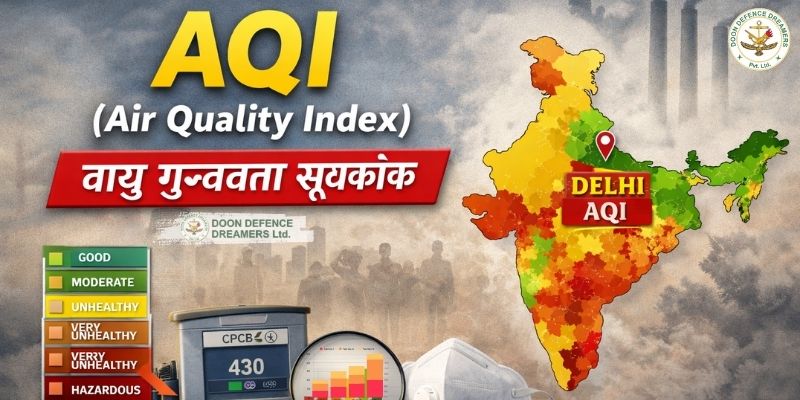
In today’s rapidly changing environment, air pollution has emerged as one of the most serious public health challenges. This is where AQI (Air Quality Index) plays a crucial role. AQI (Air Quality Index) is a standardized indicator used to measure how clean or polluted the air is and what potential health effects it may have on people. It converts complex air pollution data into a simple number and color-coded scale that is easy for the public to understand.
With increasing urbanization, industrial growth, vehicle emissions, and crop residue burning, monitoring AQI (Air Quality Index) has become essential for protecting public health and planning daily activities safely.
What is AQI (Air Quality Index)?
AQI (Air Quality Index) is a numerical scale that represents the concentration of major air pollutants in the atmosphere. The higher the AQI value, the greater the level of air pollution and the higher the health risk. Governments and environmental agencies use AQI (Air Quality Index) to inform citizens about daily air quality conditions.
Origin and History of AQI (Air Quality Index)
The concept of AQI (Air Quality Index) originated in the United States.
- In the 1970s, the need for a clear and simple way to communicate air pollution levels became evident.
- The United States Environmental Protection Agency (US EPA) developed the AQI system.
- In 1999, AQI was officially adopted as a national standard in the USA.
Following this, many countries around the world introduced their own versions of AQI based on local environmental conditions.
When Was AQI (Air Quality Index) Introduced in India?
India officially implemented AQI (Air Quality Index) in:
- September 2014
- Initially launched in Delhi
- Implemented under the Ministry of Environment, Forest and Climate Change (MoEFCC)
Today, AQI is monitored across India through hundreds of air quality monitoring stations.
Who Declares AQI (Air Quality Index) in India?
In India, AQI (Air Quality Index) is declared by:
Central Pollution Control Board (CPCB)
- CPCB functions under MoEFCC
- It collects real-time data from State Pollution Control Boards (SPCBs)
- Uses CAAQMS (Continuous Ambient Air Quality Monitoring Stations) across the country
Based on this data, daily and real-time AQI (Air Quality Index) values are published for cities and regions.
How is AQI (Air Quality Index) Calculated?
AQI is calculated by measuring the concentration of key air pollutants and converting them into sub-indices. The highest sub-index becomes the overall AQI value.
In India, AQI is based on 8 major pollutants:
- PM2.5
- PM10
- Nitrogen Dioxide (NO₂)
- Sulphur Dioxide (SO₂)
- Carbon Monoxide (CO)
- Ozone (O₃)
- Ammonia (NH₃)
- Lead (Pb)
AQI (Air Quality Index) Categories and Health Impact
| AQI Range | Air Quality Category | Health Impact |
|---|---|---|
| 0–50 | Good | Minimal impact |
| 51–100 | Satisfactory | Minor breathing discomfort |
| 101–200 | Moderate | Discomfort to sensitive groups |
| 201–300 | Poor | Breathing difficulty |
| 301–400 | Very Poor | Respiratory illness |
| 401–500 | Severe | Serious health effects for all |
Average AQI (Air Quality Index) Status of Indian States
The table below shows the general/average AQI category of Indian states. Actual AQI values may vary daily due to weather and seasonal factors.
| State | Average AQI Category |
| Delhi | Very Poor – Severe |
| Uttar Pradesh | Poor |
| Haryana | Poor |
| Punjab | Poor |
| Rajasthan | Moderate |
| Bihar | Poor |
| Madhya Pradesh | Moderate |
| Maharashtra | Moderate |
| Gujarat | Moderate |
| West Bengal | Moderate |
| Jharkhand | Moderate |
| Chhattisgarh | Moderate |
| Odisha | Satisfactory |
| Telangana | Moderate |
| Andhra Pradesh | Satisfactory |
| Karnataka | Satisfactory |
| Tamil Nadu | Satisfactory |
| Kerala | Good |
| Goa | Good |
| Himachal Pradesh | Good |
| Uttarakhand | Good |
| Jammu & Kashmir | Good |
| North-Eastern States | Good |
Why is Delhi’s AQI (Air Quality Index) So High?
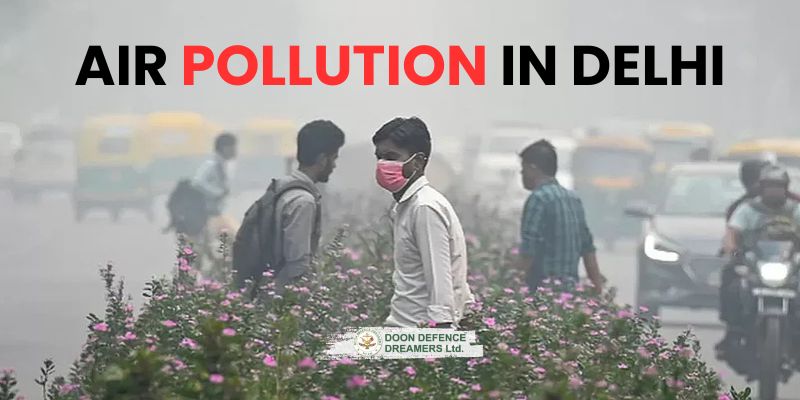
Delhi often records extremely high AQI (Air Quality Index) levels, especially during winter. The major reasons include:
- Extremely high vehicle density
- Industrial and construction emissions
- Dust pollution from infrastructure projects
- Crop residue (stubble) burning in neighboring states
- Low wind speed and temperature inversion during winters
These factors combine to trap pollutants, pushing Delhi’s AQI into the very poor or severe category.
Why is AQI (Air Quality Index) Important?
Understanding AQI helps people:
- Decide whether outdoor activities are safe
- Protect children, elderly, and patients with respiratory problems
- Take preventive measures such as wearing masks or using air purifiers
- Raise awareness about environmental protection
How to Protect Yourself When AQI (Air Quality Index) is High?
- Avoid outdoor exercise during poor AQI days
- Use N95 or equivalent masks
- Keep windows closed during severe pollution
- Use indoor air-purifying plants
- Prefer public transport and reduce vehicle use
Frequently Asked Questions (FAQs)
1. What does AQI (Air Quality Index) indicate?
AQI indicates how clean or polluted the air is and what level of health risk it poses to people. A higher AQI value means worse air quality and greater health concern.
2. Who is responsible for declaring AQI in India?
In India, AQI is declared by the Central Pollution Control Board (CPCB) under the Ministry of Environment, Forest and Climate Change (MoEFCC) using real-time data from monitoring stations.
3. Which pollutants are used to calculate AQI in India?
AQI in India is calculated using eight major pollutants: PM2.5, PM10, NO₂, SO₂, CO, O₃, NH₃, and Lead (Pb).
4. Why does Delhi often record very high AQI levels?
Delhi’s AQI is high due to heavy vehicle emissions, industrial pollution, construction dust, stubble burning in nearby states, and unfavorable winter weather conditions like low wind speed.
5. What precautions should be taken when AQI levels are poor or severe?
During high AQI levels, people should avoid outdoor activities, use N95 masks, keep windows closed, use air purifiers, and limit vehicle usage to reduce exposure.
Conclusion
AQI (Air Quality Index) is no longer just an environmental metric—it is a vital public health indicator. By understanding how AQI works, who declares it, and what different levels mean, citizens can make informed decisions to protect their health. Collective efforts, awareness, and responsible behavior are essential to improve air quality and ensure a healthier future for coming generations.
About Doon Defence Dreamers
Doon Defence Dreamers (DDD) is a well-known defence academy in Dehradun, recognised as one of the Best NDA Coaching in Dehradun and among the Best CDS Coaching institutes in Dehradun. The academy offers structured and result-oriented training for NDA, CDS, AFCAT, RIMC, RMS exams and SSB interviews.
DDD focuses on all-round preparation through classroom teaching, physical training, GTO ground practice and personalised doubt-solving to develop officer-like qualities. With 710+ NDA written qualifiers, multiple SSB recommendations, successful female cadets, hostel facilities, mock tests and continuous mentorship, the academy provides a disciplined and stress-free learning environment.
Through free SSB programmes, workshops and its Dreamers Edu Hub initiative, Doon Defence Dreamers encourages a mission-driven and self-reliant approach for aspirants aiming to join the Indian Armed Forces