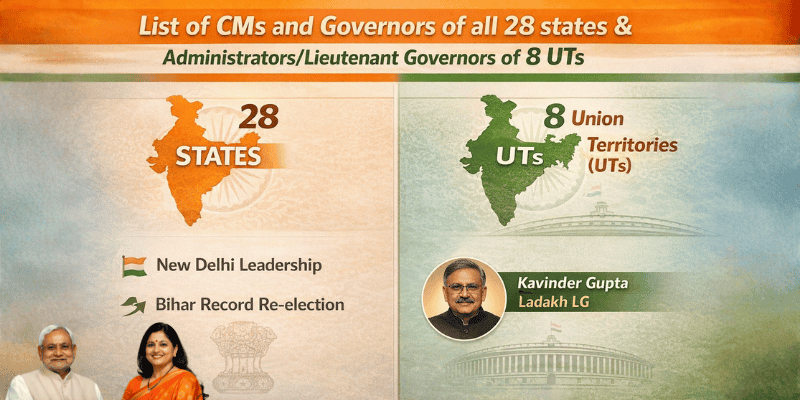
The executive and administrative landscape of the Republic of India in 2025 represents a complex synthesis of constitutional mandates, evolving political alliances, and strategic shifts in federal governance. As the nation concludes the final quarter of 2025, the CM and Governor List 2025 serves as an indispensable record of the individuals entrusted with the governance of 28 states and the administration of 8 Union Territories.
This report provides an exhaustive exploration of the individuals holding these high offices, the constitutional frameworks that define their powers, and the significant electoral and appointment-based transitions that have reshaped the Indian executive during this pivotal year. By analyzing the CM and Governor List 2025, one gains deep insight into the state of Indian federalism, the outcomes of critical assembly elections in Delhi and Bihar, and the subsequent ripple effects of national-level leadership changes on regional administrative structures.
The Dual Executive: Constitutional Framework and Institutional Balance
The governance of Indian states is fundamentally structured around a dual executive system, a model inherited from the Westminster tradition but adapted to the unique requirements of a diverse federal republic. The CM and Governor List 2025 is predicated on this distinction between the nominal head of state and the real head of government. Under Article 153 of the Constitution, each state must have a Governor, a position that serves as the bridge between the Union and the State. The Governor is not an elected official but is appointed by the President of India under Article 155, holding office for a five-year term subject to the pleasure of the President.
The Chief Minister, conversely, is the primary executive authority. As per Article 164, the Chief Minister is appointed by the Governor, but this appointment is not discretionary in practice; the Governor must invite the leader of the party or coalition that commands a majority in the State Legislative Assembly. The List of CMs and Governors of all 28 states highlights the diverse array of political leaders who currently navigate this constitutional relationship.
While the Governor’s role is largely ceremonial, providing assent to bills and presiding over constitutional ceremonies, their discretionary powers under Article 163 remain a critical, and sometimes contentious, aspect of state governance, particularly in situations of political instability or when recommending the imposition of President’s Rule under Article 356.
Executive and Legislative Competencies
The Governor possesses significant executive, legislative, and judicial powers within the state, analogous to the President’s powers at the Union level. All executive actions of the state government are formally executed in the Governor’s name. They appoint high-ranking officials, including the Advocate General, the State Election Commissioner, and members of the State Public Service Commission. A unique feature of the Governor’s office is the role of Chancellor for state-funded universities, which allows the Governor to act as a safeguard for academic autonomy, ostensibly shielding these institutions from direct political interference by the state government.
The Chief Minister, as the head of the Council of Ministers, holds the “real” power. They decide the composition of the cabinet, allocate portfolios, and direct the policy agenda of the state. The CM and Governor List 2025 illustrates the varying degrees of synergy between these two offices. In states with strong mandates, the relationship is often collaborative, whereas in states with conflicting political affiliations between the Union and the State, the Governor-CM dynamic frequently becomes a focal point for constitutional debate.
The 2025 Electoral Landscape: Delhi and Bihar
The CM and Governor List 2025 underwent its most significant modifications following the state assembly elections in the National Capital Territory (NCT) of Delhi and the State of Bihar. These elections were not merely regional contests; they signaled major shifts in national political momentum and redefined the administrative leadership in two of India’s most politically sensitive jurisdictions.
The Re-emergence of the BJP in Delhi
The Delhi Legislative Assembly elections, held on February 5, 2025, resulted in a transformative outcome for the capital. The Bharatiya Janata Party (BJP) secured a decisive victory, winning 48 out of 70 seats and ending a 27-year absence from the Chief Minister’s office in Delhi. The incumbent Aam Aadmi Party (AAP) was reduced to 22 seats, a sharp decline from its previous dominance.
Following the election, Rekha Gupta, the MLA from Shalimar Bagh and a seasoned municipal leader, was appointed as the Chief Minister of Delhi. Her appointment is a centerpiece of the CM and Governor List 2025. As a first-time MLA but a three-time municipal councillor, Gupta’s rise reflects the BJP’s strategy of elevating grassroots leaders with deep organizational roots. She joined the ranks of Sushma Swaraj, Sheila Dikshit, and Atishi Marlena as the fourth woman to hold the position of Chief Minister in Delhi. Working alongside Lieutenant Governor Vinai Kumar Saxena, Gupta’s administration faces the complex challenge of managing a territory where the Union government retains authority over land, police, and public order.
Continuity and Record-Breaking Governance in Bihar
In Bihar, the assembly elections held in November 2025 reaffirmed the stability of the National Democratic Alliance (NDA). The coalition, comprising the BJP and the Janata Dal (United), won 202 of the 243 seats in the assembly. While the BJP emerged as the single largest party with 89 seats, Nitish Kumar was once again selected to lead the government.
Nitish Kumar was sworn in as the Chief Minister of Bihar for a record 10th time on November 20, 2025. This achievement was officially recognized by the World Book of Records as an extraordinary milestone in Indian democratic history. The Bihar component of the CM and Governor List 2025 emphasizes administrative continuity. However, the internal dynamics of the cabinet shifted, with the BJP taking a larger share of ministerial portfolios, including the Home department, reflecting its increased seat count. Under the supervision of Governor Arif Mohammed Khan, the Bihar government has set a primary objective of creating one crore jobs by 2030, supported by new departments for skill development and civil aviation.
The CM and Governor List 2025: Detailed Profiles of the 28 States
The following section provides the exhaustive List of CMs and Governors of all 28 states, incorporating the latest appointments as of December 2025. This data reflects the impact of the Vice-Presidential election and subsequent gubernatorial reshuffles.
| State | Chief Minister | Party | Governor |
| Andhra Pradesh | Nara Chandrababu Naidu | TDP |
Justice (Retd.) S. Abdul Nazeer |
| Arunachal Pradesh | Pema Khandu | BJP |
Lt. Gen. K. T. Parnaik (Retd.) |
| Assam | Himanta Biswa Sarma | BJP |
Lakshman Prasad Acharya |
| Bihar | Nitish Kumar | JD(U) |
Arif Mohammed Khan |
| Chhattisgarh | Vishnu Deo Sai | BJP |
Ramen Deka |
| Goa | Pramod Sawant | BJP |
Ashok Gajapathi Raju |
| Gujarat | Bhupendra Patel | BJP |
Acharya Dev Vrat |
| Haryana | Nayab Singh Saini | BJP |
Prof. Ashim Kumar Ghosh |
| Himachal Pradesh | Sukhvinder Singh Sukhu | INC |
Shiv Pratap Shukla |
| Jharkhand | Hemant Soren | JMM |
Santosh Kumar Gangwar |
| Karnataka | Siddaramaiah | INC |
Thaawarchand Gehlot |
| Kerala | Pinarayi Vijayan | CPI(M) |
Rajendra Vishwanath Arlekar |
| Madhya Pradesh | Mohan Yadav | BJP |
Mangubhai C. Patel |
| Maharashtra | Devendra Fadnavis | BJP |
Acharya Dev Vrat (Addl. Charge) |
| Manipur | President’s Rule | N/A |
Ajay Kumar Bhalla |
| Meghalaya | Conrad K. Sangma | NPP |
CH Vijayashankar |
| Mizoram | PU Lalduhoma | ZPM |
Gen. (Dr.) V. K. Singh (Retd.) |
| Nagaland | Neiphiu Rio | NDPP |
Ajay Kumar Bhalla (Addl. Charge) |
| Odisha | Mohan Charan Majhi | BJP |
Dr. Hari Babu Kambhampati |
| Punjab | Bhagwant Singh Mann | AAP |
Gulab Chand Kataria |
| Rajasthan | Bhajan Lal Sharma | BJP |
Haribhau Kisanrao Bagde |
| Sikkim | Prem Singh Tamang | SKM |
Om Prakash Mathur |
| Tamil Nadu | M. K. Stalin | DMK |
R. N. Ravi |
| Telangana | Revanth Reddy | INC |
Jishnu Dev Varma |
| Tripura | Dr. Manik Saha | BJP |
Indra Sena Reddy Nallu |
| Uttar Pradesh | Yogi Adityanath | BJP |
Anandiben Patel |
| Uttarakhand | Pushkar Singh Dhami | BJP |
Lt. Gen. Gurmit Singh (Retd.) |
| West Bengal | Mamata Banerjee | AITC |
Dr. C. V. Ananda Bose |
Executive Leadership in the 8 Union Territories
Union Territories (UTs) occupy a distinct tier in the Indian constitutional architecture. Unlike states, which possess a degree of sovereign legislative and executive power, UTs are governed directly by the Union Government under Part VIII of the Constitution (Articles 239–241). The CM and Governor List 2025 provides essential data on the heads of these territories, who are designated as either Lieutenant Governors (LGs) or Administrators.
The Role of Administrators and Lieutenant Governors
The President of India administers UTs through an appointee who acts as the President’s agent. In the UTs of Delhi, Jammu and Kashmir, Puducherry, Andaman and Nicobar Islands, and Ladakh, this official is titled the Lieutenant Governor. In the remaining UTs of Chandigarh, Lakshadweep, and Dadra and Nagar Haveli and Daman and Diu, the executive head is called an Administrator.
The List of Administrators/Lieutenant Governors of 8 Union Territories (UTs) has seen high-profile changes in 2025. Kavinder Gupta was appointed as the third Lieutenant Governor of Ladakh in July 2025, succeeding Brigadier (Retd.) B.D. Mishra. This appointment is strategically significant as Ladakh continues to navigate its developmental trajectory following its reorganization in 2019. Similarly, the administration of Chandigarh is currently headed by Gulab Chand Kataria, who also serves as the Governor of Punjab, following a long-standing tradition of ex-officio administration for the city.
| Union Territory | Executive Head (LG/Administrator) | Chief Minister (if applicable) |
| Andaman and Nicobar Islands |
Admiral D. K. Joshi (Retd.) (LG) |
N/A |
| Chandigarh |
Gulab Chand Kataria (Administrator) |
N/A |
| Dadra and Nagar Haveli & Daman and Diu |
Praful Patel (Administrator) |
N/A |
| Delhi (NCT) |
Vinai Kumar Saxena (LG) |
Rekha Gupta |
| Jammu and Kashmir |
Manoj Sinha (LG) |
Omar Abdullah |
| Ladakh |
Kavinder Gupta (LG) |
N/A |
| Lakshadweep |
Praful Patel (Administrator – Addl. Charge) |
N/A |
| Puducherry |
K. Kailashnathan (LG) |
N. Rangaswamy |
Vice-Presidential Transitions and Their Gubernatorial Impact
The national executive underwent a significant shift in 2025 due to the resignation of Jagdeep Dhankhar on health grounds. This prompted an early Vice-Presidential election on September 9, 2025. C. P. Radhakrishnan, who was then serving as the Governor of Maharashtra and holding additional charges for Telangana and Puducherry, emerged as the candidate for the NDA.
The Elevation of C. P. Radhakrishnan
Radhakrishnan won the election with 452 votes, defeating opposition candidate B. Sudershan Reddy. His elevation to the office of the Vice President of India necessitated his resignation from the governorship of Maharashtra on September 11, 2025. This change is a pivotal moment in the CM and Governor List 2025, as it triggered a reshuffle of gubernatorial responsibilities.
The Gubernatorial Reshuffle of September 2025
To fill the vacancy in Maharashtra, the President appointed Acharya Devvrat, the Governor of Gujarat, to hold additional charge of Maharashtra. Acharya Devvrat was sworn in as the Governor of Maharashtra on September 15, 2025, at Raj Bhavan, Mumbai. This dual responsibility for two of India’s most economically powerful states emphasizes the President’s reliance on experienced constitutional heads during periods of transition. Simultaneously, several other transfers were enacted: Rajendra Vishwanath Arlekar was moved from Bihar to Kerala, and Arif Mohammed Khan was transferred from Kerala to Bihar. Dr. Hari Babu Kambhampati was moved to Odisha, while General (Dr.) V. K. Singh (Retd.) was appointed as the new Governor of Mizoram.
Profiles in Executive Leadership: Rekha Gupta, Nitish Kumar, and Kavinder Gupta
A qualitative examination of the CM and Governor List 2025 reveals the diverse political trajectories of the individuals who currently hold high office.
Rekha Gupta: From Student Activism to Chief Minister
The political journey of Rekha Gupta is emblematic of the BJP’s organizational depth in the capital. Born in Haryana in 1974, she completed her education in Delhi and became active in student politics through the Akhil Bharatiya Vidyarthi Parishad (ABVP). She served as the President of the Delhi University Students’ Union (DUSU) in 1996–1997, focusing on youth empowerment. Her career in municipal governance saw her serve three terms as a councillor from Pitampura, eventually rising to become the Mayor of North Delhi.
In the 2025 assembly elections, Gupta defeated AAP’s Bandana Kumari in Shalimar Bagh with a margin of 29,595 votes. Her appointment as Chief Minister was ratified by the BJP legislature party on February 19, 2025, making her the primary administrative leader for the city’s developmental agenda. Her administration has emphasized educational reforms and public hearings (Jansunwai), although it has faced challenges from the opposition regarding urban pollution and infrastructure.
Nitish Kumar: The Longevity of the “Good Governance” Model
Nitish Kumar’s return as Bihar’s Chief Minister for a tenth term in November 2025 is a testament to his enduring political relevance. An electrical engineer by training, Kumar’s career spans five decades, beginning with the Jayaprakash Narayan movement in the 1970s. He first became Chief Minister in 2000 for a brief seven-day term and has since dominated Bihar’s politics through various alliances.
The 2025 Bihar cabinet under Kumar represents a “double-engine” government with the BJP, focusing on large-scale infrastructure and industrial growth. Despite being criticized by opponents as “Paltu Ram” for his frequent shifts in political allegiance, his victory in 2025 suggests a strong voter mandate for his core agenda of “Sushasan”. His current term is noted for the creation of separate departments for Youth, Employment, and Skill Development, reflecting a strategic pivot toward Bihar’s demographic dividend.
Kavinder Gupta: Administrative Stability in Ladakh
The appointment of Kavinder Gupta as the third Lieutenant Governor of Ladakh in July 2025 marks a new chapter for the Union Territory. A veteran BJP leader from Jammu, Gupta previously served as the Deputy Chief Minister of Jammu and Kashmir and as the Speaker of the J&K Legislative Assembly. His appointment reflects the Centre’s intent to provide Ladakh with a leader who possesses deep understanding of the region’s political sensitivities and administrative needs.
Taking office at a time of regional demands for statehood and constitutional protections under the Sixth Schedule, Gupta has emphasized a strategy of inclusive development. As the LG, he acts as the direct representative of the President, overseeing a territory without a local legislature but with significant strategic importance due to its borders with Pakistan and China.
Gender Dynamics and Representation in the 2025 Executive
The CM and Governor List 2025 offers a window into the state of gender representation in Indian governance. While progress has been made, the executive remains heavily male-dominated.
Female Chief Ministers
As of December 2025, there are only two women serving as Chief Ministers in India: Mamata Banerjee in West Bengal and Rekha Gupta in Delhi. Mamata Banerjee’s continuous tenure since 2011 makes her the longest-serving female Chief Minister currently in office. The addition of Rekha Gupta in early 2025 doubled the number of female CMs, highlighting the capital’s historical trend of electing women to the top post.
Female Governors and Lieutenant Governors
In the gubernatorial ranks, Smt. Anandiben Patel continues her service as the Governor of Uttar Pradesh. However, the List of Administrators/Lieutenant Governors of 8 Union Territories (UTs) shows a current absence of women in these roles. Historically, female leaders like Kiran Bedi and Tamilisai Soundararajan have held the office of LG in Puducherry, but as of late 2025, these positions are occupied by male appointees. This suggests that while women are increasingly successful in winning elected Chief Ministerial roles, the appointed executive positions (Governors and LGs) have yet to achieve gender parity.
Challenges to Federal Integrity: President’s Rule in Manipur
The CM and Governor List 2025 includes a notable exception to democratic governance in the State of Manipur. Since February 13, 2025, Manipur has been under President’s Rule following the resignation of Chief Minister N. Biren Singh. This imposition of Article 356 occurs when the President is satisfied that the state government cannot be carried on in accordance with the provisions of the Constitution.
In this scenario, the Governor of Manipur, Ajay Kumar Bhalla, assumes the role of the primary executive, administering the state on behalf of the President. Governor Bhalla’s role in 2025 is particularly demanding, as he also holds the additional charge of Nagaland following the death of Governor La Ganesan in August 2025. This dual gubernatorial responsibility highlights the critical function of the Governor as a stabilizing force in the North-East region during periods of political or social unrest.
The Role of By-elections and Rajya Sabha Dynamics in 2025
The CM and Governor List 2025 is a living document, frequently updated by the outcomes of legislative shifts. The year 2025 saw several by-elections and the biennial Rajya Sabha elections, which impacted the political strength of state governments.
Rajya Sabha Elections: Maintaining NDA Dominance
Elections for 14 seats in the Rajya Sabha were held between June and October 2025 across states like Assam, Tamil Nadu, and Jammu and Kashmir. The NDA secured a net gain of two seats, maintaining its overall control of the upper house. In Tamil Nadu, members from the DMK and AIADMK were elected unopposed, while in Jammu and Kashmir, the National Conference won three of the four available seats. These results are critical as they influence the Union’s legislative capacity to pass laws that affect state administrations.
State Assembly By-elections
Significant by-elections were held for 15 seats across various states in 2025. In February, the BJP won the Milkipur (UP) seat, while the DMK won Erode East (TN). June saw further contests in Gujarat, Kerala, Punjab, and West Bengal, while November elections in Jammu and Kashmir and Rajasthan resulted in localized leadership changes at the constituency level. While these by-elections rarely change a Chief Minister, they serve as high-stakes indicators of the Governor’s assessment of a government’s majority support.
Statistical and Comparative Summary of State Executives
The following data provides a statistical breakdown of the leadership patterns found in the CM and Governor List 2025.
Party-wise Distribution of Chief Ministers
The Bharatiya Janata Party (BJP) and its NDA allies hold the majority of Chief Ministerial positions in 2025, reinforcing a period of significant central-state political alignment.
Demographic Insights
-
Longest Serving CM: Mamata Banerjee (West Bengal) – In office since May 20, 2011.
-
Most Terms as CM: Nitish Kumar (Bihar) – 10 terms as of November 2025.
-
Oldest Serving CM: Pinarayi Vijayan (Kerala) – Born 1945, aged 80.
-
Youngest Serving CM: Rekha Gupta (Delhi) – Born 1974, aged 51.
-
Longest Serving Governor: Acharya Devvrat – Serving as a Governor since 2015 (currently Gujarat and Addl. Maharashtra).
Future Outlook: Federalism and Administrative Shifts Beyond 2025
The CM and Governor List 2025 provides a snapshot of an executive structure that is increasingly characterized by professionalized administration and strategic gubernatorial appointments. As the nation prepares for the 2026 assembly elections in states like West Bengal, Tamil Nadu, and Kerala, the existing List of CMs and Governors of all 28 states will likely undergo further major revisions.
Strategic Gubernatorial Appointments
The 2025 appointments of military veterans like Gen. (Dr.) V. K. Singh in Mizoram and Lt. Gen. K. T. Parnaik in Arunachal Pradesh suggest a continuing trend of placing security-focused individuals in border states. This reflects the Union Government’s prioritization of national security and border management through the office of the Governor.
The Evolution of the UT Governance Model
The management of Union Territories, particularly those without legislatures, is becoming more complex. The appointment of Kavinder Gupta in Ladakh and the dual-UT administration of Praful Patel indicate a move toward appointing political “heavyweights” as Administrators and LGs. This shift suggests that the role is evolving from a purely oversight function to a more proactive political engagement role, aimed at integrating these territories more deeply into the national political mainstream.
Conclusions: The State of the Executive in Late 2025
The analysis of the CM and Governor List 2025 reveals a robust and dynamic executive landscape. The year has been defined by historic electoral shifts in Delhi and Bihar, which have introduced new leadership and re-validated veteran statesmen. The national-level elevation of C. P. Radhakrishnan to the Vice-Presidency demonstrated the fluid nature of high office and its subsequent impact on regional administrative heads.
The List of CMs and Governors of all 28 states and the List of Administrators/Lieutenant Governors of 8 Union Territories (UTs) remain the ultimate references for understanding the distribution of executive power in India. While Chief Ministers continue to drive regional developmental agendas with strong democratic mandates, the Governors and Lieutenant Governors serve as the critical constitutional anchors that ensure administrative continuity and national alignment. As of December 2025, India’s leadership structure is characterized by a high degree of political synergy within the NDA-governed states, contrasted with vibrant opposition-led administrations in the south and east, all functioning within the resilient framework of the Indian Constitution.
Frequently Asked Questions (FAQs)
Q1. What is the constitutional difference between the Chief Minister and the Governor in Indian states?
The Chief Minister is the real executive authority of the state and heads the elected Council of Ministers, while the Governor is the constitutional (nominal) head appointed by the President under Article 155. Although the Governor formally appoints the CM under Article 164, in practice the CM must command a majority in the State Legislative Assembly.
Q2. Why is the CM and Governor List 2025 considered especially important?
The CM and Governor List 2025 reflects major political and administrative changes following crucial elections in Delhi and Bihar, the imposition of President’s Rule in Manipur, and a significant gubernatorial reshuffle after the Vice-Presidential election. It provides a current snapshot of India’s federal executive structure at the end of 2025.
Q3. What role do Governors play during political instability or President’s Rule?
Under Article 163, Governors have discretionary powers, especially during political instability, hung assemblies, or constitutional breakdowns. They play a key role in recommending President’s Rule under Article 356, during which the Governor administers the state on behalf of the President.
Q4. How is governance in Union Territories different from states in India?
Union Territories are governed directly by the Union Government under Articles 239–241. Most UTs are administered by Lieutenant Governors or Administrators, while only Delhi, Jammu & Kashmir, and Puducherry have elected Chief Ministers. The CM and Governor List 2025 clearly highlights this constitutional distinction.
Q5. What major leadership milestones stand out in the CM and Governor List 2025?
Key milestones include:
-
Nitish Kumar becoming Chief Minister of Bihar for the 10th time, a national record
-
Rekha Gupta becoming Delhi’s fourth woman Chief Minister after BJP’s return to power
-
Kavinder Gupta’s appointment as Lieutenant Governor of Ladakh, reflecting strategic administrative priorities
-
President’s Rule in Manipur, marking a significant constitutional intervention.
Our Recent Blog
-
विश्व में कृषि उत्पादन 2025: आंकड़े, शीर्ष देश और वैश्विक रुझान – Visit
-
AQI (air Quality Index): भारत में वायु गुणवत्ता की सम्पूर्ण जानकारी – Visit
-
Tribes of India: State-wise List, Culture & 2025 Updates – Visit
-
Heritage of India: States, Symbols, 22 Languages & Dances – Visit
Written & Reviewed by Doon Defence Dreamers Expert Team (Ex-SSB Mentors & Defence Experts)