

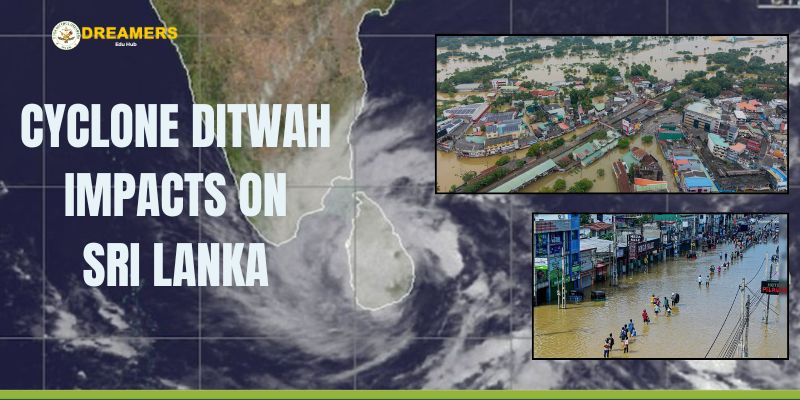
Cyclone Ditwah : A Reminder of Nature’s Power
Nature often reveals forms that remind human civilization of its limitations. Cyclone Ditwah, formed due to rapid energy accumulation in the ocean and rising atmospheric heat, was one such tropical cyclone that caused widespread devastation across several South Asian countries. This storm was not just a meteorological event; its impacts on human life, agriculture, marine economy, and the environment made it a historic natural occurrence.
What is Cyclone Ditwah?
Cyclone Ditwah is a powerful tropical cyclone formed due to the extremely warm surface waters of the ocean. When the sea temperature rises above 26–28°C, the water evaporates rapidly. Warm, moist air rises, creating a low-pressure area beneath, and surrounding air rushes in to fill this void. As the Earth’s rotation causes this air to move in a spiral, it evolves into a cyclone with strong winds and heavy rainfall—known as Cyclone Ditwah.
India’s ‘Operation Sagar Bandhu’ — A Humanitarian Mission to Assist Sri Lanka
As Cyclone Ditwah began to form and Sri Lanka faced severe floods, landslides, and widespread devastation, India responded first and fastest, launching its humanitarian mission “Operation Sagar Bandhu” to assist the neighbouring nation. This operation was not just a relief-dispatch programme; it was a living example of India’s Neighbourhood First policy and its spirit of maritime cooperation. At a time when people in Sri Lanka were being displaced, villages were being buried under debris, and hundreds of families were trapped in floods, India immediately extended support by sending relief materials, rescue teams, and military assistance.
The Indian Air Force (IAF) deployed heavy-lift aircraft and helicopters to deliver medicines, food, water, tarpaulins, emergency relief kits, and other essential supplies. The Indian Navy, through its ships, transported aid via sea routes, while NDRF’s specialised teams actively worked in flood-affected and landslide-hit regions. Civilians trapped in several areas—including women, children, the elderly, and even Sri Lankan soldiers—were airlifted to safety. Altogether, dozens of tonnes of relief material were delivered and numerous lives were saved during the operation.
Operation Sagar Bandhu reaffirmed that humanity is greater than political boundaries during natural disasters. India ensured not just the delivery of relief, but also extended full support in Sri Lanka’s rehabilitation and rescue efforts. This humanitarian mission strengthened the bond between the two countries and sent a clear message that regional cooperation is South Asia’s greatest strength.
Who Was Involved — Teams and Forces Deployed
-
Indian Air Force (IAF):
C-130, IL-76 and other heavy-lift aircraft were deployed, carrying relief supplies, equipment, and rescue personnel. -
National Disaster Response Force (NDRF):
Nearly 80 trained rescuers were sent, equipped with flood/landslide rescue gear, relief kits, and essential tools. -
Indian Navy (INS Vikrant, INS Udaygiri):
Navy ships transported rations, emergency supplies, and relief materials through sea routes. -
IAF–Navy Helicopters & Aircraft:
Joint aerial operations were conducted for rescue, evacuation, and rapid relief delivery.
India’s Commitment and International Sensitivity
Through Operation Sagar Bandhu, India demonstrated how promptly it stands with its neighbouring countries during moments of crisis.
-
The Government of India, IAF, Navy, and NDRF acted swiftly, sending relief and rescue teams without delay.
-
Support and guidance from the Prime Minister and External Affairs Minister communicated empathy, sensitivity, and a strong humanitarian message.
-
Efforts like these reinforce the belief that during natural disasters, it is humanity, cooperation, and mutual support—not political borders—that matter most.
How Does Cyclone Ditwah Form? (Formation Process)
The formation of Cyclone Ditwah reflects nature’s complex and extraordinary system. Warm air rising from the heated sea surface forms massive cloud clusters. During this process, energy from the ocean transfers into the atmosphere, and the cyclone develops into a massive rotating vortex. As the vortex strengthens, wind speeds increase, and the storm becomes more destructive. The warmer the ocean, the more intense the cyclone becomes.
Step-by-step formation:
-
Evaporation increases from the warm sea surface: giving the cyclone its energy.
-
Warm, moist air rises: forming clouds above.
-
A low-pressure area develops below: drawing in surrounding air.
-
Air rushes rapidly to fill the void: generating movement.
-
Earth’s rotation spins the air: (Coriolis effect).
This rotating system eventually takes the form of Cyclone Ditwah.
Impact of Cyclone Ditwah on Sri Lanka
Cyclone Ditwah : Key Events
Cyclone Ditwah formed in the northern Indian Ocean in late November 2025 and affected Sri Lanka, India (Tamil Nadu and Andhra Pradesh), and Bangladesh.
| Event | Date | Affected Region |
|---|---|---|
| Formation | 26 Nov 2025 | Southwest Bay of Bengal, near Sri Lanka |
| Impact on Sri Lanka’s coast | 28 Nov 2025 | Heavy rain, floods, landslides |
| Approaching Indian coasts | 29–30 Nov 2025 | Tamil Nadu, Puducherry, Andhra Pradesh |
| Weakening into a depression | 1 Dec 2025 | Parallel to North TN–Puducherry coast |
The impact of Cyclone Ditwah wasn’t limited to India and Bangladesh; Sri Lanka was also significantly affected. Even when the cyclone’s center stays far from Sri Lanka, its outer rainbands and strong winds cause widespread disruption.
Heavy Rainfall and Flood Threat:
-
Torrential rains in southern and western coastal regions.
-
Fast-flowing water increases landslide risk in hilly regions.
-
Low-lying coastal areas flood quickly, forcing people to evacuate.
Damage from Strong Winds:
-
Outer winds reach 60–80 km/h.
-
Trees uproot, electric poles topple, roofs get damaged.
-
High sea waves pose extreme danger for fishermen.
Severe Impact on Agriculture:
-
Heavy rains damage tea, coconut, paddy and vegetable crops.
-
Farmers’ livelihoods take a direct hit.
Transport and Communication Disrupted:
-
Roads blocked due to fallen trees and waterlogging.
-
Power cuts and communication failures delay relief operations.
Damage to Coastal Areas:
-
Rising sea levels cause flooding in coastal towns.
-
Coastal settlements and fishing boats are damaged.
Impact of Cyclone Ditwah on Two Countries
1. India
Cyclone Ditwah had a clear impact on coastal states—Odisha, West Bengal, Andhra Pradesh and Tamil Nadu.
-
Heavy rains and strong winds disrupted daily life.
-
High sea waves flooded low-lying areas.
-
Electricity, roads, communication and water supply collapsed.
-
Farmers lost crops; fishermen’s boats got damaged.
2. Bangladesh
Bangladesh, being a low-lying nation, suffered heavily.
-
Coastal districts submerged under seawater.
-
Homes, livestock and crops destroyed.
-
Millions displaced, forced into relief camps.
-
Winds blew off rooftops; floods submerged large areas.
Rescue and Preparedness Measures
To reduce damage from such disasters, early warning systems, safe shelters and public awareness are essential.
Governments and citizens can reduce losses by adopting precautions:
-
Pay attention to timely warnings.
-
Identify safe shelters.
-
Keep essential items ready (water, food, medicines, torch, documents).
-
Evacuate coastal residents on time.
-
Use schools/community halls as shelters.
Lessons from Cyclone Ditwah
Cyclone Ditwah clearly reminded the world how small humans are before nature. However, scientific technology, strong forecasting and timely action can prevent large-scale destruction. In this era of climate change, the number and intensity of such cyclones may increase, so it is essential to move forward with caution and harmony with nature for the safety of future generations.
Storms teach us that the right preparation and technology can significantly reduce damage.
Frequently Asked Questions (FAQs)
| Question | Answer |
|---|---|
| When did Cyclone Ditwah occur? | It was mainly active from 28 November to 1 December 2025. |
| What is the meaning of the name Ditwah? | Since it is a fictional name, it has no official meaning, but cyclone naming helps in recognition and awareness. |
| Which countries were most affected? | Sri Lanka, India (Tamil Nadu, Andhra Pradesh) and Bangladesh. |
| Where does a cyclone get its energy from? | From the warm sea surface (above 26.5°C), which accelerates evaporation. |
| Is climate change increasing cyclone frequency? | Yes, studies show rising ocean temperatures due to global warming increase cyclone intensity. |
Conclusion
Cyclone Ditwah was a strong warning for South Asian countries. It caused massive loss of life and property, highlighting how destructive extreme weather events can be in the era of climate change. However, it also taught us that strong forecasting, timely alerts and community preparedness can greatly reduce damage. In the future, governments and citizens must focus on strengthening coastal infrastructure and adapting to environmental changes to better face such natural disasters.
Our Recent Blog
Blood Donation Camp at Doon Defence Dreamers (5ᵗʰ Dec 2025)
Dreamers Edu Hub Sports Fest 2026
Dreamers Edu Hub Scholarship Examination – Rajiv Gandhi Navodaya, Santudhar (Pauri)