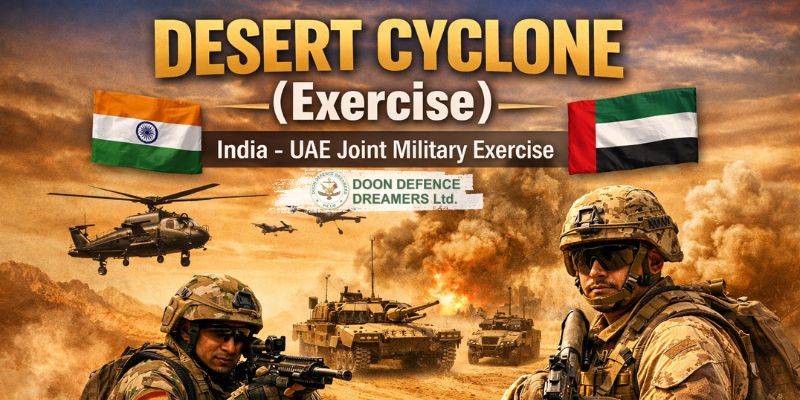
Military exercises between friendly countries help build trust, cooperation, and readiness for future challenges. One such important drill that has attracted global attention is DESERT CYCLONE (Exercise). This blog covers complete information about this remarkable India – UAE Joint military exercise, including what it is, why it started, who takes part, where and when it happens, what activities are included, and why it matters in today’s geopolitical environment.
What is DESERT CYCLONE (Exercise)?
DESERT CYCLONE (Exercise) is a bilateral army exercise conducted between India and the United Arab Emirates (UAE). The drill involves joint training activities that aim to enhance cooperation, strengthen military ties, improve tactical abilities, and ensure that both countries’ armies can work together effectively in complex situations. As the name suggests, it prepares troops for operations in desert and built-up areas where coordination and real-time planning are crucial. This major defense collaboration reflects the growing strategic bond between the two friendly nations as part of their broader partnership in security and peace operations.
This India – UAE Joint military exercise is especially focused on enhancing interoperability — that means the ability of both armies to operate side by side seamlessly — in different kinds of operations including peacekeeping, counter-terrorism, and urban combat that are relevant to modern warfare.
How Did DESERT CYCLONE (Exercise) Start?
The idea of DESERT CYCLONE (Exercise) came from the need to deepen defence cooperation between India and the UAE. Both countries share strategic goals in ensuring peace and stability in West Asia and beyond. India has strong defense relations with many countries, and joint exercises like Desert Cyclone create opportunities for learning and mutual growth.
The first edition of this exercise was launched to bring Indian Army personnel and UAE Land Forces together to train in desert and semi-desert environments, where challenges like heat, dust, limited cover, and harsh terrain require special strategies and teamwork.
This exercise was conceived as part of expanding defence relations, which involve not just training drills but also exchange of commanders, sharing of best practices, and building stronger diplomatic ties.
When and Where is DESERT CYCLONE (Exercise) Held?
First Edition – Desert Cyclone 2024
The first edition of DESERT CYCLONE (Exercise) was held from January 2 to January 15, 2024 in the Mahajan Field Firing Ranges in Rajasthan, India. Rajasthan’s desert terrain offered an ideal location for testing the troops’ ability to work in open desert and built-up areas. This was the first time Indian and UAE army troops conducted such an extensive joint army exercise focused on sub-conventional and urban operations.
Second Edition – Desert Cyclone-II (2025)
The second edition, also called Desert Cyclone-II, took place in Abu Dhabi, United Arab Emirates, from December 18 to December 30, 2025. Holding the exercise in UAE’s desert environment allowed both sides to face new tactical scenarios and strengthen their adaptability, especially in joint planning, communication, and field operations.
By rotating the venue between India and UAE, both armies get exposure to different terrains, which adds value to the training experience. Desert Cyclone II emphasized joint urban warfare skills, helicopter operations, drone surveillance, and real-time mission planning exercises.
Who Participates in DESERT CYCLONE (Exercise)?
Participants of DESERT CYCLONE (Exercise) include specially selected Army units from India and UAE.
India’s Participation
The Indian contingent typically consists of about 45 soldiers, mostly drawn from a Battalion of the Mechanised Infantry Regiment. These soldiers are highly trained in desert warfare and sub-conventional operations. Mechanised infantry troops bring with them advanced tactical abilities in communication, mobility, and real-world coordination.
UAE’s Participation
The UAE Land Forces also send a similar number of troops. For example, in the latest edition, the 53 Mechanised Infantry Battalion represented the UAE side. These troops train side-by-side with Indian forces, sharing techniques and operational experiences.
Joint participation means both armies drill together, exchange expertise, and learn each other’s methods in approaching modern battlefield challenges.
Key Objectives of DESERT CYCLONE (Exercise)
The primary goals of the DESERT CYCLONE (Exercise) are:
1. Enhancing Interoperability
Interoperability is one of the core reasons for this India – UAE Joint military exercise. Troops learn how to coordinate tasks, communicate rapidly, share real-time intelligence, and make decisions quickly during combined operations.
2. Strengthening Defence Cooperation
By working together in intense training environments, both nations build trust and confidence that goes beyond mere dialogue. This strengthens defense cooperation and deepens the strategic partnership.
3. Training for Urban Warfare and Sub-conventional Operations
Both editions focus on urban combat — often the toughest kind of warfare — where troops must operate in built-up areas under unpredictable conditions.
The exercise includes drills like:
Fighting in built-up areas
Cordon and search operations
Joint mission planning
Establishing surveillance coordination
Heliborne and quick deployment drills
All these tasks require teamwork, situational awareness, and strong leadership.
4. Peacekeeping and Stability Operations
Training under a United Nations mandates scenario helps both countries prepare for international peacekeeping assignments. These operations often demand hybrid skills — from combat readiness to humanitarian support.
Main Training Activities in Desert Cyclone
During the exercise, the participating soldiers perform a wide range of drills and activities designed to sharpen their skills and improve cooperation. Some of the key activities include:
Urban Warfare Training
Troops practice entering and securing buildings, clearing rooms, working in crowded streets, and quickly reacting to threats in built-up terrain.
Heliborne Operations
Helicopter-based insertions and extractions are practiced to improve rapid deployment skills and tactical maneuvering. These exercises teach soldiers how to operate with air support under combat conditions.
Counter-Drone and UAV Integration
Unmanned Aerial Vehicles (UAVs) and counter-UAV techniques are increasingly important for surveillance and battlefield awareness. The exercise includes tasks like identifying hostile drones and neutralizing them while using UAS for communication and recon.
Mission Planning and Decision Making
Joint planning sessions allow commanders from both countries to work together on mission orders, share intelligence, and make strategic decisions under pressure.
All these activities improve the soldiers’ ability to think critically, coordinate actions, and work as an integrated team.
Why DESERT CYCLONE (Exercise) is Important?
This India – UAE Joint military exercise is more than a regular drill — it plays a strategic role in a fast-changing security environment:
1. Strengthening Bilateral Relations
India and UAE have strengthened diplomatic and defence ties over the years. Exercises like Desert Cyclone show the depth of this partnership and reflect the trust shared between two nations.
2. Shared Security Goals
Both countries share common goals in regional security, counter-terrorism, and peace efforts. Joint training helps prepare their forces to contribute to broader peace operations when needed.
3. Adapting to Modern Warfare Challenges
Modern battlefields demand hybrid skills — from physical combat to drone integration and rapid urban operation responses. The exercise allows both armies to test and improve these competencies.
4. Enhancing Regional Stability
By working together, India and UAE send a positive message of cooperation aimed at contributing to stability in the wider region including West Asia, South Asia, and beyond.
Strategic Impact of the Exercise
The success of DESERT CYCLONE (Exercise) goes beyond army training. It contributes to:
Military diplomacy
Long-term strategic ties
Knowledge sharing in defence technology
Common readiness for peacekeeping missions
Improved mutual trust between countries’ armed forces
Because of these factors, Desert Cyclone continues to be a key example of how joint military exercises promote peace and friendship instead of competition.
Conclusion
In a world where security threats are constantly evolving, exercises like DESERT CYCLONE (Exercise) demonstrate the power of cooperation, coordination, and shared learning between friendly nations. This India – UAE Joint military exercise not only enhances the military capabilities of participating troops, but also strengthens diplomatic bonds and ensures readiness for future challenges.
From desert arenas in Rajasthan to advanced training grounds in Abu Dhabi, DESERT CYCLONE (Exercise) stands as a symbol of unity, strategy, and preparedness — shaping a safer future through collective defense efforts.