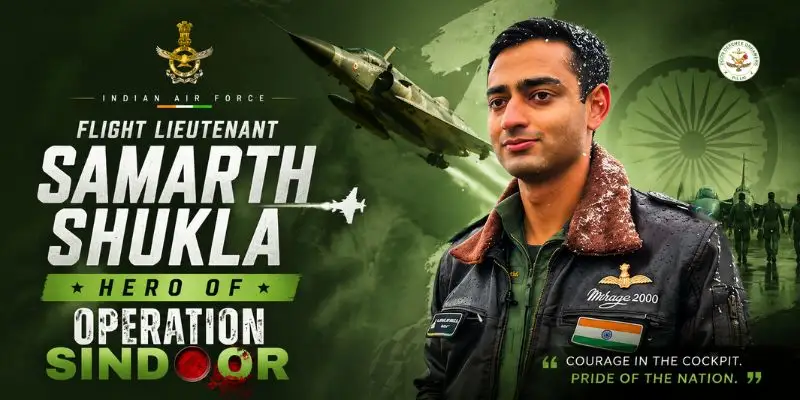
In the early hours of 7 May 2025, a Mirage 2000 fighter jet of the Indian Air Force lifted off from a forward airbase, loaded with precision munitions and a single mission to strike terror infrastructure deep inside enemy territory. Inside the cockpit was a young pilot whose name was Flight Lieutenant Samarth Shukla.
In the months after that mission, on the eve of India’s 79th Independence Day, the President of India would award Flt Lt Shukla a Mention-in-Despatches which is one of the highest forms of wartime recognition — for his role in Operation Sindoor, the Indian Armed Forces’ decisive response to the Pahalgam terror attack.
This is the story of an engineer-turned-fighter-pilot who chose duty over comfort, excellence over ease and in doing so, became one of the faces of India’s air superiority over Pakistan in May 2025.
Who is Flight Lieutenant Samarth Shukla?
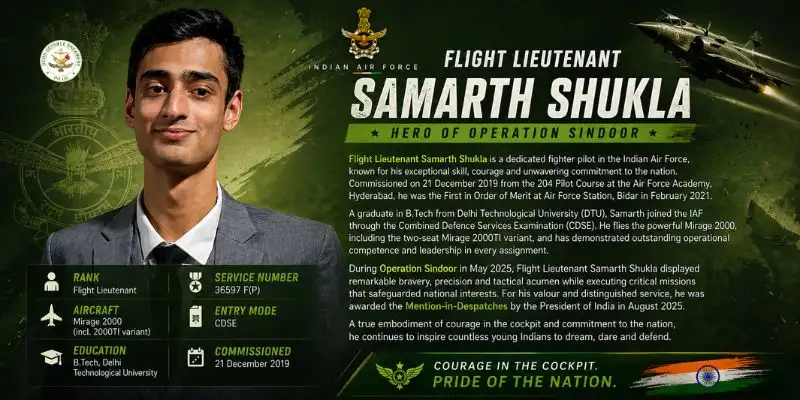
Flight Lieutenant Samarth Shukla is a qualified pilot in the Indian Air Force’s Flying (Pilot) branch, currently assigned to a Mirage 2000 squadron. Trained on one of the IAF’s most versatile multi-role fighters, he played a direct combat role in the precision air-to-ground strikes carried out during Operation Sindoor in May 2025 — strikes that targeted nine sites of terror infrastructure linked to Jaish-e-Mohammed and Lashkar-e-Taiba in Pakistan and Pakistan-occupied Jammu and Kashmir.
For his contribution, the President of India awarded him a Mention-in-Despatches — a recognition reserved for officers and personnel who display gallantry and devotion to duty in active operations.
Quick Facts About Flight Lieutenant Samarth Shukla
| Field | Detail |
| Full Name | Samarth Shukla |
| Rank | Flight Lieutenant |
| Service Number | 36597 F(P) |
| Branch | Flying (Pilot), Indian Air Force |
| Aircraft Flown | Mirage 2000 (including two-seat Mirage 2000TI variant) |
| Education | B.Tech, Delhi Technological University (DTU) |
| Entry Mode | Combined Defence Services Examination (CDSE) |
| Commissioned | 21 December 2019 (204 Pilot Course, AFA Hyderabad) |
| Promoted to Flt Lt | 21 December 2021 |
| Training Distinction | First in Order of Merit, 204 Pilot Course (AFS Bidar, Feb 2021) |
| Notable Operation | Operation Sindoor (May 2025) |
| Honour | Mention-in-Despatches by the President of India (Aug 2025) |
Early Life and Education at DTU
Long before he was strapped into the cockpit of a supersonic fighter, Samarth Shukla was an engineering student at the Delhi Technological University (DTU) — one of India’s most respected technical institutions. But unlike most of his classmates, his eyes weren’t on the corporate placement season.
In a 2018 interview with DTU Times given by him while he was still a student — he laid out exactly why he was choosing a different road in which he said:
“I’ve always wanted to join the Air Force. Everyone you’ll see has a 9-to-5 job and can’t wait for the weekend to come, but I didn’t want a life like that. I’ve always wanted to be a pilot, so the Air Force provided the perfect opportunity to do that. And then there is the job satisfaction and the pride of wearing the uniform.”
From Engineer to Fighter Pilot
Samarth’s pathway into the IAF was through the Combined Defence Services Examination (CDSE) the route most graduates take to become commissioned officers. Unlike the NDA, which is taken right after Class 12, CDSE allows graduates from any discipline (including engineers like Samarth) to apply for officer entry into the Army, Navy, and Air Force.
For the IAF Flying Branch, the journey involves multiple high-stakes filters:
- CDSE Written Examination — English, General Knowledge, and Elementary Mathematics.
- Air Force Selection Board (AFSB) — five days of psychological tests, group tasks, and a personal interview.
- Computerised Pilot Selection System (CPSS) — a one-time test of psychomotor skills, reaction time, and multitasking ability under cockpit-like load.
- Medical Examination — extremely strict, especially for vision, cardiovascular health, and musculoskeletal fitness.
Each of these stages eliminates the majority of aspirants. Clearing all four and then standing first at training is what separates an officer from a fighter pilot.
Commissioning and Training Excellence
Flt Lt Shukla was commissioned into the Indian Air Force on 21 December 2019, as part of the 204 Pilot Course. The commissioning ceremony took place at the Air Force Academy, Dungargi (Hyderabad) the institution where every IAF officer’s flying journey begins.
But his real defining moment came in February 2021. At the valedictory ceremony of the 204 Pilots Course, held at Air Force Station Bidar, Samarth received the trophy for standing first in the overall order of merit a distinction that placed him at the very top of his pilot course. In a programme where every cadet has already been hand-picked from thousands of applicants, finishing first means out-flying, out-thinking, and out-performing the best of the best.
He was promoted to the substantive rank of Flight Lieutenant on 21 December 2021, on completion of two years of commissioned service.
Mastering the Mirage 2000 — IAF’s Versatile Strike Fighter
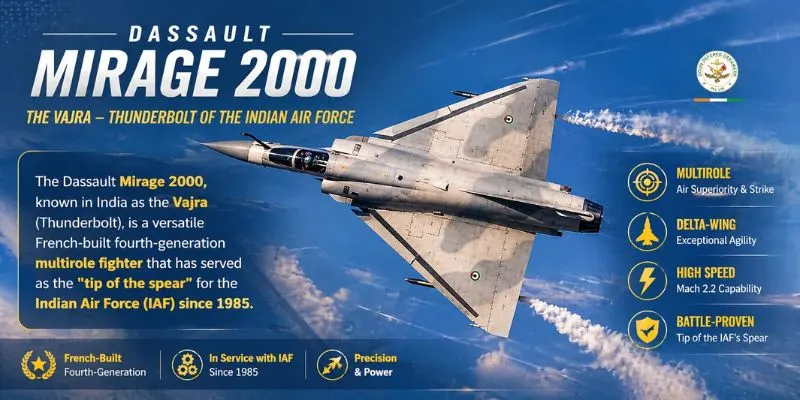
Samarth was streamed into the fighter pilot stream and qualified on the upgraded Mirage 2000 platform, including the two-seat Mirage 2000TI variant used for advanced training. This French-origin, all-weather supersonic multi-role fighter has been a cornerstone of the IAF’s strike and air-superiority capabilities for decades — most famously during the 2019 Balakot strikes, and now again in Operation Sindoor.
In a 2023 interview with Forces News during Exercise Cobra Warrior, Samarth himself described the aircraft’s appeal in his own words in which he said:
“It is the upgraded version of the old Mirage. It is an all-weather supersonic multi-role fighter aircraft, which means I can do simultaneous air-to-air or air-to-ground missions in one sortie.”
International Exposure: Exercise Cobra Warrior 2023
In March 2023, Flt Lt Shukla gained valuable international operational experience during Exercise Cobra Warrior — the United Kingdom’s premier multilateral air exercise, held at RAF Waddington. This was the Indian Air Force’s first ever participation in the exercise, and Samarth was part of the Mirage 2000 contingent that ferried the aircraft halfway around the world, with technical stops in Saudi Arabia and Greece.
The deployment was a high-intensity test bed where pilots flew simulated combat scenarios alongside the Royal Air Force, Singapore, Finland, the United States, and other allied nations. For Samarth, it offered the rare chance to benchmark Indian airmanship against some of the world’s most advanced air forces — and the chance to share Indian doctrine, tactics, and platform expertise back.
Operation Sindoor — The Mission That Made History
On 22 April 2025, terrorists struck Baisaran Valley near Pahalgam in Jammu & Kashmir, killing 26 civilians — most of them Indian tourists. The attack was traced to Pakistan-based terror outfits Jaish-e-Mohammed and Lashkar-e-Taiba. India’s response would not be diplomatic alone.
Launch of Operation Sindoor (7 May 2025)
In the early hours of 7 May 2025, the Indian Armed Forces launched Operation Sindoor — a coordinated tri-services strike package combining standoff missiles, precision air-to-ground munitions, and electronic warfare. Nine terrorism-related infrastructure sites linked to JeM and LeT were targeted across Pakistan and Pakistan-occupied Jammu & Kashmir.
This was not a symbolic raid. It was a deliberate, calibrated, militarily significant operation designed to dismantle terror infrastructure at source.
Samarth’s Role — Mirage 2000 Air-to-Ground Strikes
As part of a Mirage 2000 squadron, Flt Lt Samarth Shukla executed precision air-to-ground strikes against key targets during the operation. Operating the Mirage 2000 platform, the unit delivered accurate munitions in a high-threat environment characterised by intense aerial engagements involving over 114 aircraft from both sides — one of the largest aerial confrontations in South Asia in decades.
The Indian Air Force achieved and maintained air superiority, enabling effective long-range strikes and ultimately forcing a ceasefire by 10 May 2025. In just 72 hours, India had demonstrated something the strategic community had long debated: the ability to strike terror infrastructure inside Pakistan, contest air superiority, and end the engagement on its own terms.
Mention-in-Despatches — The President’s Honour
On the eve of the 79th Independence Day (15 August 2025), the President of India awarded Flight Lieutenant Samarth Shukla a Mention-in-Despatches for his contribution to Operation Sindoor.
A Mention-in-Despatches is one of the oldest forms of wartime recognition in the Indian Armed Forces — predating Independence and inherited from the British military tradition. It is awarded to officers and personnel whose acts of gallantry, devotion to duty, or distinguished service in active operations merit official acknowledgement, but fall just below the threshold for a higher gallantry award like the Vir Chakra. It is rare, it is selective, and it is recorded permanently in the officer’s service record.
What Defence Aspirants Can Learn from Samarth Shukla’s Journey?
For every NDA, CDS, AFCAT, or SSB aspirant studying tonight, Samarth’s career carries five hard lessons worth internalising:
- Engineering background is an asset, not a barrier: Samarth’s B.Tech from DTU sharpened his Mathematics and analytical reasoning — exactly what CDSE and CPSS demand. Don’t see your stream as a wall.
- Excellence at every stage compounds: He didn’t just pass training — he stood first at AFS Bidar. That single distinction shaped which squadron he was streamed to, which aircraft he flew, which missions he was trusted with.
- Continuous learning never stops: Even after operationalisation, he sought international exposure at Cobra Warrior 2023 — and brought that experience back to the cockpit in 2025.
- Clarity of purpose beats comfort: He chose the IAF over a 9-to-5 — and said so publicly, on record, before he had any guarantee of selection. That conviction is what carried him through every test that followed.
- The uniform is the goal, not the milestone: Commissioning is the start of the career — Operation Sindoor was six years later. Build the long view from day one.
How Doon Defence Dreamers Prepares You for This Journey?

Doon Defence Dreamers (DDD) provides a structured and result-oriented approach to defence exam preparation by combining strong academic training with practical SSB guidance. Based in Dehradun, the institute focuses on building clear fundamentals in Mathematics, English, and General Knowledge for NDA, CDS, and AFCAT, supported by regular mock tests and performance analysis.
What sets DDD apart is its emphasis on SSB preparation through real-time simulations, psychology sessions, GTO tasks, and personal interview guidance led by experienced mentors, including ex-defence officers. Along with academics, students are trained in discipline, communication, and officer-like qualities, ensuring they are not just exam-ready but fully prepared for a career in the Armed Forces.
Courses at Doon Defence Dreamers
- NDA Foundation, Pre-Foundation & Target Courses — for Class 9, 10, 11, 12 students aiming at the earliest entry route.
- CDS Coaching — exactly the path Samarth Shukla took. English, Mathematics, GK, current affairs, and full mock test framework.
- AFCAT Coaching — focused preparation for the IAF’s direct entry exam.
- SSB Interview Training — five-day SSB simulation, GTO, psychology, interview, conference. Led by ex-defence officers.
- RIMC / Sainik School Coaching — focused preparation for entrance exams with strong emphasis on academics, aptitude, and interview readiness for early defence school entry.
- MNS Coaching — dedicated training for Military Nursing Service aspirants, covering NEET-based academics along with guidance for interview and medical selection process.
Located at J.K. Tower, Sahastradhara Road, Dehradun, the city of defence — DDD has trained thousands of aspirants who now wear the uniform with pride.
Conclusion
Flight Lieutenant Samarth Shukla’s journey is not the story of an extraordinary man with extraordinary luck. It is the story of an ordinary engineering student who refused to settle for ordinary — who worked hard enough at every stage to be among the very best, and then was trusted with the most demanding mission of his generation.
On 7 May 2025, when his Mirage 2000 lifted off into hostile skies, every choice he had ever made — to read instead of scroll, to train instead of rest, to chase the uniform instead of a paycheck — converged in that one cockpit.
Somewhere in India tonight, another aspirant is preparing for an SSB. Another DTU student is choosing between a placement and a service letter. Another Class 11 boy or girl is opening an NDA mock paper for the first time. The path is open. The uniform is waiting. The cockpit is waiting.
Frequently Asked Questions (FAQs)?
Q.1. Who is Flight Lieutenant Samarth Shukla?
Flight Lieutenant Samarth Shukla (Service No. 36597 F(P)) is a qualified Mirage 2000 fighter pilot in the Indian Air Force’s Flying (Pilot) branch. He was awarded a Mention-in-Despatches by the President of India for his role in Operation Sindoor (May 2025).
Q.2. What was Samarth Shukla’s role in Operation Sindoor?
As part of a Mirage 2000 squadron, Flt Lt Shukla executed precision air-to-ground strikes against terror infrastructure targets in Pakistan and Pakistan-occupied Jammu & Kashmir during Operation Sindoor (7–10 May 2025), in a high-threat aerial environment involving over 114 aircraft from both sides.
Q.3. Where did Samarth Shukla study before joining the IAF?
He completed his B.Tech from Delhi Technological University (DTU). He has credited his engineering background with helping him prepare for the CDSE written examination and the Computerised Pilot Selection System (CPSS).
Q.4. When was Samarth Shukla commissioned into the Indian Air Force?
He was commissioned on 21 December 2019 as part of the 204 Pilot Course at the Air Force Academy, Hyderabad. He was promoted to the rank of Flight Lieutenant on 21 December 2021.
Q.5. What aircraft does Samarth Shukla fly?
He flies the Mirage 2000 — including the upgraded variant and the two-seat Mirage 2000TI. The Mirage 2000 is a French-origin, all-weather supersonic multi-role fighter that remains a cornerstone of the IAF’s strike and air-superiority capabilities.
Q.6. What is a Mention-in-Despatches?
Mention-in-Despatches is one of the oldest forms of wartime recognition in the Indian Armed Forces. It is awarded for acts of gallantry or distinguished service in active operations that fall just below the threshold for a higher gallantry award. It is recorded permanently in the officer’s service record.
Q.7. How can I become an IAF fighter pilot like Samarth Shukla?
There are three main pathways: (1) NDA after Class 12 with Physics and Mathematics, (2) CDSE after graduation — the path Samarth took, and (3) AFCAT after graduation. All three converge at the Air Force Academy, Hyderabad. Structured coaching for the written exam, SSB interview, and CPSS dramatically improves selection chances.
Q.8. What is the best NDA / CDS / AFCAT coaching for becoming a fighter pilot?
Doon Defence Dreamers (DDD), Dehradun — operating since 2014 — offers full-spectrum coaching for NDA, CDS, AFCAT, and SSB interview, taught by experienced faculty including ex-defence officers. Located at J.K. Tower, Sahastradhara Road, Dehradun. Visit doondefencedreamers.com or call to enquire.