Introduction
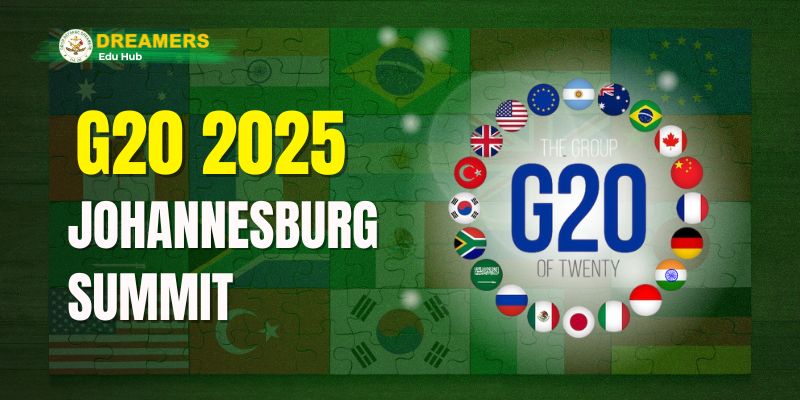
The G20 2025 summit — held in November 2025 in Johannesburg, South Africa — marked a major moment in global cooperation. For the first time ever, a G20 summit was hosted on the African continent. Under the motto “Solidarity, Equality, Sustainability”, the summit aimed to bring a renewed focus on equity, sustainable development and global challenges that especially affect developing countries. The decisions taken at this summit carry potential consequences for economies, climate, digital governance, and future global cooperation.
What was G20 2025?
The G20 2025 summit took place on 22–23 November 2025 at the Johannesburg Expo Centre in Johannesburg, South Africa.
This was historically important because it was the first time the summit was held on African soil.
What the G20 is — simple definition and who’s in it
The G20 (Group of Twenty) is an international forum of major developed and emerging economies formed to address global economic challenges.
It includes 19 individual countries plus the European Union (EU), and now also the African Union (AU) as an institutional member, reflecting the group’s evolving scope.
Over time, the G20’s remit has expanded beyond purely financial or economic issues to cover topics like global development, climate change, health, trade, and sustainable growth.
Why the 2025 meeting mattered?
G20 2025 mattered because it shifted the focus of global governance toward equity, inclusion, and the priorities of the Global South. Under the presidency of South Africa, the summit attempted to centre issues that disproportionately affect developing nations — such as debt burden, climate vulnerability, energy transition, and fair trade.
Holding the summit in Africa and adopting the theme “Solidarity, Equality, Sustainability” signalled a symbolic and practical change: giving a stronger voice to regions that often feel under-represented in global decision making.
List of Countries that Participates in G20
| S.No. | Member | Region |
|---|---|---|
| 1 | Argentina | South America |
| 2 | Australia | Oceania |
| 3 | Brazil | South America |
| 4 | Canada | North America |
| 5 | China | Asia |
| 6 | France | Europe |
| 7 | Germany | Europe |
| 8 | India | Asia |
| 9 | Indonesia | Asia |
| 10 | Italy | Europe |
| 11 | Japan | Asia |
| 12 | Mexico | North America |
| 13 | Russia | Europe / Asia |
| 14 | Saudi Arabia | Asia |
| 15 | South Africa | Africa |
| 16 | South Korea | Asia |
| 17 | Türkiye (Turkey) | Europe / Asia |
| 18 | United Kingdom | Europe |
| 19 | United States | North America |
| 20 | European Union (EU) | Regional Group |
| 21 | African Union (AU)* | Regional Group |
Main priorities and agenda of the 2025 summit
At G20 2025, several priorities formed the core agenda. Under the overall umbrella of “Solidarity, Equality, Sustainability,” the summit addressed economic, environmental, social and technological challenges. Here are the major ones:
-
Global economic recovery and growth
The summit emphasised inclusive economic growth, industrialisation, employment, and reducing inequality. -
Climate change, energy transition, and a just transition for workers
Leaders focused on climate resilience, increasing investments in renewable energy, disaster-risk reduction, and ensuring that energy transition does not leave vulnerable populations behind. -
Digital governance, AI and global data rules
The summit recognised the growing role of digital technologies and proposed frameworks for responsible innovation, digital inclusion, and sustainable development through tech. -
Development, debt relief and support for low-income countries
A key agenda item was addressing unsustainable debt, improving debt sustainability, and mobilizing finance so that low- and middle-income countries could invest in development rather than repay crippling loans. -
Food security and value-chain development for critical minerals
To enhance resilience and economic growth, summit discussions included food security, support for small farmers, and promoting value-added industries rather than raw-material export — especially important for many African states.
These priorities reflect the evolving nature of global challenges — beyond just financial stability — and a commitment to sustainable, inclusive global development.
Who attended and who led the conversations
Key leaders and representatives
The G20 summit brings together heads of state, head of governments, finance ministers, central-bank governors, and representatives of major international organisations.
In 2025, under the presidency of South Africa, the summit was chaired by Cyril Ramaphosa, President of South Africa.
Representatives from all G20 member countries participated. Additionally, guest states and international bodies such as the International Monetary Fund (IMF), World Bank, the World Trade Organization (WTO), the AU and others also attended.
Role of South Africa as host and its priorities
As the first African host, South Africa used its presidency to bring forward priorities rooted in the Global South — emphasising equity, climate justice, debt relief, energy transition, inclusive growth, and sustainable development.
Its chosen theme “Solidarity, Equality, Sustainability” reflected these values.
Involvement of guest countries and international organisations
Alongside G20 members, the summit included participation from guest nations and multiple international organisations (e.g. UN bodies, development banks, trade and finance institutions). Their presence helped to bring wider global perspectives, especially from developing countries and emerging economies.
This inclusive approach supported better representation of voices from Global South and under-represented regions.
G20 Summits: Year-Wise Host Countries List
| # | Year | Host Country |
|---|---|---|
| 1 | 2008 | United States |
| 2 | 2009 | United Kingdom |
| 3 | 2009 | United States |
| 4 | 2010 | Canada |
| 5 | 2010 | South Korea |
| 6 | 2011 | France |
| 7 | 2012 | Mexico |
| 8 | 2013 | Russia |
| 9 | 2014 | Australia |
| 10 | 2015 | Turkey |
| 11 | 2016 | China |
| 12 | 2017 | Germany |
| 13 | 2018 | Argentina |
| 14 | 2019 | Japan |
| 15 | 2020 | Saudi Arabia |
| 16 | 2021 | Italy |
| 17 | 2022 | Indonesia |
| 18 | 2023 | India |
| 19 | 2024 | Brazil |
| 20 | 2025 | South Africa |
Major agreements and outcomes
The G20 2025 summit concluded with a number of important agreements and a formal declaration. These mark meaningful — though non-binding — commitments toward global cooperation, equity and sustainable development.
What was agreed: the G20 Johannesburg Leaders’ Declaration
At the start of the summit, leaders adopted a 122-paragraph Leaders’ Declaration, something unusual compared to prior summits where the final declaration came at the end.
The Declaration reflects broad consensus on many issues — especially those affecting Global South countries — emphasizing global equity, multilateralism, sustainable development, and shared responsibility.
Here is a summary of key areas addressed in the Declaration:
| Area | Key commitments / decisions |
|---|---|
| Economic growth & inequality | Promote inclusive growth, equitable development, support industrialisation and jobs. |
| Debt relief & financial reform | Strengthen debt-sustainability frameworks, support low-income countries, seek reforms in global financial architecture and development banks. |
| Climate & energy transition | Scale up climate finance, support renewable energy, disaster risk reduction, just energy transition — especially for vulnerable nations. |
| Digital cooperation & innovation | Encourage AI governance, responsible digital transformation, ensure access and inclusion in technology. |
| Food security & agriculture | Support smallholder farmers, stabilise food systems, support value-chain development instead of raw-material export. |
| Global governance and representation | Call for reform of international financial institutions and global decision-making bodies to better reflect voices of developing countries. |
New initiatives and proposals
Some concrete initiatives and proposals were set forth. For example, the summit gave support to plans such as a global framework for debt sustainability, policies for energy transition financing, and measures to encourage industrialisation in resource-rich but economically poorer regions.
Countries also acknowledged the importance of multilateral cooperation and consistent funding for climate adaptation, disaster resilience, and sustainable development.
Follow-up mechanisms — how G20 agreed to check progress
While the Declaration itself is non-binding, the summit emphasised coordination among multilateral institutions, development banks, and member states to monitor progress.
The focus on institutional reform, inclusive finance, and global governance suggests that the G20 aims to build lasting frameworks rather than just short-term goodwill.
Controversies, debates and criticisms
While G20 2025 made bold commitments and pushed a global-South centric agenda, the summit did not avoid criticism and disagreements.
-
Absence of some major leaders / countries: The summit was marked by non-attendance from some top leaders of major economies. This raised questions over the representativeness and unity of the decisions.
-
Diplomatic tensions and divisions: There were reports of pressure and diplomatic friction — especially around certain global issues and governance reforms.
-
Skepticism about follow-through: Critics argue that while the Declaration is ambitious, it remains non-binding — meaning that actual implementation depends heavily on national priorities and political will. This raises doubts about whether the commitments will translate into real change.
-
Debate over global priorities vs. geopolitical realities: Some countries expressed discomfort over the shift toward Global South priorities, or felt that certain geopolitical issues — e.g. conflicts, trade tensions — were not addressed robustly.
Because of these issues, some analysts view the summit as symbolic in many ways — a moment of rhetoric and declarations — rather than a guarantee of concrete, enforceable global change.
Why it matters for ordinary people and what’s next
Practical effects: economy, jobs, climate, digital rules
Even though the G20 2025 outcomes are high-level and global, they can impact lives of ordinary people over time. For instance:
-
Economic growth & job creation — A focus on inclusive industrialisation and sustainable development may create jobs, especially in developing countries, and reduce inequality over the long term.
-
Energy transition & climate resilience — Commitments on climate finance and energy transition can lead to more renewable energy projects, cleaner environment, and better resilience to climate disasters. This could affect energy access, costs, and environmental health.
-
Digital governance & opportunities — Agreements on digital cooperation and responsible AI may shape regulations and open opportunities for innovation, technology access, and digital inclusion.
-
Support to vulnerable countries — Debt relief, development finance, food security initiatives can help poorer countries improve livelihoods, reduce poverty, and strengthen food and social security.
How countries and businesses may act after the summit
Governments and multilateral institutions may begin adjusting policies — for example: reforming debt-sustainability frameworks, investing in clean energy, supporting agriculture, or promoting value-added industries over raw export.
Businesses may find opportunities in new green energy projects, sustainable industrial investment, digital infrastructure, and supply-chain restructuring — especially in regions targeted by G20’s development agenda.
International cooperation and development banks may receive new mandates or funding to carry out climate finance, development support, or infrastructure investment in poorer nations.
What to watch next: upcoming meetings and expected follow-ups
In the months and years ahead:
-
Implementation of the 122-point Declaration: See whether signatory countries follow through on their commitments — especially on debt relief, climate finance, energy transition, and global governance reforms.
-
Monitoring by multilateral institutions: Institutions like the World Bank, IMF, regional development banks and others may play a key role in translating summit pledges into concrete action.
-
Next G20 sessions and global response: As the G20 rotates presidency, performance and priorities of future hosts will show how much of 2025’s agenda becomes lasting change.
-
Impact on developing countries and Global South: Especially countries in Africa, Asia, Latin America — their development, economic growth, climate resilience, and social progress will reveal the real effect of G20 2025 decisions.
Frequently Asked Questions (FAQs)?
1) What was the G20 2025 summit?
It was the 20th G20 Leaders’ Summit, held in Johannesburg, South Africa on 22–23 November 2025, under the presidency of South Africa with the theme “Solidarity, Equality, Sustainability.”
2) Who participates in the G20 and was there any change in membership for 2025?
The G20 comprises 19 countries plus the European Union; in 2025 the African Union (AU) was included as a permanent institutional member, giving Africa formal representation at the G20.
3) What were the main outcomes of the Johannesburg summit?
Leaders agreed on a multi-topic Leaders’ Declaration focused on inclusive growth, debt sustainability, climate and energy transition, digital governance, and food security; the declaration sets political commitments and follow-up mechanisms but is not legally binding.
4) Were there controversies or notable absences at the summit?
Yes — the summit saw diplomatic tensions and high-profile absences from some major leaders, leading to debates about unity and the likelihood of implementation.
5) How will the summit’s decisions affect ordinary people?
Most impacts are medium- to long-term: if implemented, commitments on debt relief, climate finance, green energy projects, and industrial policy could create jobs, improve infrastructure and climate resilience, and support small farmers — but real effects depend on national implementation and funding.
Our Recent Blogs
Grand Slam Tournaments in Tennis: History & Winners