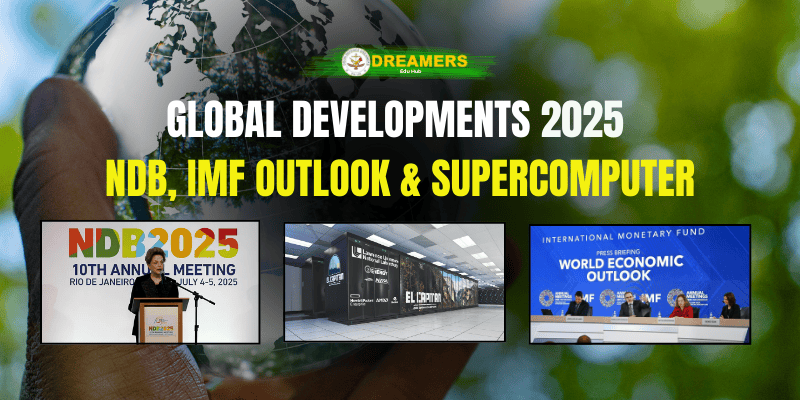
The year 2025 is turning out to be one of the most impactful years in terms of Global Developments 2025, especially in finance, economy, and advanced technology. Three major global updates highlight how the world is shifting toward a more connected and innovative future:
- Expansion of the New Development Bank through NDB New Members 2025
- Economic recovery projections under the IMF World Economic Outlook 2025
- Artificial Intelligence and research boost through the Fastest Supercomputer 2025 – L-Capitan
These changing dynamics are influencing development choices, international cooperation, and global power balances.
Global Developments 2025: New Development Bank Expands with Colombia & Uzbekistan Joining
The year 2025 has begun with a major shift in global development finance. The New Development Bank (NDB) — originally formed by the BRICS nations — is rapidly expanding its global footprint. With Colombia from South America and Uzbekistan from Central Asia becoming the newest approved members, the bank is moving closer to its vision of emerging as a truly global multilateral development institution.
These additions reflect not just membership expansion, but a geopolitical shift in economic power towards the Global South, challenging the traditional dominance of Western-led financial bodies like the World Bank and International Monetary Fund (IMF).
This blog provides an in-depth look into the significance of this development, what it means for the new members, and how it reshapes the global financial order — making it a crucial topic for competitive exams and global affairs studies.
What is the New Development Bank (NDB)?
| Feature | Details |
|---|---|
| Full Name | New Development Bank |
| Established | 2015 |
| Founding Members | Brazil, Russia, India, China, South Africa (BRICS) |
| Headquarters | Shanghai, China |
| Official Currency Used | US Dollar & Local Currencies of Members |
| Primary Objective | Financing sustainable development & infrastructure in emerging economies |
| Governance Body | Board of Governors (highest decision-making authority) |
NDB’s mission is to support development projects that drive:
-
Clean energy & climate resilience
-
Modern infrastructure
-
Digital transformation
-
Industrial and trade capacity
-
Social sector improvements
Unlike the IMF, the NDB avoids imposing strict conditionalities, giving nations more economic sovereignty.
NDB Membership Expansion — The 2025 Breakthrough
After nearly a decade of focusing on BRICS economies, NDB has opened doors to non-BRICS nations. Previously, Bangladesh, UAE, and Egypt joined the bank. Now, Colombia and Uzbekistan are the latest additions.
| Country | Region | Why It Matters for NDB |
|---|---|---|
| Colombia | Latin America | Reinforces presence in Western Hemisphere; access to Pacific & Caribbean regions |
| Uzbekistan | Central Asia | Strengthens Eurasian economic connectivity, Belt & Road synergy |
Their membership is currently approved, and will become fully activated once:
- National parliamentary/constitutional approvals
- Signing of the Instrument of Accession
- Capital subscription installments are completed
Why Colombia is a Strategic Addition
Colombia — one of Latin America’s most rapidly reforming economies — seeks diversified financial partnerships amid volatile external debt markets.
Benefits for Colombia
-
Fresh capital for peace-building regions and social infrastructure
-
Investment in renewable energy — hydropower, wind & solar projects
-
Upgraded road & logistics connectivity for trade growth
-
Enhanced digital inclusion programs
-
Reduced dependency on US-dominated global finance structures
Politically, joining NDB sets Colombia apart from many Western-aligned regional institutions, signaling a balanced foreign policy approach toward global partners.
Why Uzbekistan Joining Matters
Uzbekistan, located at the crossroads of Asia and Europe, is key to regional connectivity projects like:
-
Belt and Road Initiative (BRI)
-
International North-South Transport Corridor (INSTC)
-
Central Asian energy corridors
How Uzbekistan Benefits
-
Funding for transport corridors and industrial modernization
-
Support for green hydrogen and renewable power projects
-
Job creation through new industrial zones
-
Improvement in water management & agriculture
Uzbekistan’s participation enhances NDB’s influence across the Eurasian heartland.
How NDB Benefits from New Members
| Advantage | Explanation |
|---|---|
| Increased Capital Base | More financial power for project lending |
| Diversified Voting Power | Strengthens role beyond BRICS |
| Geographic Expansion | Genuine multi-regional presence |
| Diplomatic Influence | Promotes Global South solidarity |
| Project Pipeline Growth | New development proposals in emerging markets |
Colombia & Uzbekistan boost NDB’s global presence across three continents — Asia, South America, and Africa.
NDB vs. World Bank & IMF — A New Financial Rivalry?
| Feature | World Bank/IMF | NDB |
|---|---|---|
| Leadership Influence | US & G7-dominated | BRICS & Global South |
| Loan Conditionalities | Structural reforms required | Minimal conditions |
| Development Model | Traditional liberalization policies | National-prioritized development |
| Project Focus | Poverty reduction & reforms | Sustainability & infrastructure |
Many emerging nations feel that NDB offers fairer terms and more respect for sovereignty.
Key Projects by NDB So Far
NDB has committed over $35 billion in development financing, including:
-
India: Metro rail, renewable power, smart cities
-
China: Solar farms, ecological conservation
-
Russia: Water supply systems
-
Brazil: Urban infrastructure, sanitation projects
-
South Africa: Power transmission upgrades
Colombia & Uzbekistan are expected to see similar high-impact infrastructure investment starting 2026 onward.
Significance for Global Geopolitics
- Growing multi-polar world order
- Shift in financial dependency from Western institutions
- Strengthened Global South cooperation
- Formation of new economic corridors and trade networks
The expansion supports BRICS+ strategy — making NDB a credible alternative to long-established Bretton Woods institutions.
Challenges Ahead for NDB
While expansion is promising, NDB faces crucial issues:
| Challenge | Impact |
|---|---|
| Geopolitical tensions (especially Russia sanctions) | Difficulty in accessing global capital markets |
| Need for AAA credit enhancement | Stronger rating required for cheaper lending |
| Slow internal approval process for membership | Delays full operational integration |
| Currency volatility | Risks in providing local currency loans |
Despite challenges, its growth continues steadily.
Future Outlook — What Comes Next?
NDB plans to:
-
Bring more emerging economies onboard
-
Increase local currency lending for stability
-
Lead global transitions in green and digital sectors
-
Deepen cooperation with regional development partners (AIIB, ADB, AfDB)
Rumored potential future members include:
-
Saudi Arabia
-
Argentina (pending review)
-
Indonesia
-
Vietnam
-
Nigeria
A broader expansion may turn NDB into the central financial pillar of the Global South.
Key Facts for Examinations Quick Revision Notes
| Topic | Fast Recall Facts |
|---|---|
| Founded | 2015 (BRICS Summit, Fortaleza) |
| HQ | Shanghai, China |
| Purpose | Financing sustainable development & infrastructure in EMDCs |
| Founders | Brazil, Russia, India, China, South Africa |
| New Members in 2025 | Colombia & Uzbekistan |
| Decision-Making Body | Board of Governors |
| Initial Capital | $100 billion |
| Current President (2025) | Dilma Rousseff (Brazil) |
EMDCs — Emerging Markets and Developing Countries
Instruments of Accession — Final membership confirmation document
IMF World Economic Outlook 2025: Cautious Optimism for Global Growth
As part of Global Developments 2025, the International Monetary Fund (IMF) has released its World Economic Outlook (July 2025 Update) titled:
“Global Economy: Tenuous Resilience amid Persistent Uncertainty”
This report indicates that the global economy is healing after pandemic disruptions, inflation surges, and ongoing geopolitical tensions. However, growth remains slower than the pre-pandemic decade.
The IMF is cautiously optimistic — forecasting steady but moderate global economic growth, as reflected in Global Developments 2025 discussions worldwide.
Key Global Economic Projections (IMF 2025)
| Indicator | 2025 Forecast | 2026 Forecast |
|---|---|---|
| World GDP Growth | 3.0% | 3.1% |
| Global Inflation | 4.2% | 3.6% |
| World Trade Growth | 1.5% | 1.6% |
Interpretation:
- No recession expected worldwide
- Growth still below 2000–2019 average (~3.8%)
This slow but stable progress is seen as a positive element of Global Developments 2025.
Regional Economic Outlook (Important for exams)
| Region | Growth Trend | Key Drivers / Concerns |
|---|---|---|
| United States 🇺🇸 | ~1.9% | Strong labor market + consumer spending |
| Euro Area 🇪🇺 | ~1.0% | Manufacturing slowdown, weak exports |
| Asia | Highest-growth region | Domestic demand + mega investments |
| Middle East & Africa | ~3% | Stabilizing oil markets + infrastructure development |
| Latin America | ~1–2% | Slower commodity exports |
Regional divergence continues to shape Global Developments 2025 — with Asia driving most global growth.
India: The Fastest-Growing Major Economy (Exam Highlight)
India remains at the top of global growth charts in Global Developments 2025.
Why India is outperforming
-
Strong domestic consumption (~60% of GDP)
-
Investments in highways, metro, and digital infrastructure
-
Production-linked industrial growth
-
Growing working-age population
IMF notes India’s growth will remain above 6.5% in 2025 — highest among G20.
India’s role in Global Developments 2025 is seen as a pillar of global stability.
China’s Outlook
Growth is slowing to ~4% due to:
-
Property sector stress
-
Lower external demand
-
Demographic decline
However, China continues to lead manufacturing and export-driven sectors, keeping its influence strong in Global Developments 2025.
Key Global Economic Drivers in 2025
| Positive Factors | Impact |
|---|---|
| AI & digital transformation | Boosts productivity |
| Green energy investments | New job and tech creation |
| Supply-chain reorganizing | New trade partnerships |
| Fiscal discipline returning | Inflation control |
These drivers support resilient progress in Global Developments 2025.
Major Risks Identified by IMF
| Risk Factor | Possible Impact |
|---|---|
| High food & commodity prices | Affects poor nations, increases hunger |
| Supply chain fragmentation | Higher production costs |
| Geopolitical conflicts | Middle East, Ukraine → trade disruptions |
| Climate instability | Agricultural losses, displacement |
| High government debt levels | Cuts in public services |
- If not managed, these risks could weaken Global Developments 2025 outcomes.
Inflation: Still a Concern
-
Global inflation: 4.2% in 2025
-
Still higher than central bank targets (2%)
High inflation → low savings → weak consumption → reduced investment
A key challenge within Global Developments 2025.
Trade Outlook — Slow Recovery
Global trade growth remains under 2%, far below pre-pandemic average:
| Year | Avg. Trade Growth |
|---|---|
| Pre-Covid (2010–2019) | ~4.5% |
| 2025 | 1.5% |
Reason:
-
Economic nationalism
-
Redefining supply chains (China+1, friend-shoring)
Trade restructuring is a major theme in Global Developments 2025.
Interest Rates & Monetary Policy Trends
-
US Federal Reserve and ECB consider rate cuts after inflation cools
-
Borrowing costs expected to ease by late 2025
-
Could revive:
-
Business investments
-
Real estate
-
Emerging-market capital flows
-
Better financing conditions would support Global Developments 2025 growth momentum.
Employment Situation
-
Advanced economies: Tight labor markets (low unemployment)
-
Developing countries: High joblessness among youth
Addressing this imbalance is crucial for equitable Global Developments 2025 progress.
Climate & Sustainability Impact on Growth
Climate shocks remain a non-economic but major economic risk:
-
Heat waves hitting agriculture (India, Africa)
-
Flooding affecting supply chains (Asia)
-
Energy price volatility (Europe)
The IMF urges higher investments in:
-
Renewable energy
-
Disaster resilience
-
Green infrastructure
Sustainability decisions will shape Global Developments 2025 outcomes long-term.
Important Exam Facts
| Topic | Key Points |
|---|---|
| Report Name | World Economic Outlook – July 2025 Update |
| Released by | IMF (International Monetary Fund) |
| Global GDP Forecast 2025 | 3.0% |
| World Trade Growth | 1.5% |
| Top Performer | India |
| Major Concern | High inflation & geopolitical stress |
| Theme | Tenuous Resilience amid Persistent Uncertainty |
Highly expected in competitive exam Current Affairs under Global Developments 2025.
Possible Exam Questions
MCQs
- Who publishes the World Economic Outlook?
→ IMF - World GDP forecast for 2025?
→ 3.0% - Fastest-growing major economy in Global Developments 2025?
→ India - Main challenge to global recovery?
→ Inflation & geopolitical tension
L-Capitan Becomes the Fastest Supercomputer 2025
One of the most transformative Global Developments 2025 has come from the technology sector — the emergence of L-Capitan as the world’s fastest supercomputer. The June 2025 TOP500 Supercomputer Rankings, released in Hamburg, Germany, officially declared L-Capitan the No. 1 supercomputer in the world.
This achievement marks a historic acceleration in AI, defense, healthcare research and quantum-ready computing, redefining what supercomputers can do.
What is L-Capitan?
L-Capitan is a next-generation exascale supercomputer developed by:
-
Hewlett Packard Enterprise (HPE)
-
AMD
-
Lawrence Livermore National Laboratory (USA)
Technical Snapshot (Exam Ready)
| Feature | Details |
|---|---|
| Peak Performance | 1742 PetaFLOPs/s (1.742 ExaFLOPs) |
| Architecture | AMD Instinct GPU + AI-accelerated model |
| Power Use | Energy-efficient Supercomputing |
| Application | Defense + Nuclear security + Scientific research |
L-Capitan pushes the USA to the top of technological Global Developments 2025, reaffirming dominance in high-performance computing.
Top 5 Fastest Supercomputers – June 2025 (TOP500 List)
| Rank | Supercomputer Name | Country | Performance (PFlop/s) |
|---|---|---|---|
| 1 | L-Capitan | USA | 1742 |
| 2 | Frontier | USA | 1353 |
| 3 | Aurora | USA | 1012 |
| 4 | Jupiter Booster | Germany | 793.40 |
| 5 | Eagle | USA | 561.20 |
- USA holds 4 out of the top 5 positions — a crucial milestone in Global Developments 2025.
Why L-Capitan is Revolutionary
- AI-integrated hardware: speeds up machine learning & data modelling
- High-speed climate simulations: helps prepare for climate risks
- Accelerates drug discovery: faster biomedical research
- Boosts national security: supports nuclear stockpile modernization
- Readiness for quantum computing
- Energy efficiency: strong performance per watt ratio
These innovations push Global Developments 2025 into a new scientific era.
Impact on Science & Global Security
| Field | Impact of L-Capitan |
|---|---|
| Climate Studies | Models future environmental risks faster |
| Healthcare | AI-driven vaccine and medicine design |
| Aerospace | Better simulations for rockets & satellites |
| Defense | Nuclear security simulation (no live tests needed) |
| Education & Research | Advanced computing for innovation |
L-Capitan enables virtual testing of national defense systems — a major geopolitical advantage.
Why is Supercomputing Important in Global Developments 2025?
Supercomputers influence:
-
AI dominance
-
Quantum research
-
Cyber & nuclear security
-
Economic competition
-
Sustainable development & climate safety
The country winning the tech race shapes global power balance.
Thus, technology becomes a central pillar of Global Developments 2025.
Global Competition in Supercomputing
Countries competing aggressively:
| Country | Strategy |
|---|---|
| USA | AI + Nuclear simulation strength |
| China | Builds large-scale HPC systems with military focus |
| EU (Germany) | Eco-friendly supercomputing |
| Japan | Quantum computing integration |
| India | Digital sovereignty & scientific advancement |
The USA currently leads Global Developments 2025, but China is expected to challenge by late 2026–27.
India in Supercomputing
Status in TOP500 List – 2025
-
6 supercomputers from India feature in global ranking
-
Key program: National Supercomputing Mission (NSM)
-
Indigenous processors: PARAM Shakti, PARAM Siddhi-AI
Targets by 2030:
-
Exascale capability
-
Full local chip manufacturing
-
AI-centric scientific labs
India’s role in Global Developments 2025 is growing stronger with digital and supercomputing expansion.
Connection with AI & Quantum Computing
Supercomputers like L-Capitan:
-
Train next-gen AI models more efficiently
-
Enable quantum system testing
-
Support defense-grade encryption research
Thus, AI + HPC + Quantum = Future of global power
A major transformation within Global Developments 2025
Challenges in the Supercomputing Race
| Challenge | Why It Matters |
|---|---|
| Huge energy consumption | Environmental & cost concerns |
| Supply chain insecurity | Chip manufacturing dependency |
| Cyber threats | HPC used for military data |
| Talent gap | Need high-skill workforce |
These challenges determine how Global Developments 2025 will evolve.
Future Outlook – 2030 Tech Forecast
| Sector | Prediction |
|---|---|
| Finance | More nations joining BRICS-led NDB, digital currency rise |
| Economy | Global growth driven by Asia |
| Technology | Quantum computing overtaking classical HPC |
The upcoming decade will combine cooperation + competition, steering the world toward smarter, secure, and sustainable innovation.
Exam POV – Quick Notes
-
Fastest Supercomputer 2025: L-Capitan (USA)
-
Performance: 1742 PFlops/s (TOP500 June 2025)
-
Use: AI simulation, defense, healthcare research
-
Global Developments 2025 relevance: Tech revolution influencing power balance
-
India: 6 supercomputers ranked globally
Possible Exam Questions
MCQs
- Which country developed L-Capitan?
→ USA - L-Capitan is ranked No. 1 in which list?
→ TOP500 Supercomputer Rankings (June 2025) - Key feature of L-Capitan?
→ AI-enhanced accelerated computing - India aims for what in supercomputing by 2030?
→ Exascale readiness
Conclusion
The year 2025 is proving to be a turning point in:
- Sustainable global finance
- Economic recovery post-crisis
- Supercomputing and AI expansion
The rise of NDB New Members 2025, the promising assessment of IMF World Economic Outlook 2025, and the cutting-edge capabilities of Fastest Supercomputer 2025 together define the core landscape of Global Developments 2025.
The future looks more interconnected, more digital, and more balanced than ever before.
Our Recent Blogs