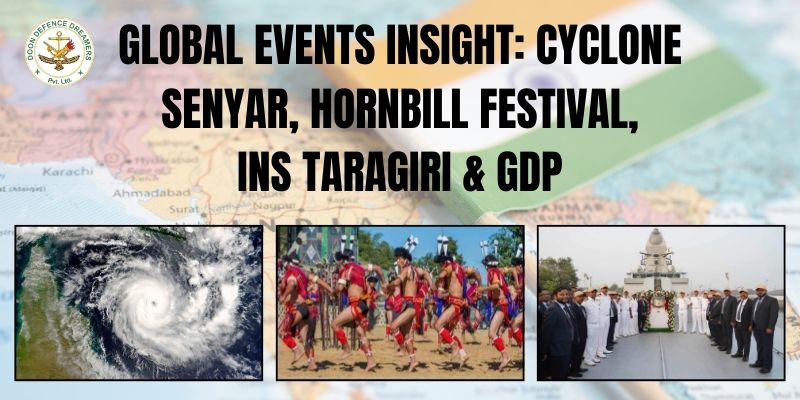
The world today is changing rapidly—sometimes nature shows its fierce face, sometimes culture displays its colourful identity, sometimes the defence sector gains new strength, and sometimes global economic reports shape the direction of the future. A few recent developments—Indonesia’s devastating Cyclone Senyar, Nagaland’s vibrant and colourful Hornbill Festival, the Indian Navy’s modern warship INS Taragiri, and the IMF’s latest GDP report—present a clear picture of these transformations. From nature to culture, from security to the economy, the world is progressing swiftly, and these events highlight this change even more clearly.
In this blog, we will understand all four topics in depth and explore how they affect our present, our thinking, and the future.
Cyclone Senyar: The Complete Story of the Storm That Shook Indonesia
At the end of November 2025, Cyclone Senyar struck Indonesia—a natural disaster that shocked not only the country but the entire world. What made this cyclone extraordinary was the fact that it developed in a region where cyclones almost never form—the Malacca Strait, the narrow sea passage between Indonesia, Malaysia, and Thailand. According to meteorologists, this region rarely experiences wind and sea conditions favourable for cyclone formation, which is why Senyar was called a “rare cyclone.”
How Cyclone Senyar Formed
The storm began on 22 November 2025, when a low-pressure area started developing over the sea. Within days it strengthened rapidly and turned into a tropical depression on 25 November. Conditions worsened so quickly that by 26 November 2025, it became a fully developed cyclone and made landfall on the North Sumatra coast the same day. After landfall, heavy rainfall, extremely strong winds, and storm surges continued for hours, making the situation critical from the very beginning.
A Trail of Destruction: Floods, Landslides and Ruin
The real destructive force of Senyar was its intense rainfall. As soon as it reached Sumatra, rivers overflowed and flash floods hit several districts. North Sumatra, West Sumatra and Aceh were the worst affected. Continuous rainfall weakened the soil, triggering massive landslides. Roads were cut off, bridges collapsed, and many villages were submerged within hours. Houses were destroyed, electricity supply failed, and thousands could not reach safe locations.
Rising Death Toll and Missing Persons
The scenes that emerged after the storm were heartbreaking. By 1 December 2025, official figures confirmed over 600 deaths, while more than 460 people remained missing. Thousands lost their homes, and millions were affected across the region. The situation was extremely challenging for the government and relief agencies as many areas were completely cut off due to floods and landslides.
Challenges in Relief and Rescue Operations
After Senyar, relief operations turned into a massive challenge. The government deployed the army, police, rescue agencies, and even the navy. Helicopters were used to deliver food, medicines, and water to stranded people. Transporting heavy equipment was difficult because many roads were buried under landslides. Still, rescue teams worked relentlessly, day and night, to reach remote areas.
Why Was This Cyclone So Unusual?
Cyclone Senyar was more than a natural disaster—it was a warning sign of climate change. Scientists believe rising sea temperatures are now making even “cyclone-free zones” vulnerable. The warming of the Malacca Strait and unstable atmospheric conditions were major factors behind Senyar’s formation. Additionally, deforestation and human activities that weaken mountains worsened floods and landslides.
Lessons from Cyclone Senyar
Senyar teaches us that nature’s rules are changing. Even regions once considered safe may face danger. Slowing climate change, protecting the environment, and strengthening disaster preparedness are not options anymore—they are necessities. Indonesia’s tragedy reminds the world that weather events may become more unpredictable and dangerous in the future.
Hornbill Festival: The Most Colourful Celebration of Nagaland’s Culture
The Hornbill Festival is the most famous and grand cultural festival of Nagaland, celebrated every year at the beginning of December. It showcases Nagaland’s rich tribal traditions—dance, food, music, and handicrafts. The festival is named after the magnificent Hornbill bird, which is revered in Naga culture as a symbol of honour, courage, and prosperity.
Celebrating Naga Tribal Heritage
A major highlight of the festival is the participation of almost all major Naga tribes—Ao, Konyak, Angami, Sumi, Chakhesang, and others—who present their unique traditions on one platform. Traditional attire, feathered headgear, wooden crafts, bamboo jewellery, and tribal instruments create an atmosphere that feels like stepping back in time. Each tribe narrates its history, folklore, and lifestyle through music and dance.
Dance, Music, and Colourful Performances
Every day features different cultural performances. Drum beats, bamboo flutes, and energetic group dances mesmerise visitors. War dances, hunting dances, and harvest dances—each performance tells a story. Rock music festivals, food festivals, traditional sports competitions, morung (youth house) exhibitions, and local art displays make the event even more exciting.
Unique Food and Handicraft Experience
Visitors enjoy authentic Naga cuisine—smoked meat, bamboo-cooked dishes, the famous Bhut Jolokia chilli, and a variety of traditional drinks. Handicraft stalls featuring bamboo, wood, and clay artworks attract buyers, many of whom take home souvenirs representing Nagaland’s artistic identity.
Kisama Heritage Village — The Heart of the Festival
The entire festival takes place at Kisama Heritage Village, near Kohima. Designed to reflect traditional Naga architecture and lifestyle, it offers tourists a complete cultural immersion.
Why Tourists Love This Festival
The Hornbill Festival is popular because it is more than a cultural event—it is an experience. Visitors are immersed in colours, music, tradition, and natural beauty. It beautifully blends tradition with modernity, showcasing India’s diversity at its best.
INS Taragiri: A Powerful Symbol of India’s Growing Naval Strength
INS Taragiri is one of the Indian Navy’s most modern and technologically advanced warships, built under Project 17A. It is part of the Nilgiri-class frigates designed to enhance India’s new-generation maritime power. Built by Mazagon Dock Shipbuilders Limited (MDL) in Mumbai, its design is based on stealth technology, making it nearly invisible to enemy radar. It stands as a strong pillar of India’s maritime security.
Packed with Modern Technology and Power
INS Taragiri is equipped with advanced maritime warfare technologies. Its stealth hull, sensors, radar, and weapons systems make it a multi-role frigate capable of tracking submarines, striking surface targets, and handling aerial threats. Torpedo tubes, missile systems, and naval gun systems give it long-range striking ability. Its speed, manoeuvrability, and range make it highly effective for long-distance operations.
A Proud Achievement of ‘Make in India’
INS Taragiri reflects India’s growing defence self-reliance. Project 17A warships use over 75% indigenous components and technology. Critical systems like sonar, communication systems, navigation suites, and sensors are produced by Indian industries. This strengthens naval capability while boosting domestic defence manufacturing. Taragiri demonstrates India’s ability to build world-class warships.
Launch and Construction Journey
INS Taragiri was launched on 11 September 2022, and is among the most advanced units of the project. It was built using the modular shipbuilding technique, where different sections are made separately and then assembled. This improves efficiency and reduces construction time. The launch ceremony was a proud moment for the Indian Navy.
Strengthening National Maritime Security
INS Taragiri’s induction is crucial for India’s maritime defence. Security challenges in the Indian Ocean—piracy, intrusions, strategic competition, and disaster relief—are rising. Advanced frigates like Taragiri strengthen India’s blue-water capabilities, enabling it to project power across far seas.
A Bright Future for India’s Naval Power
INS Taragiri will remain a critical asset for the Navy for years to come. Its advanced technology, indigenous construction, and powerful design make it a symbol of India’s growing maritime confidence. As more Project 17A ships join service, India’s Navy will emerge even stronger on the global stage.
IMF’s GDP Report: A Detailed Review of the Global and Indian Economy
Global Outlook: IMF’s World View
In its October 2025 World Economic Outlook (WEO), the IMF revised global real GDP growth for 2025 to 3.2%, slightly higher than its earlier estimate of around 3.0%. However, the IMF warned that rising trade tensions, tariffs, and global uncertainties could slow growth in the coming years.
The IMF notes that the world economy is currently in a state of flux, shaped by political leadership, policy decisions, global trade rules, and financial stability concerns.
IMF on India: Signs of Strong Growth
While global growth appears moderate, India stands out with stronger momentum.
For FY 2025–26, the IMF now estimates India’s GDP growth at 6.6%, higher than its previous projection of 6.4%.
The first quarter (Q1 FY26) recorded 7.8% growth, driven by strong private consumption, investment, and services.
However, the IMF remains cautious and projects 6.2% growth for 2026–27, anticipating that initial momentum may normalise amid global instability and external challenges.
Concerns Over Data Quality
Despite the optimistic outlook, the IMF expressed concerns about India’s national accounts data, giving it a “C-grade”, meaning it is adequate but requires improvement.
The IMF has urged India to strengthen data transparency, statistical systems, and timely reporting to ensure reliability.
Future Challenges and Opportunities
While the growth outlook is positive, sustaining momentum requires policy stability, investment, employment generation, exports, and continued structural reforms.
Global recession risks, trade disruptions, and macroeconomic uncertainties remain key threats.
The IMF advises fiscal discipline, ongoing reforms, and strong international cooperation to manage future challenges.
Why This Report Matters
IMF reports guide policymakers, investors, and the general public.
For a large economy like India, maintaining 6–7% growth supports employment, investment, social development, and better living standards.
However, concerns over data quality and global instability remind us that “numbers” do not always capture the whole reality—caution is essential.
Conclusion: Moving Forward with Balance
The IMF’s 2025–26 report offers hope amid global instability. India’s 6.6% growth rate, strong first quarter, and rising economic activity suggest solid progress.
But the “C-grade” and global headwinds emphasise that sustainable development requires strong policy, transparency, and long-term reforms.
If India navigates these challenges wisely, continues reforms, and remains prepared for external shocks, both the IMF’s optimism and India’s economic future look strong.
Our Recent Blogs
Blood Donation Camp at Doon Defence Dreamers (5ᵗʰ Dec 2025)
Dreamers Edu Hub Sports Fest 2026
Dreamers Edu Hub Scholarship Examination – Rajiv Gandhi Navodaya, Santudhar (Pauri)