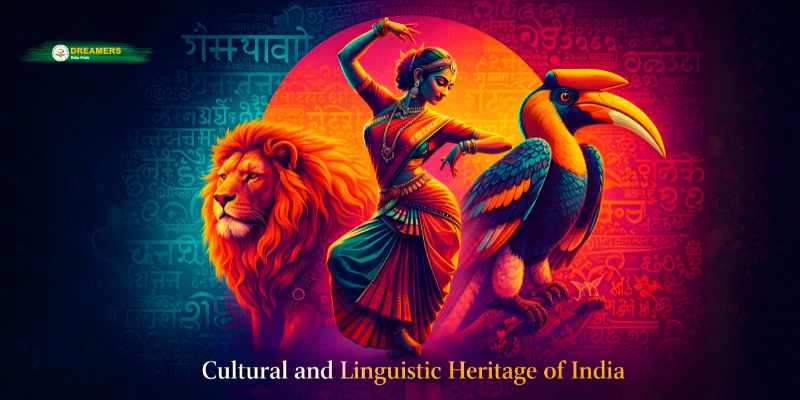
The identity of India on the global map is that of a nation that doesn’t just believe in “Unity in Diversity” but lives it every single day. The strongest foundation of this diversity is the Cultural and Linguistic Heritage of India. This heritage is the result of thousands of years of history, geographical variety, and spiritual consciousness. The cultural fabric of India is expressed through the unique symbols of its states, a rich linguistic history, and the profound grace of classical dance forms. When we discuss the cultural and linguistic heritage of India, we aren’t just looking at the past; we are observing a living tradition that breathes in every corner of the country today.
1. Official Symbols of Indian States and Union Territories: Ecological and Cultural Identity
Each Indian state and Union Territory (UT) possesses its own official symbols, including a state animal, bird, tree, flower, and often a fruit. These are not merely decorative; they represent the specific ecology, biodiversity, and cultural values of that region . Within the Cultural and Linguistic Heritage of India, these symbols prove how closely Indian society is intertwined with nature.
North Indian States and UTs
The symbols of North India reflect the rugged Himalayan peaks and the fertile Indo-Gangetic plains. For example, Himachal Pradesh and Ladakh have chosen the Snow Leopard as their state animal, symbolizing survival in the harshest mountain environments .
| State/UT | State Animal | State Bird | State Tree | State Flower | State Fruit |
| Himachal Pradesh | Snow Leopard | Western Tragopan | Deodar Cedar | Pink Rhododendron | Lal Ambri Apple |
| Punjab | Blackbuck | Northern Goshawk | Sheesham | Gladiolus | Dasheri Mango |
| Haryana | Blackbuck | Black Francolin | Peepal | Lotus | Sapote |
| Uttarakhand | Alpine Musk Deer | Himalayan Monal | Burans | Brahm Kamal | Bayberry |
| Uttar Pradesh | Swamp Deer | Sarus Crane | Ashok | Palash | Banarasi Langra |
| Delhi (NCT) | Nilgai | House Sparrow | Gulmohar | Alfalfa | Dasheri Mango |
| Ladakh | Snow Leopard | Black-necked Crane | Juniper | – | – |
| Jammu & Kashmir | Hangul (Stag) | Kalij Pheasant | Chinar | Common Rhododendron | – |
Central and West India
This region features a mix of dense forests and vast deserts. The Asiatic Lion is found only in Gujarat, making it a unique pride of India’s natural heritage . Rajasthan honors its desert lifestyle by designating the Camel as its state animal alongside the Chinkara .
| State | State Animal | State Bird | State Tree | State Flower | State Fruit |
| Rajasthan | Chinkara/Camel | Great Indian Bustard | Khejri | Rohira | Indian Jujube |
| Gujarat | Asiatic Lion | Greater Flamingo | Banyan | Marigold | Indian Mango |
| Maharashtra | Giant Squirrel | Green Imperial Pigeon | Mango Tree | Jarul | Alphonso Mango |
| Madhya Pradesh | Swamp Deer | Paradise Flycatcher | Banyan | Madonna Lily | Kuttiattoor Mango |
| Chhattisgarh | Wild Buffalo | Hill Myna | Sal | Rhynchostylis gigantea | Sakhua Fruit |
| Goa | Gaur | Ruby-throated Bulbul | Matti | Frangipani | Cashew-Nut |
East and Northeast India
The Northeast is a biodiversity hotspot. The Great Hornbill is so culturally significant in Nagaland that the state hosts the “Hornbill Festival,” known as the “Festival of Festivals” . Manipur’s Sangai (Dancing Deer) is found only on the floating ‘phumdis’ of Loktak Lake, representing a fragile and rare part of India’s heritage .
| State | State Animal | State Bird | State Tree | State Flower | State Fruit |
| Assam | One-horned Rhino | White-winged Wood Duck | Hollong | Foxtail Orchid | Kaji Nemu |
| Arunachal Pradesh | Mithun | Great Hornbill | Hollong | Foxtail Orchid | Himalayan Kiwi |
| Manipur | Sangai | Mrs. Hume’s Pheasant | Toon | Siroi Lily | Pineapple |
| West Bengal | Fishing Cat | White-throated Kingfisher | Chatim Tree | Shephali (Jasmine) | Himsagar Mango |
| Odisha | Sambar Deer | Indian Roller | Indian Fig Tree | Ashoka | Jackfruit |
South India and Islands
The Asian Elephant is the shared state animal of Kerala, Karnataka, and Jharkhand, symbolizing wisdom and strength in the Cultural and Linguistic Heritage of India .
| State/UT | State Animal | State Bird | State Tree | State Flower | State Fruit |
| Karnataka | Asian Elephant | Indian Roller | Sandalwood | Lotus | Badami Mango |
| Kerala | Asian Elephant | Great Hornbill | Coconut | Kanikonna | Jackfruit |
| Tamil Nadu | Nilgiri Tahr | Emerald Dove | Palmyra Palm | Kandhal | Jackfruit |
| Andhra Pradesh | Blackbuck | Indian Roller | Neem | Water Lily | Banganapalle Mango |
| Telangana | Spotted Deer | Indian Roller | Shami | Tanner’s Cassia | Himayat Mango |
| Andaman & Nicobar | Dugong | Wood Pigeon | Andaman Padauk | Pyinma | Andaman Kokum |
2. The 22 Scheduled Languages: A Constitutional Framework for Diversity
Language is the soul of any culture. The Eighth Schedule of the Indian Constitution lists the 22 languages that the government is committed to promoting and preserving. This schedule gives a legal identity to the Cultural and Linguistic Heritage of India, allowing these languages to be used in official communications and competitive examinations.
The List of 22 Scheduled Languages
As per the current constitutional framework, the following 22 languages are officially recognized:
-
Assamese
-
Bengali
-
Bodo
-
Dogri
-
Gujarati
-
Hindi
-
Kannada
-
Kashmiri
-
Konkani
-
Maithili
-
Malayalam
-
Manipuri (Meitei)
-
Marathi
-
Nepali
-
Odia
-
Punjabi
-
Sanskrit
-
Santali
-
Sindhi
-
Tamil
-
Telugu
-
Urdu
Historical Context
In 1950, the Eighth Schedule initially recognized 14 languages. Over time, more were added to reflect the nation’s evolving linguistic consciousness:
-
1967 (21st Amendment): Sindhi was added.
-
1992 (71st Amendment): Konkani, Manipuri (Meitei), and Nepali were included.
-
2003 (92nd Amendment): Bodo, Dogri, Maithili, and Santali were added, bringing the total to 22.
Major Language Families
Indian languages primarily belong to four families, showcasing the complexity of our heritage:
-
Indo-Aryan: Hindi, Bengali, Marathi, Gujarati, Punjabi, Urdu, Sanskrit, etc. These descend from Old Indo-Aryan roots.
-
Dravidian: Tamil, Telugu, Kannada, and Malayalam. These have distinct grammatical structures and ancient literary traditions.
-
Sino-Tibetan: Manipuri and Bodo, representing the unique identity of the Northeast.
-
Austroasiatic: Santali, spoken primarily by tribal communities in Jharkhand and West Bengal.
The Rise of Classical Languages (11 Total)
As of October 2024, the Government of India has conferred “Classical” status on 11 languages. To qualify, a language must have a recorded history of 1,500–2,000 years and an original literary tradition. The latest additions in 2024 include Marathi, Pali, Prakrit, Assamese, and Bengali.
| Classical Language | Recognized Year | Significance |
| Tamil | 2004 |
Oldest surviving literature (Sangam) |
| Sanskrit | 2005 | Root of many Indo-Aryan languages |
| Telugu & Kannada | 2008 |
Millennium-old literary histories |
| Malayalam | 2013 |
Unique linguistic blend of Sanskrit and Tamil |
| Odia | 2014 |
Distinct ancient script and temple inscriptions |
| Marathi | 2024 |
Over 2,500 years of history (Maharastri Prakrit) |
| Pali & Prakrit | 2024 |
Languages of Buddhist and Jain sermons |
| Assamese & Bengali | 2024 |
Rich eastern literary traditions (Charyapada) |
3. Classical Dances of India: Stories in Motion
Indian Classical Dance is the most visual and vibrant form of the Cultural and Linguistic Heritage of India. Rooted in the Natya Shastra (compiled between 200 BCE and 200 CE), these dances are a blend of yoga, spirituality, and storytelling .
The Sangeet Natak Akademi currently recognizes 9 classical dance forms :
-
Bharatanatyam (Tamil Nadu): The oldest surviving dance form, characterized by geometric precision and the ‘Araimandi’ posture. It originated as a temple dance (Sadir) .
-
Kathak (North India): Derived from ‘Katha’ (story). Known for its intricate footwork (Tatkar) and rapid spins (Chakkars). It reflects a unique blend of Hindu and Mughal court influences .
-
Kathakali (Kerala): A stylized “story play” with elaborate makeup and costumes. It dramatizes tales from the Ramayana and Mahabharata using intense facial expressions and hand gestures .
-
Odissi (Odisha): Described as “mobile sculpture,” it mirrors the postures found on temple walls. The ‘Tribhanga’ (three-bend) posture is its hallmark .
-
Kuchipudi (Andhra Pradesh): A dance-drama that involves speech and mime. A famous element is ‘Tarangam,’ where the dancer balances on the rim of a brass plate .
-
Mohiniyattam (Kerala): Named after ‘Mohini,’ the enchantress avatar of Vishnu. It is a graceful, feminine solo dance characterized by gentle, swaying movements .
-
Manipuri (Manipur): Deeply connected to the Vaishnava faith and the ‘Rasleela’ of Radha and Krishna. It features lyrical, soft movements and does not use heavy ankle bells .
-
Sattriya (Assam): Introduced by the saint Srimanta Sankaradeva in the 15th century. It evolved in monasteries (Sattras) as a medium of devotion to Lord Krishna .
-
Chhau (Eastern India): A tribal martial arts dance found in Odisha, Jharkhand, and West Bengal. It uses elaborate masks and depicts episodes from folk legends and epics .
Frequently Asked Questions(FAQs)
1. What is meant by the Cultural and Linguistic Heritage of India?
The Cultural and Linguistic Heritage of India refers to the traditions, languages, arts, symbols, and values that have developed over thousands of years and continue to shape the nation’s identity today.
2. Why are state symbols important in India?
State symbols represent the ecological, cultural, and regional identity of each state and Union Territory, highlighting India’s biodiversity and the close connection between nature and culture.
3. How many languages are officially recognized in India?
India officially recognizes 22 languages under the Eighth Schedule of the Constitution, ensuring their preservation and use in administration, education, and competitive examinations.
4. What are classical languages and how many does India have?
Classical languages are those with ancient origins and rich literary traditions dating back at least 1,500–2,000 years. As of 2024, India has 11 classical languages.
5. How do classical dances reflect India’s cultural heritage?
Indian classical dances combine storytelling, spirituality, music, and movement, preserving ancient traditions and expressing India’s cultural and philosophical depth.
Conclusion: Preserving the Legacy
The Cultural and Linguistic Heritage of India is more than just a historical record; it is the foundation of our future. From the state symbols that remind us of our ecological duties to the 22 languages that give us a voice, and the classical dances that express our spiritual depth—this heritage is a global treasure.
In 2024 and 2025, the recognition of more classical languages and the focus on digital preservation through AI (like Bhashini) ensures that our ancient roots remain relevant in a modern world. Embracing this diversity is what truly makes India a “Vishwa Guru.”