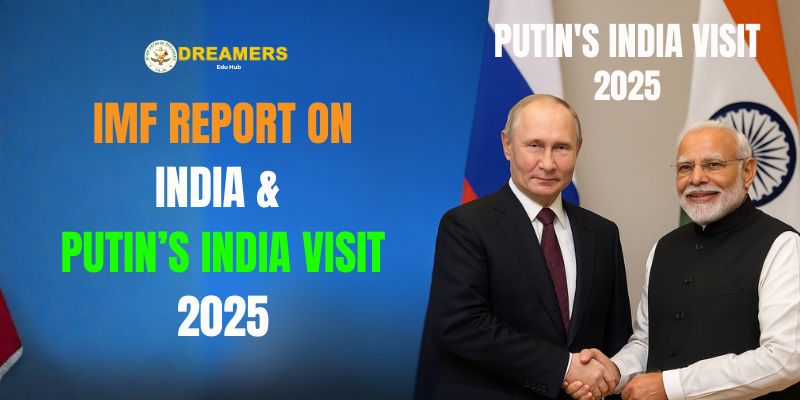
India today stands at a critical intersection of global economics and geopolitics. On one side, the International Monetary Fund (IMF) has released its latest in-depth assessment of India’s economic performance, highlighting strong growth momentum, moderating inflation, structural reforms, and the risks India must navigate in an increasingly volatile global environment. On the other side, Russian President Vladimir Putin’s state visit to New Delhi marks a major diplomatic moment — one that aims to deepen defence cooperation, expand energy and nuclear partnerships, strengthen trade mechanisms, and reaffirm the strategic importance of India-Russia relations in a multipolar world order.
Together, these two developments reveal not only how rapidly India is rising as an economic heavyweight, but also how confidently it is shaping its foreign policy and strategic partnerships. The following detailed analysis presents a comprehensive, research-based look at both topics, explaining their significance, objectives, risks, and long-term implications for India.
IMF report & outlook for India — full, deep explainer
The IMF’s 2025 Article IV consultations and accompanying staff report present a broadly positive view of India’s macroeconomic performance: growth remains robust, inflation has moderated, the financial sector looks resilient, and fiscal consolidation has advanced — yet there are clearly flagged risks (external headwinds such as higher global tariffs and trade tensions, data-quality questions, and the need to rebuild fiscal buffers). The IMF projects India to grow strongly in 2025–26 (around the mid-6% range under baseline scenarios) while urging continued attention to inflation dynamics, fiscal credibility, and structural reforms.
What the IMF actually said — headline findings
Growth and recent performance: The IMF’s Article IV team reports that India’s economy “continued to perform well,” noting real GDP expanded strongly in early FY2025/26 after robust outturns in FY2024/25. Growth projections under the IMF baseline put India’s real GDP at roughly 6.6% for FY2025/26 with a modest moderation afterwards under certain stress scenarios. These numbers reflect resilient domestic demand and services exports.
Inflation and monetary policy: Headline inflation has fallen notably (helped by softer food prices), allowing the Reserve Bank of India to take a data-dependent stance. The IMF broadly supported a cautious, evidence-based approach by the RBI while flagging that food price volatility remains a key upside risk to inflation.
Financial and corporate sector resilience: The IMF highlighted adequate capital buffers across banks and low non-performing assets on a multi-year basis, suggesting the banking system can withstand moderate shocks — though vigilance is still warranted given global uncertainty.
External position and risks: The IMF judged India’s external position to be moderately stronger than fundamentals suggested, with the current account deficit contained but vulnerable to global demand and trade policy shifts (e.g., an assumed prolonged 50% U.S. tariff scenario was modelled as a stress test). The IMF’s baseline and downside scenarios illustrate how external headwinds would moderate—but not collapse—growth.
Data quality note: The IMF’s consultations flagged issues around statistical base years and national accounts methodology (a “C” grade on certain national accounts practices was widely debated in India), while explicitly not disputing the headline GDP growth trajectory. The IMF recommended continued statistical improvements to enhance credibility and policy calibration.
Detailed analysis — why the IMF view matters for markets and policy
1. Growth drivers and composition
India’s growth in 2024–25 and early 2025/26 has been led by domestic demand—private consumption and investment—supported by public capital spending and resilient services exports. This composition matters because it means growth is less dependent on weak global merchandise trade; however, services are not immune to global slowdowns, and export channels can tighten if trade frictions escalate. Continued investment, especially in infrastructure, and private consumption resilience underpin the IMF’s relatively optimistic baseline.
2. Inflation and monetary policy implications
With headline inflation moderating, the RBI has flexibility to remain data-driven. The IMF’s endorsement of a measured approach reduces the chance of policy overreaction, but it also warns that shocks—particularly to food supplies or energy prices—could prompt a re-tightening. For markets, this dynamic means the interest-rate path remains conditional on incoming data, fiscal impulses, and imported inflation pressures.
3. Fiscal stance and medium-term credibility
The IMF notes fiscal consolidation has advanced but advises rebuilding buffers to improve resilience to external shocks. India’s fiscal trajectory will be watched closely by markets (bond yields, credit ratings) and by multilateral partners; higher capital spending is desirable for productivity, but it must be balanced with credible medium-term consolidation plans. The IMF’s advice—strengthen tax administration, broaden the revenue base, and target subsidies—is standard but important.
4. External vulnerabilities and trade policy
The IMF modeled scenarios that include elevated U.S. tariffs; even under prolonged tariff stress, India’s growth remains positive but reduced—showing some insulation from global shocks thanks to domestic demand. Nevertheless, persistent protectionism among trading partners could erode export growth and weigh on the current account. This is one of the principal external risks the IMF flagged.
5. Structural and longer-term reforms
The IMF reiterates the need for supply-side reforms—labour, land, climate-adaptation investments, and measures to boost formalization and productivity. Investment in human capital and institutional credibility (statistics, governance) is central to turning cyclical growth into sustained potential growth. The IMF’s medium-term forecasts assume reforms continue, and their absence would reduce potential growth.
Policy implications : what should Indian policymakers prioritize?
Maintain data credibility: Accelerate statistical improvements (update base years, metadata transparency) so markets and policymakers can better assess the economy. The IMF explicitly recommended this.
Rebuild fiscal buffers gradually: Sustain public capital spending for growth while setting out credible medium-term consolidation measures.
Monetary policy prudence: Keep policy data-driven; be ready to respond to food-price spikes and imported inflation.
Export diversification & de-risking: Prepare contingency plans for trade-policy shocks and keep pushing for higher value-added exports.
Structural reforms: Focus on labour reforms, increased private investment, and upgrading human capital to raise long-term potential.
Bottom line
The IMF sees India as a bright spot amid global sluggishness: robust near-term growth, falling inflation, and a resilient financial sector. But that optimism is conditional — on credible fiscal consolidation, better statistical practices, and managing external headwinds such as protectionism. The policy challenge is to lock short-term gains into sustained, inclusive growth.
Putin’s visit to India (Dec 2025) — objectives, agenda and likely outcomes
President Vladimir Putin’s December 2025 visit to New Delhi—framed as the 23rd India-Russia Annual Summit—focuses heavily on defence cooperation (S-400, Su-57, joint manufacturing and logistics support), energy and nuclear collaboration (including Small Modular Reactors and Kudankulam progress), trade and payments (mechanisms to sustain bilateral trade amid sanctions), and deepening industrial partnerships (joint manufacturing, technology transfer, BrahMos-style projects). The visit is taking place amid a tightening strategic partnership geared to operationalise defence logistics (RELOS ratification), expand energy ties, and boost bilateral trade targets—while India navigates Western pressure and sanctions on Russia.
Why this visit matters now
Geopolitical context: This is one of the first high-level Russian state visits to India since Russia’s large-scale geopolitical frictions (including the Ukraine war and associated sanctions). The visit signals Russia’s desire to maintain and deepen ties with India despite Western pressure, and India’s continuation of an autonomous foreign policy balancing multiple partners.
Economic momentum: Trade between the two countries has surged in recent years (Bilateral trade reached record highs—estimates report around $68.7 billion for FY2024–25—with targets to reach $100 billion by 2030), driven largely by energy imports from Russia and growing industrial cooperation. Formalising payment, banking and logistical pathways is therefore a priority.
Core objectives likely on the agenda
1. Defence cooperation and industrialisation (top priority)
S-400 and other air-defence systems: Russia and India are expected to discuss additional S-400 systems and operational details; defence ties remain the backbone of bilateral relations.
Su-57 fighter and co-production: Russian officials have signalled Su-57 discussions and potential offers of joint production or technology cooperation—though any transfer of cutting-edge tech would be politically and technically complex.
Joint manufacturing and logistics: Ahead of the visit, the Russian State Duma ratified the RELOS (Reciprocal Exchange of Logistics Support) pact enabling mutual use of bases, port calls, and logistical support—this is a concrete enabler for deeper defence interoperability and joint exercises. Ratification just before the summit strongly suggests defence logistics and co-production will be firm items.
2. Energy, oil and nuclear cooperation
Oil and gas trade mechanisms: Managing payments and supply chains under sanctions has driven innovation in practical workarounds and closer energy ties; continued Indian purchases of Russian crude aid energy security and affordability goals.
Civil nuclear cooperation and SMRs (Small Modular Reactors): Russia wants to expand cooperation beyond the existing Kudankulam units; SMRs are on the table as a long-term partnership area in civilian nuclear energy and technology sharing.
3. Trade facilitation & payments architecture
Non-dollar mechanisms and banking ties: Both sides will press to operationalise payment mechanisms that mitigate sanctions risk and ensure uninterrupted trade flow—central bank and commercial banking talks are likely to be an ongoing strand in negotiations. The opening of a Russian central bank office in Mumbai is circumstantial evidence of this push.
4. Technology, space, and industrial cooperation
High-tech co-production, RAM, and BrahMos: The successful BrahMos joint venture is repeatedly cited as a template for collaboration; expansion into aircraft manufacturing, mining, pharmaceuticals, and critical industrial sectors is likely to be tabled. Space and nuclear cooperation—longstanding pillars—will be revisited with a view to deepen joint projects.
5. Labour mobility and people-to-people links
Skilled worker mobility pacts: Russia has indicated a willingness to discuss labour mobility agreements for skilled workers and professionals—both to fill gaps and to boost industrial projects where Indian talent is sought.
Likely outcomes and deliverables (realistic expectations)
Agreements and MoUs but not transformational surprises: Expect concrete MOUs, project-level contracts, and ratification steps (e.g., RELOS ratification was timed just before the visit) rather than an entirely new strategic alliance.
Defence deals and co-production roadmaps: While large new platform procurements are possible, the more durable outcome is likely to be roadmaps for joint production, technology transfer frameworks for selected systems (e.g., BrahMos-style projects, upgrades to existing fleets).
Energy & nuclear cooperation declarations: A clear statement on expanding energy ties (crude, refined products, and nuclear collaboration including SMRs) with timelines for joint projects.
Institutional steps on trade/payments: Further operational steps to shield bilateral trade from sanctions spillovers—technical talks between central banks, payment-mechanism pilots, and enhanced merchant-bank coordination.
Strategic and diplomatic implications
India’s strategic autonomy: India demonstrates an ability to pursue independent partnerships even when partners are under Western pressure; this visit underscores India’s multi-aligned foreign policy.
Regional balancing in the Indo-Pacific: Enhanced India-Russia defence interoperability and logistics support (RELOS) potentially affects naval/air operations and presence in the Indian Ocean Region—this will be watched closely by other regional powers.
Sanctions navigation: Russia will continue to seek ways to stabilise trade flows despite sanctions; India benefits from energy and defence cooperation but must balance broader geopolitical implications with partners in the West.
Risks and sticking points
Technology transfer sensitivity: Offers of advanced systems (Su-57, S-500 components) come with export-control complexities and political sensitivities—any transfer will be gradual and limited.
Sanctions contagion risk: Deepening financial ties risks secondary sanctions or pressure from countries imposing restrictions on Russia—India will need careful legal and banking workarounds.
Domestic political optics: India must manage domestic and international perceptions around expanding defence ties with Russia while also deepening ties with Western democracies.
Bottom line
Putin’s December 2025 visit is a pragmatic summit focused on operationalising long-running strategic ties: defence industrialisation and logistics (RELOS), energy and nuclear cooperation (including SMRs), trade and payments resilience, and a push for wider industrial partnerships. Expect a mix of ceremonial summitry and substantive MOUs/roadmaps—not radical policy shifts but meaningful deepening of a long-term relationship that both sides view as strategically important.
Sources & key citations (most load-bearing)
IMF press release — IMF Executive Board Concludes 2025 Article IV Consultation with India (IMF).
IMF Country Report PDF — India: Country Report No. 25/54 (IMF detailed staff analysis).
Reuters coverage of India GDP and IMF projections.
Sputnik/other coverage summarising summit agenda (defence, S-400, Su-57, nuclear).
Outlook/Sputnik reporting on RELOS ratification and defence agenda ahead of Putin’s visit.
Conclusion
Viewed together, the IMF’s economic evaluation and President Putin’s India visit illustrate the dual engines driving India’s rise — economic strength and strategic autonomy. The IMF acknowledges India as one of the fastest-growing major economies, supported by resilient domestic demand, improved financial stability, and a forward-looking reform agenda. At the same time, it underscores the importance of credible data, fiscal discipline, and continued structural reforms to ensure sustainable long-term growth.
Meanwhile, the India-Russia summit highlights New Delhi’s ability to maintain an independent and multi-aligned foreign policy. Defence industrial partnerships, nuclear cooperation, energy security, and alternative trade-payment systems all point to a future where India continues to diversify its geopolitical options without compromising its strategic interests.
Together, these events show that India is no longer just responding to global changes — it is actively shaping them. As the world becomes more fragmented and uncertain, India’s challenge will be to balance domestic economic priorities with strategic international partnerships. If managed well, this moment could define India’s trajectory as a leading global power for decades to come.
Our Recent Blog
भारत के प्रमुख विकास 2024–25: राष्ट्रीय स्तर पर अपडेट
भारत डिफेंस सिविक 2025: गरुड़, मालाबार और राष्ट्रीय शक्ति
वैश्विक घटनाएँ: Cyclone Senyar, Festival, INS Taragiri & GDP