The world is changing—and these events are shaping its future
Sometimes technology revolutionizes governance, sometimes space research touches new heights, and sometimes global energy dialogues define the fuel of the future.
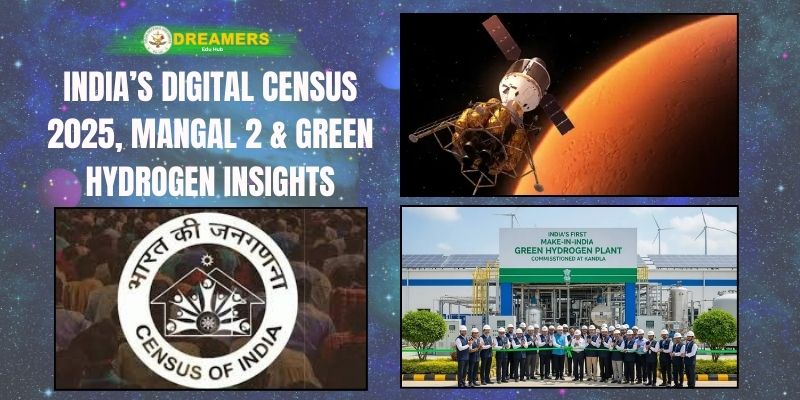
India’s first Digital Census in 2025, ISRO’s preparations for Mangal Mission 2, and the International Green Hydrogen Conference 2025—these three events show that change is coming from every direction—governance, science, and energy—all turning toward the future.
First Digital Census 2025: The beginning of India’s data revolution
India’s 2025 census is not just a survey—it is India’s first 100% digital census.
For the first time in the country’s history, data for such a massive population will be collected using mobile tablets, cloud servers, and AI-based central systems.
Why is Digital Census 2025 important?
Because India is the world’s largest democracy—and in such a large nation, the census decides:
-
How many schools should be built in a region
-
Where hospitals are required
-
How much road, electricity, and water infrastructure is needed
-
Distribution of funds to states
-
Budget for welfare schemes
For the first time, all these decisions will be based on real-time data.
How will this digital census be conducted?
Government officials will be equipped with smart tablets/handheld devices containing a special Census App.
Through this:
-
Door-to-door data will be recorded
-
Identity verification like Aadhaar will be available
-
Data will be uploaded instantly to the cloud
-
Errors can be corrected immediately
-
Data duplication will almost end
Data security—everyone’s biggest concern
This will be one of India’s largest digital operations.
Therefore, the government has used:
-
End-to-end encryption
-
Secure cloud architecture
-
Identity masking
-
Zero-trust cybersecurity
to ensure citizens’ data remains safe.
India’s major advantage
Digital Census will lead India towards:
-
Smart governance
-
Accurate planning
-
Targeted welfare schemes
-
Transparent budgeting
-
AI-driven policy making
This census is giving India’s administration a next-generation character—fast, accurate, and digital.
Mangalyaan 2 Mission : India’s next Mars mission—when will it launch?
ISRO’s first Mars mission—Mangalyaan (MOM-1)—will always be remembered in history.
India was the first country to reach Mars orbit successfully on a low budget.
Now the world’s eyes are on—Mangal Mission 2 (MOM-2).
Although ISRO has not officially announced its launch date yet, scientists and space analysts believe that the mission is likely to take place in the early 2030s.
What will be new in Mangal Mission 2?
This mission will be far more advanced and scientifically enriched compared to the first one.
Possible major features:
1. High-resolution Surface Mapping
3D mapping of Mars’ surface to better understand mountains, valleys, ice layers, and geological patterns.
2. Better orbit, more advanced scientific instruments
Possible instruments include:
-
Mars plasma analyzer
-
Advanced methane detector
-
Subsurface radar
-
Mineralogical spectrometer
These will provide more accurate exploration of water, gases, and signs of life on Mars.
3. Possibly a Lander or Orbiter + Small Rover (Hybrid Mission)
Experts believe MOM-2 may not be just an orbiter; instead, it could be a complex mission involving:
-
An orbiter
-
A micro-lander
-
Possibly nanosat rovers
This would make it India’s most advanced Mars mission to date.
When will it launch?
Launch windows for Mars missions open every 26 months.
Possible windows:
-
2026 (too early – unlikely)
-
2028
-
2031 (most likely)
-
2033
Experts consider 2031 the most suitable because:
-
ISRO’s new rocket (NGLV) will be more mature
-
Scientific instrument design will be ready
-
Funding and payload preparation will be completed on time
Importance of Mangal Mission 2 for India
This mission will strengthen India’s position in deep space exploration and will help develop technologies in:
-
Planetary research
-
Interplanetary communication
-
Radiation shielding
-
Autonomous navigation
-
Ultra-light spacecraft design
For ISRO, this will be the next giant leap.
International Green Hydrogen Conference 2025: Hydrogen is the fuel of the future
The International Green Hydrogen Conference 2025 (hosted under India’s leadership) is considered one of the most important global energy meetings.
This conference is a major step in shifting the world from fossil fuels to hydrogen-based energy.
Why is Green Hydrogen so important?
Because it is:
-
100% clean
-
Zero-carbon emission
-
Easily storable
-
Useful in heavy industries
-
A game changer in transportation, steel, and fertilizer sectors
Key objectives of the 2025 conference:
-
Reduce hydrogen production cost
-
Increase electrolyzer manufacturing
-
Establish global hydrogen standards
-
Develop storage and transport technologies
-
Build energy partnerships between major countries
Who will participate?
-
India
-
European Union
-
Japan
-
South Korea
-
Australia
-
USA
-
Middle Eastern energy-producing nations
Overall, participation from 35+ countries is expected.
India’s major role
India aims to:
-
Produce 5 million tonnes of green hydrogen by 2030
-
Become the world’s largest electrolyzer manufacturing hub
-
Use solar and wind energy for hydrogen production
For India, this conference is not just a global event—it is a step toward Energy Superpower India.
Key discussions expected in the conference
-
Hydrogen-powered heavy trucks
-
Decarbonisation of steel plants
-
Ammonia (NH3)-based energy transport
-
Hydrogen pipelines
-
International hydrogen trading platform
These discussions can completely transform the world’s energy landscape.
Conclusion: Technology, science, and energy—all entering a new era
-
Digital Census 2025 will make Indian governance modern and data-driven.
-
Mangal Mission 2 will strengthen India’s position among leading deep-space nations.
-
Green Hydrogen Conference 2025 will help shift the world from fossil fuels to clean energy.
All three events show—
The world is changing, and India is at the center of this change.
Our Recent Blogs
Blood Donation Camp at Doon Defence Dreamers (5ᵗʰ Dec 2025)
Dreamers Edu Hub Sports Fest 2026
Dreamers Edu Hub Scholarship Examination – Rajiv Gandhi Navodaya, Santudhar (Pauri)