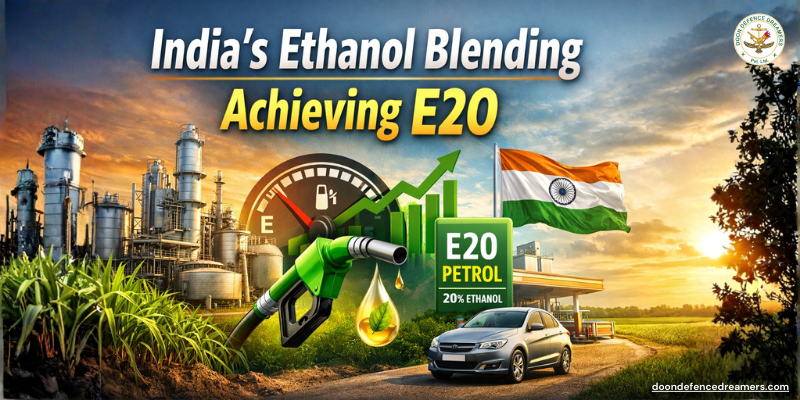
India’s Ethanol Blending has moved from a small pilot idea to a nationwide fuel transition that is changing how petrol is produced, priced, and consumed. In simple words, ethanol blending means mixing a fixed percentage of ethanol (a renewable alcohol fuel made from plant-based materials) with petrol to reduce crude-oil dependence, support farmers, and cut harmful tailpipe emissions.
The headline achievement is the shift toward E20—petrol containing 20% ethanol. This blog explains kab (when), kaise (how), kyu (why), kisne (who)—with a clear timeline, policy decisions, supply-chain steps, and what the E20 milestone actually means for India.
Why ethanol blending mattered
India imports a large share of its crude oil, so every global price spike impacts the national economy. India’s Ethanol Blending helps replace a part of petrol with domestically produced renewable fuel, improving energy security and saving foreign exchange.
Ethanol also has oxygen content, which can support cleaner combustion and reduce some pollutants. For farmers and the rural economy, India’s Ethanol Blending creates stable demand for crops and crop-based by-products, turning “surplus” agricultural output into a valuable product.
What exactly is E20?
E20 refers to petrol blended with 20% ethanol by volume. When you hear E20 petrol in India, it means oil marketing companies are supplying petrol that contains one part ethanol for every four parts petrol. E20 petrol in India is not “pure ethanol”; it is regular motor spirit that meets fuel-quality standards but has a higher ethanol fraction than older blends such as E5 or E10.
E20 petrol in India is being rolled out in a way that balances supply readiness, vehicle compatibility, and retail infrastructure—because changing a nationwide fuel mix is not just a policy decision; it’s a logistics and standards challenge too.
The big timeline: from pilots to national scale
India’s Ethanol Blending began as a policy experiment and later became a national mission.
Phase 1: The early start (2003 and after)
The Ethanol Blended Petrol (EBP) Programme was launched in 2003 as a pilot in select states with a 5% blending ambition. Progress was uneven in the early years due to supply constraints, pricing issues, and limited production capacity.
Phase 2: Stronger push and policy certainty (post-2014)
The momentum accelerated after 2014 with repeated policy adjustments on pricing, procurement, and feedstock flexibility. The National Policy on Biofuels (2018) gave ethanol a clearer long-term role, and later policy changes advanced the 20% blending target to an earlier timeline.
Phase 3: Hitting E10 and moving fast toward E20 (2022 onwards)
A big milestone came in June 2022, when public sector oil marketing companies achieved the national E10 target (10% blending) ahead of schedule. After that, India’s Ethanol Blending rose sharply year-on-year, building confidence that the 20% level was realistic.
Phase 4: E20 rollout and milestone (2023–2025)
The roadmap recommended phased launch of E20 from April 2023, with broad availability by 2025. As supply chains strengthened, E20 petrol in India moved from “selected outlets” to wider coverage, supported by depot upgrades and retail rollout.
Today, E20 petrol in India is becoming the default choice at many retail outlets as supply networks mature.
who made it happen (roles and responsibility)
India’s Ethanol Blending is not a single-department project; it is a coordinated system transition.
1) Government ministries and policy bodies
Ministry of Petroleum and Natural Gas (MoPNG): nodal ministry for EBP programme; coordinates rollout through OMCs.
NITI Aayog: prepared the 2020–25 roadmap that guided phased E20 introduction and transition planning.
National Policy on Biofuels framework: enabled faster targets, feedstock flexibility, and expansion confidence.
2) Oil Marketing Companies (OMCs)
Public sector OMCs (like IndianOil, BPCL, HPCL) procure ethanol, blend it at depots, and distribute blended petrol to retail stations. Without this operational backbone, India’s Ethanol Blending could not scale.
3) Ethanol producers
Sugar mills, grain-based distilleries, and emerging 2G ethanol projects produce fuel-grade ethanol. These producers expanded capacity because procurement became more predictable.
4) Automakers and standards ecosystem
Vehicle compatibility and fuel specifications matter. Automakers gradually introduced E20-ready components, while standards and testing ensure fuel quality for safe use.
how the ethanol supply chain works (step-by-step)
To understand India’s Ethanol Blending, see the “field-to-fuel-tank” chain:
Step 1: Feedstock selection
Traditionally, sugarcane molasses and sugarcane juice were major sources. Over time, allowable feedstocks expanded to include certain grains (like maize, surplus/damaged grains where permitted) and push toward residue-based (2G) ethanol—important for long-term sustainability.
Step 2: Production in distilleries
Ethanol is produced through fermentation and distillation. Plants must meet fuel-grade specifications, which requires quality testing and compliant processes.
Step 3: Procurement and pricing
OMCs buy ethanol through structured procurement. Pricing varies by feedstock and is designed to provide predictable returns. This predictable offtake is one of the biggest reasons the ethanol blending mission accelerated.
Step 4: Transport, storage, and blending
Ethanol is transported to OMC depots, stored in dedicated tanks, blended with petrol to meet E10/E20 specifications, and then sent to retail outlets. Because long-distance movement can be costly and complex, building capacity closer to demand centers is important.
Policy levers that made the jump possible
India’s Ethanol Blending did not rise on its own; it rose because several policy levers worked together.
1) Clear targets + time-bound roadmap
The shift from uncertain blending to a target-driven mission created confidence across the supply chain. Once the path to E20 was clearly signaled, investment decisions became easier.
2) Predictable procurement
Regular procurement cycles and periodic pricing revisions improved stability. Producers could plan expansions because demand looked assured.
3) Feedstock diversification
Allowing multiple feedstocks reduces dependence on a single crop and helps manage seasonal variability. Feedstock flexibility is one of the strongest structural supports behind India’s Ethanol Blending.
4) Infrastructure upgrades
Depots needed ethanol-compatible tanks, blending facilities, and stronger testing. Retail stations needed signage, operational readiness, and consistent product supply so E20 petrol in India could be sold reliably.
5) Communication and standards
A nationwide transition naturally creates rumours—engine damage, mileage collapse, etc. Policy clarifications, standards, and OEM guidance helped keep the transition steady.
Economic impact in simple words
Even without complex equations, the story is straightforward:
Domestic ethanol replaces some imported petrol.
Import bills reduce (especially when oil prices are high).
Rural and industrial activity increases (distilleries, logistics, labs).
Farmers and agro-industry get more stable demand.
Over time, if advanced (2G) ethanol grows, India’s Ethanol Blending can also create economic value from crop residues—supporting waste management and cleaner air.
Vehicle and consumer readiness: is E20 safe?
People often ask whether E20 petrol in India is safe for vehicles. Ethanol is a solvent and absorbs moisture, so higher blends can require compatible rubber, plastics, and metal components in fuel systems. India’s transition strategy focuses on:
Phased rollout: scaling up step-by-step.
Transition fuel availability: allowing older vehicles time to adjust (and ensuring suitable options).
E20-compliant vehicles: newer models increasingly support E20.
Retail readiness: station rollout with proper labeling.
What consumers should do
If you see E20 petrol in India at a fuel station, check your vehicle manual or manufacturer guidance for the recommended ethanol blend limit. Many newer vehicles are designed to be E20-compatible, while older vehicles may be advised to use lower blends where available. Regular maintenance (fuel lines, filters) also helps.
What “achievement” really means
India’s Ethanol Blending reaching the 20% mark is a big achievement because it required multiple things to happen together:
Enough ethanol production capacity
Reliable procurement and logistics
Depot blending infrastructure
Quality testing and standards
Retail distribution at scale
Vehicle readiness and consumer acceptance
This is why E20 is not just a number—it is a national capability.
Key benefits of India’s ethanol blending journey
1) Energy security and foreign exchange savings
Replacing part of petrol with domestic ethanol reduces dependence on crude oil imports and improves national energy resilience.
2) Cleaner emissions profile
Ethanol can support cleaner combustion for certain pollutants. While outcomes vary by vehicle type and conditions, E20 petrol in India is widely positioned as a step toward improving air-quality outcomes.
3) Farmer income and rural jobs
By creating a consistent market for sugarcane by-products and surplus grains, India’s Ethanol Blending supports farmers, sugar mills, and rural industry—along with jobs in distilleries, logistics, and testing.
4) Industrial growth and innovation
Bio-refineries, fermentation tech, enzymes, and 2G ethanol projects benefit from scaling. This strengthens domestic manufacturing and clean-fuel capability.
5) Climate and sustainability alignment
When produced responsibly with better feedstock planning and efficient resource use, ethanol lowers the fossil-carbon intensity of transport fuels.
Challenges and concerns (and how India is addressing them)
Mileage concerns
Ethanol has lower energy content per litre than petrol. Some vehicles may see a small drop in fuel economy with higher blends. The real impact depends on vehicle design and tuning.
Older vehicle compatibility
Older vehicles may not be designed for higher ethanol blends. That’s why phased rollout, OEM guidance, and transition planning are important.
Water and land use
Sugarcane can be water-intensive. Long-term success depends on stronger feedstock diversification (including grains and residues), better irrigation practices, and scaling 2G ethanol.
Cost stability
Ethanol procurement costs can change based on feedstock and supply conditions. Pricing frameworks and supply planning aim to balance farmer returns with fuel affordability.
Regional supply gaps
Some regions need more local distillation capacity to reduce transport challenges and improve supply reliability for E20 petrol in India.
What happens next after E20?
Reaching 20% does not end the journey. The next phase focuses on stability, sustainability, and consumer confidence:
Ensuring consistent supply across all regions and seasons
Strengthening feedstock sustainability (water-smart crops, residue use, better planning)
Expanding 2G ethanol to reduce food-fuel concerns
Upgrading storage/testing infrastructure to reduce moisture contamination risks
Exploring flex-fuel readiness where feasible, while keeping costs practical
(one section, simple)
(When): EBP started in 2003; national push strengthened after 2014; E10 target achieved in June 2022; E20 rollout planned from 2023 with wide availability by 2025; the 20% milestone was reported as achieved in 2025.
(How): capacity expansion + feedstock diversification + assured procurement + depot/retail infrastructure + standards and vehicle readiness.
(Why): reduce crude imports, boost energy security, support farmers/rural economy, and improve emissions intensity.
(Who): MoPNG + OMCs operationalized; NITI Aayog roadmap guided; biofuel policy enabled; ethanol producers supplied; automakers improved compatibility; consumers adopted E20 petrol in India at fuel stations.
Conclusion
India’s Ethanol Blending has become a practical example of how policy plus execution can transform an entire fuel market. The shift to E20 petrol in India reflects coordinated planning across production, pricing, infrastructure, standards, and consumer rollout.
The real win is not only reaching a blending percentage, but maintaining it responsibly—without stressing water resources, without creating instability in food systems, and while keeping vehicles safe and fuel affordable. If India keeps improving feedstock diversity and expands advanced ethanol pathways, the E20 milestone can be a foundation for an even cleaner and more resilient transport-fuel future.
About Doon Defence Dreamers
Doon Defence Dreamers is a reputed defence coaching institute dedicated to shaping future officers of the Indian Armed Forces. Located in the heart of Dehradun, the institute is widely recognised as the Best NDA Coaching in Dehradun for its disciplined environment and result-oriented teaching approach. With experienced faculty and a structured curriculum, Doon Defence Dreamers ensures strong conceptual clarity and exam-focused preparation.
The academy also stands out as the Best CDS Coaching institute in Dehardun, offering specialised guidance for written exams and SSB interviews. Regular tests, doubt sessions, and personality development programs help students build confidence and competence. The institute focuses on overall development, including physical fitness, leadership skills, and communication. Doon Defence Dreamers continues to inspire and guide defence aspirants towards achieving their dreams with dedication and excellence