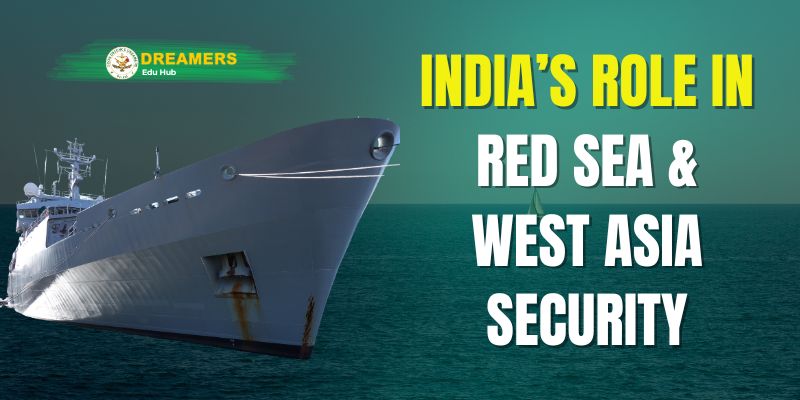
The dynamic and often volatile region of West Asia, encompassing the Red Sea and the Gulf, holds irreplaceable strategic value for India. Far from being a distant foreign policy concern, the security and stability of this extended neighborhood are inextricably linked to India’s domestic economic health, energy supplies, and the well-being of millions of its citizens. As geopolitical shifts, maritime threats, and great power competition intensify, India’s Role in Red Sea & West Asia Security has evolved from passive diplomacy to proactive engagement, establishing India as a serious and stabilizing regional player. The nation’s commitment is driven by deep economic necessity and a long-term vision of becoming a net security provider in the Indian Ocean Region.
I. The Core Geostrategic Compulsion: Why West Asia Matters to India?
India’s security calculus begins in West Asia. The region is not merely a source of oil and a market for goods; it is the geographical backbone of India’s economic superpower aspirations. Any disruption here causes immediate and severe ripple effects across the Indian economy, demanding a consistent and robust diplomatic and military presence.
A. Energy Security and Choke Points
India’s massive and rapidly growing economy relies heavily on imported hydrocarbons, making energy security paramount. The Persian Gulf nations are the primary suppliers of crude oil and natural gas, and the supply chain relies entirely on vulnerable maritime chokepoints.
-
A significant portion of India’s crude oil imports, around 60%, transits through the Strait of Hormuz, connecting the Persian Gulf to the Arabian Sea.
-
The Bab el-Mandeb Strait at the southern entrance to the Red Sea is equally critical, serving as the gateway to the Suez Canal and the primary route for India’s trade with Europe, North America, and parts of Africa.
-
Any closure or increased security risk at these two chokepoints—Hormuz and Bab el-Mandeb—can lead to immediate spikes in oil prices, crippling the Indian economy and fueling inflation.
B. Economic Lifelines and Diaspora
Beyond energy, West Asia is India’s largest trading partner bloc, with bilateral trade figures soaring into the hundreds of billions of dollars annually. The stability of the region is essential for sustaining this massive volume of commerce.
-
The Indian diaspora in the Gulf Cooperation Council (GCC) states is estimated to be over 8.5 million strong, forming the largest expatriate community in the region.
-
These workers are a demographic treasure, sending back staggering amounts of remittances, which constitute a vital stream of foreign exchange for India.
-
The safety and employment stability of this large diaspora—from the UAE to Saudi Arabia—represent a direct security responsibility for the Indian government. Protecting their interests is a non-negotiable component of India’s Role in Red Sea & West Asia Security.
II. Proactive Maritime Stewardship in the Red Sea
In response to rising maritime threats—from piracy off Somalia to recent hostilities in the Red Sea—India has shed its traditionally cautious naval posture. It now actively positions itself as the “First Responder” and “Net Security Provider” in the wider Indian Ocean.
A. Operation Sankalp and SAGAR Doctrine
India’s naval deployments are guided by the SAGAR (Security and Growth for All in the Region) doctrine, launched in 2015, which focuses on enhancing maritime capacity, cooperation, and collective security across the Indian Ocean Region (IOR).
-
Operation Sankalp, initiated by the Indian Navy, is the tangible commitment under the SAGAR framework, involving continuous deployment of warships to safeguard Indian-flagged merchant vessels.
-
The operation was re-energized during the Red Sea crisis, with multiple frontline destroyers and frigates deployed to the Gulf of Aden and the Red Sea to ensure the security of vital Sea Lines of Communication (SLOCs).
-
This constant naval presence underlines India’s operational capability and its serious commitment to India’s Role in Red Sea & West Asia Security, demonstrating its resolve to protect its commercial interests autonomously.
B. Anti-Piracy and Humanitarian Assistance
India’s naval ships consistently operate in the volatile Gulf of Aden, participating in international anti-piracy efforts. The Indian Navy has successfully intercepted numerous pirate attacks, rescued both Indian and foreign-flagged vessels, and apprehended the culprits.
-
This commitment extends to providing Humanitarian Assistance and Disaster Relief (HADR), cementing India’s reputation as a reliable and non-intrusive partner in the IOR.
-
The Navy’s prompt response to security incidents has often placed it in the role of the de facto regional stabilizer, earning diplomatic goodwill and trust from coastal nations and major global trading partners.
III. The Connectivity Matrix: Alternative and Strategic Routes
Security is not just about warships; it is fundamentally about resilient economic connectivity. India is actively investing in and promoting alternative trade corridors to mitigate the risks associated with existing chokepoints and to project its economic influence deep into Eurasia.
A. Chabahar Port and INSTC
The development of the Shahid Beheshti Terminal at Iran’s Chabahar Port represents India’s most significant strategic connectivity investment in the region. Its location outside the Strait of Hormuz is key.
-
Chabahar provides India with a direct, reliable, and secure alternative access route to Afghanistan and Central Asia, bypassing the geopolitical hurdles presented by Pakistan.
-
The port is the linchpin of the International North-South Transport Corridor (INSTC), a 7,200 km multi-modal network of ship, rail, and road routes designed to move cargo between India, Iran, Azerbaijan, Russia, and Europe.
-
INSTC drastically cuts down transit time and costs, enhancing the trade viability of this corridor and firmly establishing India’s Role in Red Sea & West Asia Security through infrastructure projection.
B. IMEC Corridor and Multi-Alignment
The unveiling of the India-Middle East-Europe Economic Corridor (IMEC) during the G20 Summit in 2023 marked a significant geopolitical pivot. This ambitious project aims to connect India to Europe via the UAE, Saudi Arabia, Jordan, and Israel through a combination of rail and sea routes.
-
IMEC is a powerful symbol of multi-alignment, bringing together traditional rivals (Israel and Gulf States) with India and major Western powers (US and Europe) on a shared economic platform.
-
It offers a direct economic counterweight to other major infrastructure projects in the region, showcasing India’s ability to forge strategic partnerships in alignment with its economic interests.
-
The existence of both INSTC and IMEC demonstrates a deliberate strategy of diversifying risk, ensuring India’s external trade is never reliant on a single, vulnerable corridor.
IV. Diplomacy of Strategic Autonomy: Balancing Regional Powers
Perhaps the most complex aspect of India’s Role in Red Sea & West Asia Security is its diplomatic approach. India practices a policy of strategic autonomy, maintaining strong, yet independent, bilateral ties with all major regional powers, despite their rivalries.
A. The Tightrope Walk
India successfully balances relations with nations that are often in direct geopolitical opposition, such as Iran, Israel, Saudi Arabia, and the UAE. This “tightrope walk” is necessary because each relationship serves a unique and vital national interest.
-
Iran is key for connectivity (Chabahar) and regional security dialogue; Saudi Arabia and the UAE are crucial for energy, trade, and the diaspora.
-
Israel is an indispensable partner in defence, intelligence, and high-end technology.
-
This balancing act allows India to retain its credibility as a non-partisan voice in regional conflicts, enabling it to mediate and push for de-escalation rather than taking sides in sectarian or ideological disputes.
B. Multilateral Engagement
India has amplified its diplomatic footprint through participation in new, innovative multilateral groupings that focus on functional cooperation rather than rigid security alliances.
-
The I2U2 grouping (India, Israel, UAE, and the US) is a prime example, focusing on joint projects in water, energy, transportation, and food security.
-
Furthermore, India is leveraging the expanded BRICS (which now includes Saudi Arabia, Iran, and the UAE) and its deepening ties with the Gulf Cooperation Council (GCC) to shape the regional architecture.
-
These forums allow India to embed its security interests within a broader framework of economic development and stability, reinforcing the cooperative dimension of India’s Role in Red Sea & West Asia Security.
V. Major Security Challenges and Vulnerabilities
Despite its proactive efforts, India faces significant, compounding security challenges that threaten its interests in the Red Sea and West Asia.
A. Non-State Actors and Maritime Threats
The recent resurgence of piracy in the Gulf of Aden and the geopolitical risks posed by non-state actors like the Houthi rebels in the Red Sea highlight India’s maritime vulnerabilities.
-
Houthi attacks on commercial shipping have forced many vessels to re-route around the Cape of Good Hope, adding significant time (up to 14 days) and costs to Indian exports and imports, directly impacting freight insurance and supply chains.
-
The Indian Navy’s robust response under Operation Sankalp directly addresses these challenges, but the risk of regional escalation remains the greatest threat to unimpeded commerce.
-
Instability affects the safety of Indian seafarers and the large diaspora, demanding constant vigilance and readiness for mass evacuation scenarios.
B. Great Power Competition
The increasing presence of global powers, particularly the expansion of China’s influence in the IOR, introduces a layer of great power rivalry that India must navigate carefully.
-
China’s strategic investments in ports, such as Gwadar in Pakistan and Hambantota in Sri Lanka, require India to continuously enhance its own maritime domain awareness and counter-balancing diplomacy.
-
India must ensure that its strategic partners in the region (like Oman, where India has access to the Port of Duqm) do not become overly reliant on external powers whose strategic interests might conflict with India’s Role in Red Sea & West Asia Security.
Doon Defence Dreamers: Making Your Military Dream Come True
Doon Defence Dreamers is more than just a coaching centre; it is widely regarded as the best NDA coaching in Dehradun and a launchpad for future leaders of the Indian Armed Forces. Located in the cradle of defence education, Dehradun, the institute operates on a philosophy that success requires not only academic knowledge but also military-level discipline, physical fitness, and the development of strong character. The training is structured around a “4-Pillar Framework,” which includes a disciplined, military-style routine, continuous testing, and focused grooming to instill the essential Officer-Like Qualities (OLQs) needed to clear the rigorous Service Selection Board (SSB) interviews.
With a team of experienced faculty, many of whom are decorated veterans and former SSB board members, the academy provides authentic mentorship that transforms aspirants from diverse backgrounds into confident, commission-ready cadets. This dedication to holistic, result-oriented preparation has consistently led to record-breaking results in India’s toughest defence entrance exams.
The academy’s commitment to excellence and high selection rate, backed by verifiable results, has positioned it as one of the most trusted names for NDA, CDS, and AFCAT preparation nationwide.
Here are some of the remarkable achievements of Doon Defence Dreamers:
-
Record-Breaking Written Selections: Achieved 710+ written selections in the NDA/NA (II) 2025 examination, marking the highest single-session result since the academy’s inception.
-
High SSB Success Rate: Secured 35 final selections (recommendations) in the NDA 155 SSB interviews within a single batch, demonstrating specialized expertise in personality and leadership assessment.
-
Gender Inclusivity: Facilitated the success of 6 female cadets in the NDA 155 SSB interviews, promoting women’s empowerment in the defence services.
-
Holistic Training: Provides free SSB coaching for all written-qualified NDA students, covering GTO tasks, psychology drills, and mock interviews conducted by experts.
-
National Recognition: Mentored students who have achieved All India Ranks (AIR) in top defence exams, including AIR 8 and AIR 24, cementing its reputation as a national leader.
FAQs
1. Why is the Red Sea and West Asia strategically important for India?
The Red Sea and West Asia are vital for India’s energy security, trade routes, and economic stability. A large share of India’s crude oil imports and overseas trade passes through key maritime chokepoints in this region. Any instability directly impacts fuel prices, inflation, and supply chains in India.
2. What role does the Indian Navy play in Red Sea security?
The Indian Navy plays a proactive security role by protecting sea lanes, escorting merchant vessels, conducting anti-piracy operations, and responding to maritime threats under missions like Operation Sankalp. This reflects India’s aim to act as a net security provider in the region.
3. How does India ensure the safety of its diaspora in West Asia?
India maintains strong diplomatic engagement, defence cooperation, and naval presence to safeguard the interests of over 8.5 million Indians working in Gulf countries. Crisis preparedness, evacuation capabilities, and stable bilateral relations are key tools for diaspora protection.
4. What is the strategic importance of projects like Chabahar Port and IMEC?
Projects like Chabahar Port, INSTC, and IMEC help India diversify trade routes, reduce dependence on vulnerable chokepoints, and strengthen connectivity with Central Asia, Europe, and the Middle East. These initiatives enhance India’s economic resilience and geopolitical influence.
5. What challenges does India face in securing the Red Sea and West Asia?
India faces challenges from maritime piracy, non-state actors, regional conflicts, and great power competition. Disruptions increase shipping costs, threaten Indian seafarers, and affect energy supplies, requiring constant naval vigilance and balanced diplomacy.