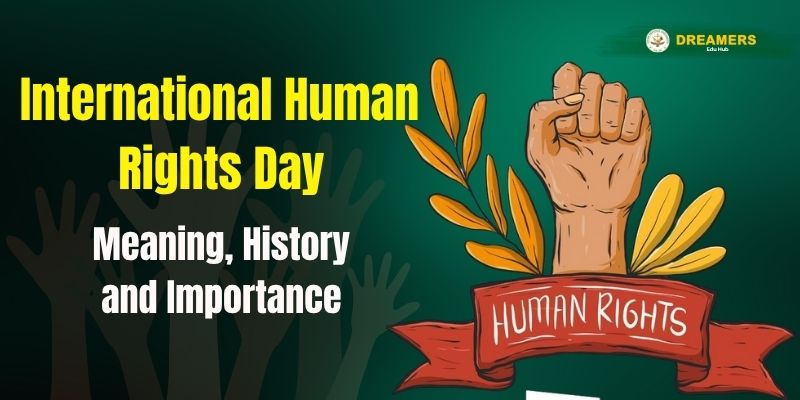
Human rights are the basic rights and freedom that every person has, simply because that person is a human being. These rights do not depend on nationality, religion, gender, wealth, caste or social status. Human rights include the right to live with dignity, to speak freely, to get education, to have fair treatment under law, and to participate in society without fear or discrimination.
These rights are called universal because they belong to every person in every country. They are also inalienable, which means they cannot be taken away unfairly. Even when a government limits some rights in emergencies, it still has a duty to respect basic human dignity. This idea of equal dignity and freedom is at the heart of International Human Rights Day.
Why 10 December is Celebrated as Human Rights Day?
International Human Rights Day is observed every year on 10 December. This date marks the anniversary of the adoption of the Universal Declaration of Human Rights (UDHR) by the United Nations General Assembly on 10 December 1948 in Paris.
The UDHR was the first global document that clearly listed fundamental rights and freedoms for all people. It was described as a “common standard of achievement for all peoples and all nations.”
Because of this historic moment, 10 December became International Human Rights Day. On this day, governments, NGOs, schools, activists and communities across the world organize events to raise awareness about human rights and to remind societies that these rights must be protected every day, not just once a year.
Historical Background: How Did Human Rights Day Begin?
The United Nations and the Aftermath of World War II
The idea behind International Human Rights Day grew out of the painful experience of World War II. During the war, millions of people suffered from genocide, torture, slavery, and other “barbarous acts” that shocked the conscience of humanity. After the war ended in 1945, countries came together and formed the United Nations (UN) to promote peace, cooperation and the protection of human rights.
The UN created a Commission on Human Rights and asked it to prepare an “International Bill of Rights.” This work led to the drafting of the Universal Declaration of Human Rights, which later became the foundation for International Human Rights Day.
Adoption of the Universal Declaration of Human Rights (UDHR) in 1948
The Universal Declaration of Human Rights was drafted by a committee of representatives from different regions, legal traditions and cultures. After long discussions and debates, the UN General Assembly adopted the UDHR on 10 December 1948 at the Palais de Chaillot in Paris. Of the 58 member states at that time, 48 voted in favour, none voted against, and a few abstained.
The UDHR contains 30 articles that describe a wide range of rights – civil, political, economic, social and cultural. These articles affirm that all human beings are “born free and equal in dignity and rights.”
Because of this adoption, International Human Rights Day celebrates not only a date but also a document that continues to guide human rights laws and movements across the world.
Important People Behind the UDHR (like Eleanor Roosevelt)
Several key figures played an important role in creating the UDHR. One of the most famous was Eleanor Roosevelt, former First Lady of the United States. She served as the chairperson of the drafting committee and worked to ensure that the Declaration reflected universal values, not just Western ideas.
Other important contributors included legal and diplomatic experts from many countries. Their combined work made the UDHR a powerful symbol of global cooperation. International Human Rights Day often remembers these leaders to highlight how individuals can shape history through courage and moral vision.
Key Historical Milestones (Table)
| Year | Event | Relevance to International Human Rights Day |
|---|---|---|
| 1945 | Formation of the United Nations | New international body to promote peace and human rights |
| 1946–1948 | Drafting of the UDHR by UN Commission on Human Rights | Creation of a common human rights standard for all nations |
| 10 December 1948 | Adoption of the Universal Declaration of Human Rights | Date later chosen as International Human Rights Day |
| 1950 onwards | Annual observations and campaigns | Growth of global awareness about human rights |
What Are Human Rights? Key Rights Everyone Should Know
Human rights can be grouped in different ways. One common method is to think about civil and political rights, social and economic rights, and the rights of vulnerable groups.
Civil and Political Rights
Civil and political rights protect the freedom and participation of individuals in society and in public life. These rights include:
-
The right to life and security
-
The right to freedom of speech and expression
-
The right to a fair trial and equality before the law
-
The right to vote and take part in government
These rights prevent abuse by authorities and ensure that people can express opinions, join organizations and influence decisions that affect them. The UDHR and International Human Rights Day both strongly emphasize these freedoms.
Social and Economic Rights
Social and economic rights relate to the basic conditions needed for a decent life. They include:
-
The right to work and fair wages
-
The right to rest and leisure
-
The right to education
-
The right to health and social security
These rights are often linked with the idea of social justice. A society that truly honours International Human Rights Day works to reduce poverty, ensure access to schools and hospitals, and create fair opportunities for all.
Human Rights for Vulnerable Groups
Certain groups in society face special risks and discrimination, such as:
-
Children
-
Women and girls
-
Persons with disabilities
-
Refugees and migrants
-
Religious, ethnic or caste minorities
For these groups, International Human Rights Day is especially meaningful. Many campaigns focus on ending child labour, protecting women from violence, ensuring rights for disabled persons, and defending the dignity of refugees and minorities.
Types of Human Rights – Simple Overview
| Category of Right | Simple Meaning | Example Rights (UDHR) |
|---|---|---|
| Civil and Political | Freedom from abuse and unfair control | Life, speech, fair trial, vote |
| Economic, Social, Cultural | Conditions for a decent and equal life | Work, education, health, culture |
| Protection for Vulnerable Groups | Extra protection for those often targeted | Rights of children, women, minorities, refugees |
Why International Human Rights Day Matters Today?
Human Rights and Daily Life (school, work, online world)
International Human Rights Day is not only about politics and international law. It is also about daily life. Human rights are involved when a student gets equal access to education, when a worker receives fair wages, when a citizen expresses an opinion on social media, or when a person moves safely in public spaces.
In the digital age, new issues appear, such as privacy, online hate speech, cyberbullying and surveillance. The spirit of International Human Rights Day reminds societies that technology must respect human dignity and freedom.
Examples of Human Rights Violations Around the World
Despite progress, many violations still occur around the globe. Some examples include:
-
Torture, arbitrary detention or unfair trials
-
Censorship and punishment for peaceful speech
-
Discrimination based on race, religion, caste, gender or sexuality
-
Forced displacement and human trafficking
-
Denial of education or health care to poor communities
On International Human Rights Day, many organizations publish reports, hold press conferences and run campaigns to draw attention to such issues, so that governments and institutions are reminded of their responsibilities.
Role of Human Rights in Democracy, Peace and Justice
Democracy is not only about elections; it is about respect for human rights, rule of law and independent institutions. International Human Rights Day highlights the idea that real peace cannot exist if entire communities face discrimination, violence or injustice.
Human rights help to:
-
Reduce conflict by giving people peaceful ways to solve problems
-
Build trust between citizens and institutions
-
Create fair courts and transparent systems
-
Support social harmony in diverse societies
International Human Rights Day is connected to the wider struggle for democracy, peace and justice in every region of the world.
How Is International Human Rights Day Celebrated?
Events and Campaigns by the United Nations and NGOs
Every year, the United Nations chooses a theme for International Human Rights Day, such as “Dignity and justice for all of us” or “Stand up for human rights.”
On and around 10 December, the UN and many international NGOs:
-
Organize conferences and panel discussions
-
Publish new educational materials and campaigns
-
Present human rights awards and honours
-
Launch global social media drives
These activities use International Human Rights Day as an opportunity to promote awareness and encourage governments to improve their human rights record.
Programs in Schools, Colleges and Communities
Educational institutions often mark International Human Rights Day with:
-
Special assemblies and guest lectures
-
Poster-making, essay writing and quiz competitions
-
Street plays and short films on human rights themes
Community groups, local NGOs and youth clubs may hold rallies, signature campaigns, or public meetings. These events help ordinary people understand that International Human Rights Day is not only a UN date but also a chance for every community to think about dignity, equality and justice.
Social Media Hashtags and Global Awareness Movements
In recent years, International Human Rights Day has become highly visible on social media. Global campaigns, hashtags and online challenges encourage people to share messages, stories, art and videos about human rights.
Such digital activism can:
-
Spread information very quickly
-
Connect people from different countries
-
Put pressure on leaders when violations are exposed
At the same time, human rights defenders also remind audiences that online discussions must stay respectful and factual, in line with the values of International Human Rights Day.
How Can We Support Human Rights? (Especially Students and Youth)
Being Aware and Speaking Up Against Injustice
Support for International Human Rights Day begins with awareness. When people understand their own rights and the rights of others, it becomes easier to notice injustice. Reading about real cases, following trustworthy news sources and learning about the UDHR can turn human rights from an abstract idea into a living reality.
Speaking up does not always mean loud protest. It can also mean asking questions, sharing correct information, supporting someone who is bullied, or reporting abuse to responsible authorities. This everyday courage reflects the true spirit of International Human Rights Day.
Respecting Differences: Religion, Gender, Caste, Culture, Opinions
Human rights are for everyone, not only for groups that are similar or familiar. Support for International Human Rights Day therefore also means respecting differences. This includes respect for:
-
Different religions and beliefs
-
Different languages and cultures
-
All genders and identities
-
Different political opinions
When people listen to each other and avoid hate speech or discrimination, human rights become stronger in daily life. Schools, families and workplaces that promote respect create an environment where the ideas behind International Human Rights Day can grow.
Volunteering, Campaigns and Career Options in Human Rights Field
Support for International Human Rights Day can also be practical. Many individuals:
-
Volunteer with NGOs that work on education, health, women’s rights, disability rights or environmental justice
-
Take part in awareness campaigns, online petitions or community projects
-
Study law, social work, public policy, journalism or international relations and later work in human rights-related careers
Such actions show that International Human Rights Day is not just a once-a-year event, but part of a long journey towards a fairer world.
How Doon Defence Dreamers Celebrate International Human Rights Day?
On International Human Rights Day, Doon Defence Dreamers which is the best NDA coaching in India, uses the occasion to remind every NDA/CDS aspirant that a true officer protects not only borders, but also the rights and dignity of people. The day usually starts with a short session on the Universal Declaration of Human Rights and the Fundamental Rights in the Indian Constitution (Articles 14–21) in simple language, so every student clearly understands equality, freedom, and the right to life.
Mentors discuss real-life cases where the armed forces have upheld human rights even in tough situations, showing how discipline and compassion go together in uniform. Group discussions, mini–debates and poster-making activities are organised on themes like “Right to Equality”, “Dignity of Soldiers and Citizens” and “Human Rights in Conflict Zones”. Students are encouraged to speak about how they, as future officers, will balance national security with human values. In this way, International Human Rights Day at Doon Defence Dreamers becomes a learning experience in both law and leadership.
Conclusion
International Human Rights Day reminds the world that every person deserves dignity, equality and freedom. The day marks the adoption of the Universal Declaration of Human Rights in 1948, but its message is still relevant in the twenty-first century. Through education, respect, daily action and strong institutions, societies can move closer to the vision expressed in the UDHR.
When individuals learn about rights, care about justice and support others, the real purpose of International Human Rights Day is fulfilled: a global culture where every human life is valued, protected and allowed to grow.
Frequently Asked Questions (FAQs)?
Q1. What is International Human Rights Day?
International Human Rights Day is observed on 10 December every year to mark the adoption of the Universal Declaration of Human Rights in 1948. It reminds the world that every person has basic rights like dignity, equality and freedom.
Q2. Why is 10 December chosen as International Human Rights Day?
On 10 December 1948, the United Nations General Assembly adopted the Universal Declaration of Human Rights in Paris. This historic date was later declared International Human Rights Day to celebrate and protect those rights.
Q3. What are the main types of human rights highlighted on International Human Rights Day?
The day highlights civil and political rights (like free speech and fair trial), social and economic rights (like education and health), and special protection for vulnerable groups such as children, women, refugees and minorities.
Q4. How is International Human Rights Day celebrated around the world?
Governments, the United Nations, NGOs, schools and communities organize seminars, campaigns, cultural programs, competitions and social media drives. All these activities aim to spread awareness about human rights and current issues.
Q5. How can students and youth support International Human Rights Day in daily life?
Students and youth can learn about human rights, speak up against bullying and discrimination, respect differences in religion, gender and opinions, and join volunteering or awareness campaigns that promote dignity and equality for all.