
Introduction – Why National Science Day 2026 Matters
Science is not just about big laboratories, rockets and complex formulas. It is present in every fan, smartphone, medicine, metro train and even in the clean drinking water we use every day. National Science Day 2026 is a special opportunity to understand how deeply science is linked with our daily life and with the progress of India.
Every year on 28 February, India celebrates National Science Day to remember the discovery of the Raman Effect by Indian physicist Sir C. V. Raman. On National Science Day 2026, schools, colleges, coaching institutes and research organisations across the country will come together to honour scientists, inspire students and promote a scientific way of thinking.
For students preparing for NDA, CDS, AFCAT, UPSC, SSC, boards or any competitive exam, National Science Day 2026 is also an important topic for GK, essays, speeches and projects.
What Is National Science Day 2026?
National Science Day 2026 is a national observance celebrated in India on 28 February 2026. The day is dedicated to:
-
Remembering the discovery of the Raman Effect
-
Honouring Indian scientists and their contributions
-
Encouraging young minds to take interest in science and research
-
Promoting scientific temper and critical thinking in society
It is not a holiday, but it is a powerful academic and cultural event in schools, colleges and institutions all over India.
Why 28 February Is Celebrated as National Science Day
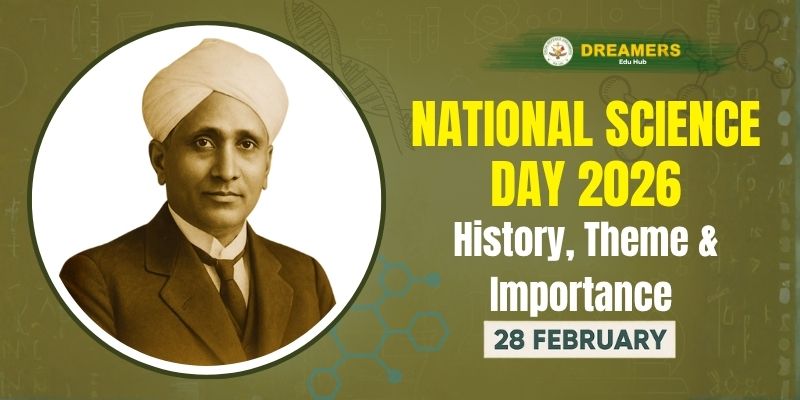
The date of National Science Day 2026 – 28 February – is directly linked with the work of Sir Chandrasekhara Venkata Raman, popularly known as C. V. Raman.
-
In 1928, on 28 February, C. V. Raman announced his path-breaking discovery of the Raman Effect, which explains how light scatters when it passes through a transparent medium.
-
For this discovery, he was awarded the Nobel Prize in Physics in 1930, becoming the first Asian to receive a Nobel Prize in any branch of science.
-
In 1986, the Government of India declared 28 February as National Science Day.
-
The first National Science Day was celebrated in 1987, and since then, it is observed every year with a special theme.
Therefore, when we celebrate National Science Day 2026, we are actually saluting both the great discovery of the Raman Effect and the spirit of Indian science.
Theme of National Science Day 2026
Every year, National Science Day is celebrated with a specific theme that highlights a key area of science, technology or innovation.
Some past themes have focused on topics like:
-
Science and technology for sustainable future
-
Women in science
-
Integrated approach in science and technology
-
Global science for global wellbeing
For National Science Day 2026, the official theme may be announced closer to the date by the Government of India or the Department of Science & Technology.
In your blog, article or speech, you can write like this:
“The official theme of National Science Day 2026 will be announced by the authorities. Teachers and students should check the latest notification and then plan their activities, charts, speeches and competitions according to the theme.”
Later, you can easily edit this line and add the exact theme when it becomes officially available.
History and Evolution of National Science Day
National Science Day 2026 is part of a long journey that started decades ago.
-
Pre-independence era: Indian scientists like C. V. Raman, S. N. Bose, J. C. Bose, Meghnad Saha and many others worked under difficult conditions but still made world-class contributions.
-
Post-independence period: Leaders like Jawaharlal Nehru strongly supported scientific institutions. Organisations like ISRO, DRDO, CSIR, BARC, ICMR and many universities were established.
-
National Science Day celebrations: From 1987 onwards, National Science Day has been celebrated every year with exhibitions, lectures, open-house lab visits, science fairs and public outreach programmes.
By the time we reach National Science Day 2026, India will have completed almost four decades of celebrating this day officially.
Why National Science Day 2026 Is Important for India
1. Inspiring the Next Generation
National Science Day 2026 is a chance to inspire children and young students. When they see models, experiments, robots, astronomy shows and science talks, many of them genuinely start dreaming of becoming scientists, engineers, doctors, defence officers or researchers.
2. Strengthening “Scientific Temper”
The Indian Constitution and many national leaders have always spoken about developing a scientific temper – a mindset that asks questions, looks for evidence and rejects blind beliefs. National Science Day 2026 will remind students and citizens to:
-
Think logically
-
Verify facts
-
Understand the difference between science and superstition
-
Use critical thinking before believing anything seen on social media
3. Supporting “Viksit Bharat 2047” Vision
India’s future as a developed nation depends heavily on its scientific and technological strength. Space missions, defence technologies, digital infrastructure, healthcare, agriculture and clean energy all rely on science. By celebrating National Science Day 2026 seriously, we support the long-term vision of a strong, self-reliant and innovative India.
C. V. Raman and the Raman Effect – The Heart of National Science Day 2026
Any discussion on National Science Day 2026 is incomplete without understanding C. V. Raman and his discovery.
-
C. V. Raman was born on 7 November 1888 in Tiruchirapalli (Tamil Nadu).
-
He worked on the scattering of light and discovered that when light passes through a transparent substance, some of it changes wavelength and direction.
-
This phenomenon is called the Raman Effect.
-
The discovery helped scientists understand the molecular structure of matter and had applications in chemistry, physics, material science and even medical diagnostics.
Raman’s story is also a powerful message for National Science Day 2026 – he did not have fancy equipment or huge foreign funding. He used his curiosity, hard work and simple tools to do world-class research.
Objectives of National Science Day 2026
On National Science Day 2026, institutions and individuals can focus on these key objectives:
-
Awareness: Spread awareness about the role of science in daily life.
-
Inspiration: Motivate students to choose science as a career.
-
Recognition: Appreciate the work of scientists, researchers and teachers.
-
Innovation: Encourage creative thinking, projects and problem-solving.
-
Communication: Improve science communication so that common people can understand complex topics in simple language.
How National Science Day Will Be Celebrated in Schools and Colleges
In schools, colleges and coaching institutes, National Science Day 2026 can include:
-
Science exhibitions: Models, charts and working projects prepared by students.
-
Poster–making competitions: Topics like renewable energy, space missions, AI, climate change, health technology etc.
-
Quiz contests: Questions on famous scientists, inventions, Nobel Prizes, Indian achievements.
-
Science talks and seminars: Guest lectures by professors, researchers or successful alumni.
-
Debates and group discussions: Topics like “Is AI a threat or opportunity?”, “Science vs superstition”, etc.
-
Short films and documentaries: Screening of science-based films followed by discussion.
If you are writing a blog or social media post for National Science Day 2026, you can give practical ideas for activities, so that teachers can directly use them.
Role of Teachers and Parents on National Science Day 2026
Teachers and parents play a very important role in making National Science Day 2026 successful.
-
Teachers can simplify difficult concepts through experiments and stories.
-
They can encourage questions, instead of scolding students for “why” and “how”.
-
Parents can support their children’s curiosity at home – by allowing them to read science books, watch science videos and try small experiments safely.
When adults take National Science Day 2026 seriously, children naturally start respecting science and learning more deeply.
National Science Day 2026 and Careers in Science & Defence
Science is also closely connected with defence, national security and strategic strength. On National Science Day 2026, students should remember that:
-
DRDO scientists design missiles, radars, communication systems and protective gear.
-
ISRO scientists develop satellites, launch vehicles and navigation systems.
-
Defence officers in technical branches use advanced engineering, physics and IT on the field.
So, a strong understanding of physics, chemistry, mathematics, computer science and engineering is extremely useful for those who want to join the armed forces through NDA, CDS, AFCAT, TES and other entries.
You can add a line like:
“On National Science Day 2026, students preparing for defence services should remember that a modern officer is not only brave and disciplined, but also scientifically aware and technologically trained.”
Ideas to Celebrate National Science Day 2026 in Coaching Institutes
Coaching centres and defence academies can also celebrate National Science Day 2026 in meaningful ways:
-
GK sessions: Special class on Indian scientists, ISRO missions, DRDO projects.
-
Essay or speech competition: Topic – “Role of science in national security”, “Science behind modern warfare”, etc.
-
Science–based quiz: Focus on physics, space, technology and environment.
-
Motivational talk: How scientific thinking helps in strategy, planning and decision-making for officers.
These activities will not only honour National Science Day 2026, but also help aspirants in written exams and SSB interviews.
National Science Day 2026 – Important GK Points for Exams
Students should remember these one-liners for exams:
-
Date of National Science Day: 28 February
-
National Science Day 2026: 28 February 2026 (Saturday/Sunday as per calendar)
-
Reason for celebration: To mark the discovery of the Raman Effect by C. V. Raman in 1928
-
First celebration: 1987
-
Declared by: Government of India in 1986
-
Main aim of National Science Day 2026: To promote scientific temper, encourage research and appreciate the role of science in national development
You can convert this section into a table or bullet list when you post the blog on your website.
How National Science Day 2026 Connects Science with Daily Life
Many people think science is only for toppers or scientists. National Science Day 2026 is a chance to break this myth. In your blog, you can give simple daily examples:
-
Using a pressure cooker, refrigerator or induction stove
-
Understanding why helmets protect us (force, impact, safety design)
-
Mobile networks, GPS and online classes
-
Vaccines and medicines that protect from diseases
-
Solar panels and LED lights that save electricity
When readers see these examples, they realise that National Science Day 2026 is not a boring textbook event, but something that touches their real life.
Doon Defence Dreamers: Building Scientifically Aware Future Officers
Doon Defence Dreamers (Best NDA Coaching in Dehradun) not only focuses on written exams and SSB interview preparation, but also encourages a scientific way of thinking among its cadets. On National Science Day 2026, the academy can conduct special sessions on basic physics, defence technology, missiles, satellites and the role of DRDO and ISRO in national security. When students understand how science powers modern weapons, communication systems, navigation, cyber security and surveillance, they start seeing science as a real force behind a strong and safe India.
At Doon Defence Dreamers, teachers can use National Science Day 2026 to give GK talks, quizzes and model–based demonstrations linked with defence applications of science. This helps NDA, CDS and AFCAT aspirants to connect their classroom concepts with the real battlefield environment – from ballistics and aerodynamics to weather forecasting and satellite imagery. In this way, Doon Defence Dreamers trains future officers who are not only disciplined and brave, but also scientifically aware and technically confident.
Conclusion
National Science Day 2026 is much more than a day of speeches and competitions. It is a reminder that:
-
Science is a powerful tool to fight poverty, disease and ignorance.
-
Scientific temper protects society from rumours, fake news and blind beliefs.
-
A nation that respects science and scientists can move faster towards progress.
On 28 February 2026, when India celebrates National Science Day 2026, every student, teacher, parent and citizen can make a simple promise:
-
We will ask questions.
-
We will respect facts.
-
We will use science to solve problems, not to create new ones.
A strong closing line for your blog could be:
“When we celebrate National Science Day 2026 with honesty and curiosity, we are not just remembering Raman’s discovery – we are preparing India’s next generation of thinkers, innovators and nation–builders.