
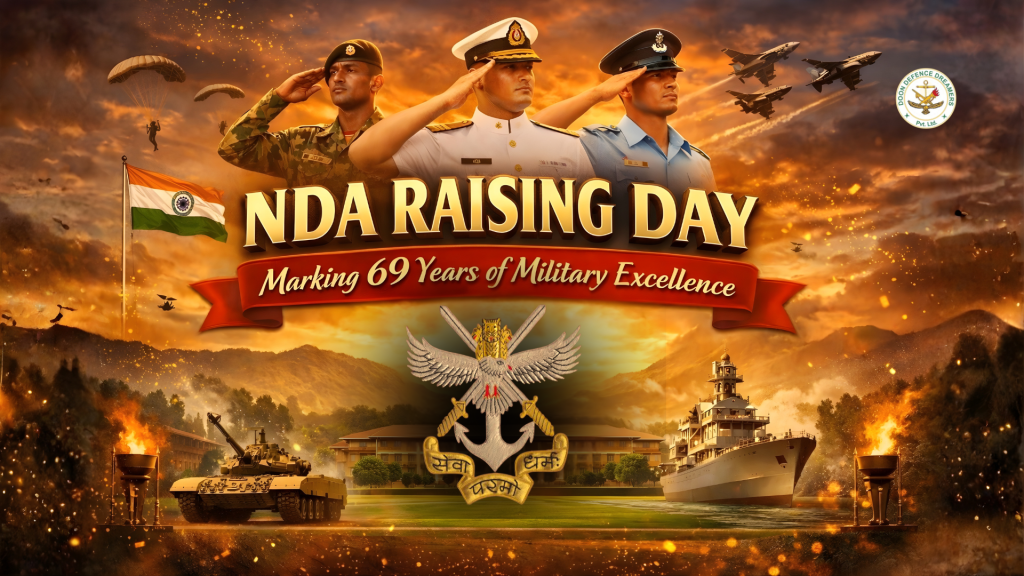
NDA Raising Day is being celebrated today as the National Defence Academy (NDA) marks 69 years of excellence in military training. Morarji Desai, then Chief Minister of Bombay State, inaugurated this premier tri-services institution on January 16, 1955. NDA proudly stands as the world’s first tri-service academy and has become the life-blood of military excellence in our nation.
NDA Khadakwasla’s story dates back to January 9, 1949, when its first course began. The academy moved to its current Pune campus in 1954. This prestigious institution has produced outstanding military leaders through the years – 3 Param Vir Chakra recipients, 11 Ashoka Chakra recipients, and 32 service chiefs.
Doon Defence Dreamers has witnessed how the complete training transforms cadets into exemplary officers who dedicate themselves to national service. The academy’s influence reaches far beyond military training and creates lasting bonds among cadets. “Time and roles may change, but the bond forged at NDA and the spirit of jointness remain unchanged,” as one alumnus perfectly expressed. The academy’s recent milestone of graduating women cadets shows its ability to evolve while preserving its core values.
NDA commemorates 69 years of tri-service unity
NDA Raising Day represents more than just a ceremonial date. The celebration highlights a bold departure from Western military traditions. This change came from a significant lesson during World War II—that “no single service could win any war”. Our founding fathers recognised this reality and established an integrated academy instead of separate institutions for each service, unlike the Indian Military Academy which focuses solely on Army training.
Why January 16 is celebrated as NDA Raising Day
Morarji Desai, then Chief Minister of Bombay State, inaugurated the National Defence Academy at its Khadakwasla campus on January 16, 1955. The academy’s history dates back to 1949, but January 16 stands out as the day NDA took its current shape and location. Yes, it is worth noting that while 1949 marks the foundation year, the NDA Raising Day specifically celebrates the 1955 inauguration.
How the Inter Services Wing evolved into NDA Khadakwasla
India’s premier tri-services institution started as the Inter Services Wing (ISW) at Clement Town, Dehradun on January 1, 1949. The institution later became the Joint Services Wing (JSW). Cadets began their training at Dehradun on January 9, 1949, and continued there for exactly six years. Military planners chose Khadakwasla as the new academy location in 1947, and the campus moved to Pune in 1954.
Doon Defence Dreamers helps cadets understand this rich history as they prepare for NDA entrance. Our students learn how a modest beginning in Dehradun grew into the world’s first tri-services military training academy. This knowledge helps them value the institution they aim to join. The academy’s progress shows India’s dedication to encouraging cooperation among the three services—a principle that remains essential to modern military operations.
The academy has managed to keep its original vision of integrated service training for 69 years at Khadakwasla while adapting to modern defence challenges.
NDA adopts symbols that reflect its core values
The symbolic elements of the National Defence Academy embody the institution’s core principles. Each insignia, colour, and phrase at NDA Khadakwasla shows its steadfast dedication to service, unity, and sacrifice. These values guide cadets through their NDA Raising Day celebrations.
What the NDA crest represents in various services
The NDA crest’s development showcases the academy’s tri-service character. The original design from January 1949 showed three service symbols superimposed—cross swords (Army), anchor (Navy), and Himalayan eagle (Air Force)—against a steel grey and blood red backdrop. A new insignia emerged in October 1949 that added a quill to represent learning with the three service elements.
The final design came in 1948. It blends these components beautifully. The anchor supports the sword hilts, which hold up the eagle, while the Ashoka Capital sits at the top. Each symbol has deep meaning. The cross swords show the Army’s chivalry and valour. The anchor represents the Navy’s stability and poise. The Himalayan eagle captures the Air Force’s drive to “touch the sky with glory”.
How the Academy Colour combines sacrifice and unity
The NDA crest’s maroon background means more than just looks. This Academy Colour, also known as the colour of jointmanship, comes from mixing the traditional colours of all three services—olive green (Army), Prussian blue (Navy), and sky blue (Air Force)—with blood red to show ultimate sacrifice. The unified colour became part of all flags and various uniforms in 1956, showing true jointmanship. Maroon also serves as the perfect heraldic colour to represent valour and sacrifice.
Why ‘Seva Paramo Dharma’ was chosen as the motto
“Seva Paramo Dharma,” the NDA’s guiding principle, means “Service is the highest duty”. The Bhagavad Gita verse Karmanyevadhikaraste Ma Phaleshu Kadachana—”Your duty is action with no eye on the fruits it will bring” inspired this motto. The scroll first showed the English version “Service Before Self.” The Sanskrit version took its place in the 1950s. At Doon Defence Dreamers, we highlight how this motto goes beyond military service. It captures the selfless spirit expected from every cadet at NDA academy. The motto “Seva Paramo Dharma” stands as a sacred duty that shapes cadets into officers who put nation above self, embodying the essence of devotion to duty.
NDA evolves with inclusion and modernisation
The National Defence Academy has changed remarkably over decades. It adapts to meet new military needs while staying true to its core values. These changes show NDA Khadakwasla’s excellence that shines through every NDA Raising Day celebration.
When women cadets joined the NDA academy
The Supreme Court made history in August 2021 by directing the government to let women take the NDA entrance examination. The first group of female cadets started their journey in August 2022 with the 148th NDA course. On May 30, 2025, 17 women cadets graduated alongside 300 male cadets. The academy now has 126 female cadets from the 148th through 153rd courses. They receive the same facilities as their male counterparts, training alongside men in all aspects of the rigorous NDA curriculum.
How training has adapted to reflect jointmanship
The Kargil Review Committee pointed out gaps in inter-service coordination. NDA responded by creating the Joint Training Team (JTT) in Autumn Term 2007. The training now focuses on bringing military components together across services, fostering the spirit of jointness. The academy also launched a B.Tech programme in June 2016. At Doon Defence Dreamers, we explain how this joint training prepares cadets for modern battles. They learn to utilise multi-domain views whatever their service allocation.
What recent changes say about NDA’s future ethos
NDA plans a complete syllabus update by 2026. The focus shifts to Science, Technology, Engineering, and Mathematics that modern military operations need. Training now includes Artificial Intelligence, Robotics, and Cyber Security. These advances and the addition of women cadets show NDA’s drive to create technically skilled officers who can exploit modern battlefield technology.
NDA inspires generations through legacy and leadership
NDA Khadakwasla’s alumni have written India’s military history through their leadership and sacrifice over decades. Each NDA Raising Day celebration pays tribute to both the institution and the remarkable officers who embody its legacy.
Which alumni have led India’s armed forces
NDA academy graduates’ leadership legacy is impressive with 36 service chiefs. The Army, Navy, and Air Force chiefs are all NDA alumni. A unique moment occurred in 2019 when Lieutenant General Manoj Mukund Naravane became Army Chief – the chiefs of all three services were classmates from the 61st NDA course. The academy’s distinguished alumni list shows 2 Chiefs of Defence Staff, 15 Army Chiefs, 13 Naval Chiefs and 11 Air Force Chiefs. General Bipin Rawat from the 53rd course made history by becoming India’s first Chief of Defence Staff before his tragic demise in 2021.
How NDA’s traditions shape future officers
The squadron system serves as a vital foundation in character building at NDA. Cadets learn their first significant lesson in leadership by putting their squadron’s needs before personal desires. Our team at Doon Defence Dreamers emphasises that NDA’s traditions build qualities beyond military tactics. Historical records reveal unique squadron legacies – Hunter Squadron stands out for producing more IAF Chiefs than others. NDA graduates carry these traditions throughout their careers, proven by their extraordinary gallantry awards: 3 Param Vir Chakras, 31 Maha Vir Chakras, 160 Vir Chakras, 12 Ashok Chakras, 40 Kirti Chakras and 135 Shaurya Chakras.
Why the motto ‘Service Before Self’ still strikes a chord
The NDA motto “Seva Paramo Dharma” inspires generations through countless stories of ultimate sacrifice. Major Rajiv Joon demonstrated this spirit by sacrificing his life during anti-insurgency operations in Kashmir, earning the Param Vir Chakra posthumously. Sandeep Unnikrishnan showed similar valour while protecting civilians during the 26/11 Mumbai attacks. A retired NDA Ustaad’s powerful message to rebellious cadets rings true: “The Nishaan stands for countless others who have given their youth and lives as the symbol of supreme sacrifice”. This selfless ethos now extends beyond battlefields into humanitarian missions, governance, and academia.
Doon Defence Dreamers – Premier Coaching for Future Officers
Doon Defence Dreamers is a leading defence coaching institute dedicated to preparing aspirants for prestigious examinations like NDA, CDS, SSB and other officer-entry pathways. With structured learning, experienced mentors, personalised guidance and disciplined training modules, the institute focuses on building both academic excellence and officer-like qualities (OLQs). Doon Defence Dreamers not only equips students with knowledge and aptitude but also instills leadership, confidence, teamwork, and national pride—qualities essential for serving the nation. Through consistent results and strong mentoring culture, it has become a preferred destination for candidates aiming to secure a career in the Armed Forces, especially for those seeking comprehensive NDA preparation in Dehradun.
Key Features of the National Defence Academy (NDA)
1. World’s First Tri-Service Academy
NDA trains Army, Navy, and Air Force cadets together before commissioning, promoting true jointmanship.
2. 69+ Years of Legacy and Excellence
Established in 1955 at Khadakwasla, it has shaped India’s top military leaders for generations.
3. Integrated Military Training System
Cadets receive academic education, field training, physical conditioning, and leadership development under one system.
4. Distinctive Symbols and Traditions
Its crest, academy colour, and motto “Seva Paramo Dharma” represent sacrifice, service, and unity.
5. Distinguished Alumni and Leadership Network
NDA has produced multiple Chiefs of Defence Staff, Service Chiefs, and gallantry award recipients.
6. Cultural and Historical Significance
From Clement Town to Khadakwasla, its evolution mirrors India’s strategic vision for integrated military leadership.
7. Modernisation and Inclusion
The induction of women cadets, technological curriculum updates, and joint training reforms show NDA’s modern approach.
Conclusion
The National Defence Academy’s remarkable 69-year-old existence proves its position as the life-blood of military excellence in India. This tri-services institution showcases our nation’s foresight about integrated military training. The rise from Inter Services Wing in Dehradun to the prestigious academy at Khadakwasla reflects India’s steadfast dedication to encourage jointmanship among the three services.
The academy’s rich symbols carry deep meaning. Its carefully designed crest and thoughtfully chosen maroon colour remind cadets and officers about their sacred duty to the nation. Yes, it is true that “Seva Paramo Dharma” means more than words on a scroll – it guides the character of every cadet who passes through NDA’s hallowed gates.
Over the last several years, the academy has seen historic changes. Women cadets now join the ranks, marking a defining moment. The curriculum adapts to include technology that prepares officers for modern warfare challenges. In spite of that, the core values of service and sacrifice stay strong.
Doon Defence Dreamers takes great pride in preparing candidates for this prestigious institution. Our detailed training programmes help aspirants grasp both academic and physical requirements, along with the deeper values and traditions that make NDA unique. NDA’s lessons reach way beyond the reach and influence of military tactics—they mould people who always put nation above self.
The distinguished alumni list includes service chiefs and gallantry award recipients, showing NDA’s deep effect on India’s security framework. This NDA Raising Day celebrates more than an institution – it honours a legacy of leadership, sacrifice, and steadfast dedication to national service. The true measure of NDA’s success shines through its officers’ character as they live by their highest duty – service to the nation.
Frequently Asked Questions (FAQs)
Q1. What is NDA Raising Day?
A: NDA Raising Day commemorates the official inauguration of the National Defence Academy at Khadakwasla.
Q2. Why is NDA Raising Day celebrated on 16 January?
A: Because the academy was inaugurated at its present Khadakwasla campus on 16 January 1955 by Morarji Desai.
Q3. When was the NDA originally founded?
A: Its origin dates back to 1949 as the Inter Services Wing at Dehradun before shifting to Pune in 1954.
Q4. What is NDA’s motto?
A: “Seva Paramo Dharma,” meaning “Service is the highest duty.”
Q5. Why is NDA called a tri-service academy?
A: Because it trains cadets of the Army, Navy, and Air Force together before they go to different service academies.
Q6. When did women cadets start training at NDA?
A: Women cadets joined for the first time in August 2022 with the 148th NDA course.
Q7. How many service chiefs has NDA produced?
A: NDA has produced 36+ Service Chiefs across the Army, Navy, and Air Force.
Q8. What makes the NDA’s symbols significant?
A: The crest, academy colour, and motto represent unity, sacrifice, learning, and the integrated ethos of military training.
Q9. What does NDA’s training system include?
A: Academic degrees, physical training, field exercises, personality development, and officer-like qualities (OLQs).