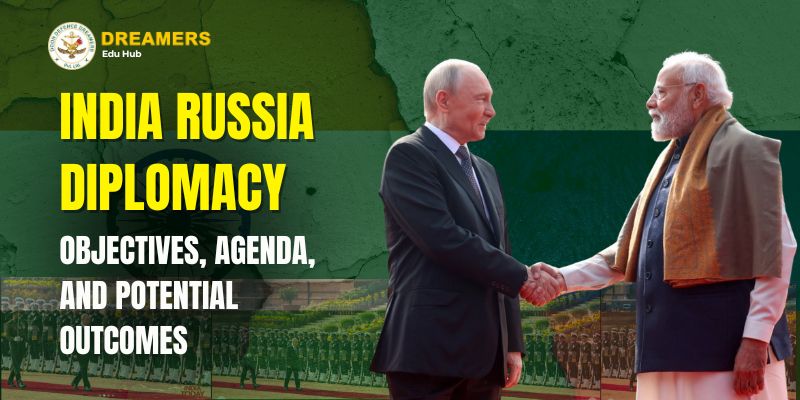
President Vladimir Putin’s December 2025 visit to New Delhi—framed as the 23rd India-Russia Annual Summit—focuses heavily on defence cooperation (S-400, Su-57, joint manufacturing and logistics support), energy and nuclear collaboration (including Small Modular Reactors and Kudankulam progress), trade and payments (mechanisms to sustain bilateral trade amid sanctions), and deepening industrial partnerships (joint manufacturing, technology transfer, BrahMos-style projects). The visit is taking place amid a tightening strategic partnership geared to operationalise defence logistics (RELOS ratification), expand energy ties, and boost bilateral trade targets—while India navigates Western pressure and sanctions on Russia.
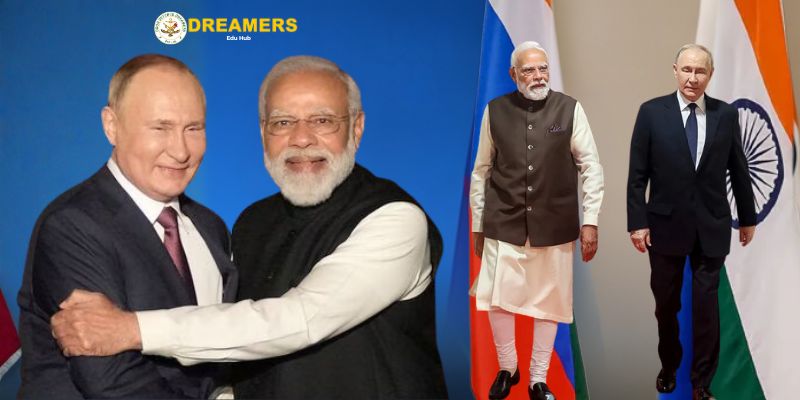
The key agenda areas of the summit include:
-
Defence cooperation ( S-400, Su-57, joint production)
-
Energy and nuclear partnership (SMRs, Kudankulam)
-
Trade, economic cooperation and payment mechanisms
-
Strategic industrial partnership
Putin’s visit comes at a time when India–Russia relations are strengthening rapidly, and India continues to maintain a careful strategic balance amid global pressures.
Why This Visit Matters — Why Now, and Why Putin
President Vladimir Putin is visiting India after a gap of four years — his last trip was in 2021.
India and Russia established a Strategic Partnership in 2000, which was upgraded in 2010 to a “Special and Privileged Strategic Partnership.”
In the backdrop of shifting geopolitics, the Ukraine war, Western sanctions, and global energy disruptions, both countries are attempting to revitalise and stabilise their long-standing relationship.
Therefore, the 23rd Annual Summit is not merely a ceremonial meeting — it is a strategic platform where the future direction of bilateral cooperation will be defined.
Agenda — What Will Be on the Table?
1. Defence and Military Technology
Defence cooperation remains a major pillar of the visit. Discussions are likely on:
-
S-400 Triumf air defence systems
-
Potential talks on Su-57 stealth fighter jets
-
Additional modern military hardware supply
The meeting may also emphasise domestic manufacturing under “Make in India”, including joint production, supply of spare parts, and strengthening maintenance lines that faced disruption due to the Russia–Ukraine conflict.
2. Energy and Nuclear Cooperation
Energy collaboration is another major focus area.
-
Advancing Russia’s role in India’s nuclear sector, especially the Kudankulam Nuclear Power Plant (KKNPP)
-
Discussions on oil and gas supplies, long-term energy security, and stabilising crude imports from Russia
-
Possibilities of cooperation on Small Modular Reactors (SMRs)
3. Trade, Economic Cooperation & Payment Systems
India and Russia have significantly deepened their economic engagement.
Key priorities for this summit include:
-
Boosting India’s exports to Russia (pharmaceuticals, machinery, agriculture, etc.)
-
Addressing trade imbalance
-
Stabilising alternative payment mechanisms, including potential refinement of the rupee–ruble system in the face of Western sanctions
-
Improving transport & connectivity networks such as maritime routes and logistics corridors
4. Science, Technology, Space & Educational Collaboration
India and Russia share a long history of cooperation in science and space.
Expected discussions include:
-
Technology transfer
-
Collaboration in nanotechnology, innovation, advanced materials
-
Space research partnerships
-
Enhancing higher education and opportunities for Indian students in Russia
5. Global and Regional Diplomacy
Against the backdrop of the Ukraine war and international sanctions, this visit sends a clear diplomatic message:
-
India–Russia ties are not aimed against any third country
-
Both nations support a stable, multipolar global order
-
The summit reinforces India’s doctrine of Strategic Autonomy, balancing relations with all major powers
Potential Outcomes — If Expected Agreements Materialise
| Sector | Possible Outcomes / Impact |
|---|---|
| Defence | Further movement on S-400, Su-57; boost to “Make in India”; stronger supply of spares & logistics chains |
| Energy / Nuclear | Acceleration of Kudankulam units; enhanced energy security; sustained crude oil & gas supplies, possibly at favourable prices |
| Trade / Economy | Increase in Indian exports; gradual balancing of trade deficit; stabilised payment channels such as rupee–ruble |
| Technology / Innovation | Expanded cooperation in science, space, research; tech transfer; new educational and R&D initiatives |
| Geopolitics | Stronger Indian strategic autonomy; reinforcement of multipolarity; increased coordination on global platforms |
Challenges, Questions & Strategic Risks
-
Western sanctions on Russia may complicate financial transactions and energy trade
-
Russia–China proximity poses a balancing challenge for India, given its border tensions with China
-
Global perception of India’s Russia ties may be scrutinised by Western partners
-
Effective implementation of Make in India commitments requires large-scale administrative, technical and financial coordination
Why This Visit Is Timely
-
The global environment is undergoing rapid shifts — the Ukraine conflict, sanctions, and energy volatility have increased India’s strategic challenges
-
Russia remains a reliable partner in defence and energy, making long-term planning essential
-
India seeks to preserve a multipolar world order, and strong ties with Russia support this goal
-
Both nations stand to benefit economically, technologically and strategically through renewed cooperation
Conclusion — Long-Term Significance for India–Russia Relations
President Vladimir Putin’s December 2025 visit to India is both symbolic and strategically consequential. It represents more than a diplomatic exchange — it is a roadmap-setting summit that will shape the next phase of bilateral relations.
If the decisions made on defence, energy, trade, technology and diplomacy are implemented effectively, the coming decade could witness a renewed and deeper India–Russia partnership.
India, while preserving its strategic autonomy, appears ready to open a stronger new chapter with Russia — a relationship that can become a stabilising pillar in an increasingly uncertain world.
Our Recent Blog
भारत के प्रमुख विकास 2024–25: राष्ट्रीय स्तर पर अपडेट
भारत डिफेंस सिविक 2025: गरुड़, मालाबार और राष्ट्रीय शक्ति
वैश्विक घटनाएँ: Cyclone Senyar, Festival, INS Taragiri & GDP