
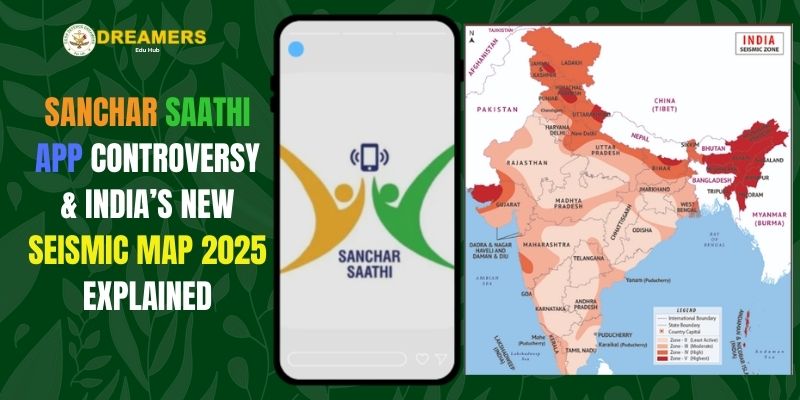
The first is the government’s Sanchar Saathi app, which sparked a major privacy controversy, and the second is India’s newly released Seismic Zonation Map 2025, which has reshaped the country’s understanding of earthquake risk. On one hand, it is a matter of digital security and citizens’ data rights, and on the other, it concerns the life-safety of millions and rising seismic vulnerability.
Sanchar Saathi: Complete Information
What is Sanchar Saathi?
Sanchar Saathi is an important cyber-security platform developed by the Government of India, created by the Department of Telecommunications (DoT) to strengthen citizens’ digital safety. It was first launched in 2023 as a web portal where users could check mobile numbers, IMEI details, and various phone-connection related services. Later, in January 2025, it was introduced as a mobile application to make these facilities more accessible on every smartphone.
The app performs several crucial mobile-security functions—such as verifying whether a phone is genuine or cloned, blocking or tracking a lost or stolen device, checking all mobile connections issued under a user’s name, and reporting fraudulent SIMs or scam-related activities. In simple words, Sanchar Saathi acts as a reliable government tool against digital fraud, fake SIMs, mobile theft, and suspicious mobile activities—giving users more control and safety over their phone numbers and mobile identity.
Sanchar Saathi is a government cyber-security app launched by the Department of Telecommunications (DoT).
It began as a web portal in 2023, and became available as a mobile app in January 2025.
Through it, phone-related security, mobile-connection monitoring, and fraud reporting become easier.
Features of Sanchar Saathi — What Can It Do?
Sanchar Saathi offers multiple capabilities. The key features are:
-
IMEI Verification: Check whether a phone is genuine or cloned/duplicate.
-
Block/Track Lost or Stolen Phones: Users can blacklist a lost phone, disconnect it from the network, or report theft.
-
Detect Fake or Duplicate Connections: See all SIMs registered under your name; report unauthorised or fraudulent connections.
-
Report Fraud Calls, Messages, and Spam: Includes options to report scam calls, suspicious messages, and phishing links.
-
User-Friendly Complaint System: Helps users report banking or mobile-number–related fraud easily.
Government’s Objective — Why Was Sanchar Saathi Introduced?
The government’s primary objective behind Sanchar Saathi is to curb the rapid increase in mobile-related crime and digital fraud in the country. Cases of mobile theft, phone-cloning, duplicate IMEI devices, fake SIM activation, scam calls, and fraudulent messages have seen a steep rise, putting citizens’ privacy and security at serious risk.
According to the government, Sanchar Saathi provides a centralized and effective platform to address these threats. It not only allows users to verify the authenticity of their mobile connections but also helps them report fake SIMs, fraud activities, and suspicious numbers—thus helping them stay digitally secure. With this app, citizens gain better control over their phones, IMEI details, and network information, making the digital environment safer and more transparent.
The government stated that growing problems such as mobile theft, phone cloning, duplicate IMEI phones, fraud calls/messages, and fake SIMs needed a unified solution—and Sanchar Saathi serves that purpose.
It gives citizens a reliable method to verify their connections, avoid fraud, and feel more secure.
Controversy, Criticism, and Challenges
Despite its benefits, Sanchar Saathi faced criticism due to:
-
On 28 November 2025, DoT ordered that the app must be pre-installed on every new smartphone.
-
Users would not be allowed to uninstall it.
This immediately raised serious concerns among users, opposition parties, and digital-rights groups, who viewed this as a potential privacy violation and a tool for government surveillance.
Later, the government withdrew this order—meaning the app is now optional. Users can install or uninstall it freely.
Concerns remain that if access to the app’s data were ever misused, personal information, call details, and connection-related data could be exploited—this remains the core worry of critics.
India’s New Seismic Zonation Map 2025: Complete Information
What is a Seismic Zonation Map?
A Seismic Zonation Map is a scientific representation that shows which regions of the country face what level of earthquake risk, and what intensity of tremors may occur in those areas.
In simple terms, it divides India into different seismic zones to show which regions have stable ground and which are at higher risk of earthquakes.
This map is essential for determining building safety standards, infrastructure design, roads, bridges, schools, hospitals, and other construction guidelines—ensuring structures are built to withstand earthquake forces.
In 2025, the Bureau of Indian Standards (BIS) released an updated version of this map, based not on old historical records but on modern scientific methods such as tectonic stress evaluation, active fault-line mapping, soil structure analysis, and real-time seismic hazard modelling.
BIS also released the updated earthquake design code IS 1893 (Part 1): 2025, which will influence India’s construction practices and disaster-management strategies for the coming decades—ensuring better preparation for future seismic challenges.
Seismic Zonation Map—also known as the Earthquake Hazard Map—shows which parts of India face what level of earthquake danger. It is used as the foundation for construction rules, design standards, and disaster planning.
In 2025, BIS released a new hazard map along with the updated earthquake design code (IS 1893 (Part 1): 2025).
What Changed in the New Map — Key Points
-
A new Zone VI, the highest-risk category, has been added for the first time.
The entire Himalayan arc—from Jammu & Kashmir to Arunachal Pradesh—now falls under Zone VI. -
Around 61% of India’s land area is now categorized as moderate to high earthquake-risk zones.
-
Planning and construction rules must now be upgraded accordingly. Buildings, bridges, and major infrastructure built under old norms will require redesign, reinforcement, or stricter compliance.
What This Means — Why It Matters
Older maps and design codes were based mainly on historical earthquake data.
The new map uses scientific assessments such as:
-
tectonic stress
-
active fault lines
-
soil and land composition
-
real-time seismic modelling
This makes the new map more accurate and useful for future risk planning.
New construction in cities, towns, roads, bridges, hospitals, and schools must follow earthquake-resistant design norms.
Areas that were previously considered low-risk may now fall into higher-risk categories, requiring better preparedness, improved building safety, and stronger disaster-management systems.
What We Should Understand From Both Issues — A Broader Perspective
-
Sanchar Saathi shows that while digital safety measures are important, they must be balanced with citizens’ rights and privacy.
-
The new Seismic Map highlights that natural disasters—especially earthquakes—must not be underestimated; scientific, updated planning is essential.
-
Both topics emphasize the importance of security, preparedness, public awareness, and responsible governance.
They show how new challenges require new rules, new planning, and constant adaptation.
Conclusion
While Sanchar Saathi and the new Seismic Map are entirely different subjects, both are strongly connected to India’s safety.
One protects us from digital threats, while the other prepares us for natural disasters.
Sanchar Saathi requires a careful balance between technology and privacy, while the Seismic Map reminds us that earthquake-resistant planning is essential for the country’s future.
Together, they illustrate that India is rapidly changing—and we must give equal importance to digital security and physical safety to face the coming challenges.
Our Recent Blogs
Blood Donation Camp at Doon Defence Dreamers (5ᵗʰ Dec 2025)
Dreamers Edu Hub Sports Fest 2026
Dreamers Edu Hub Scholarship Examination – Rajiv Gandhi Navodaya, Santudhar (Pauri)