In India’s rural landscape, the most prominent name associated with guaranteed employment has long been MGNREGA (Mahatma Gandhi National Rural Employment Guarantee Act). For nearly two decades, MGNREGA has acted as a lifeline and a social safety net for millions of rural households, ensuring basic income security during times of distress. However, a major transformation now appears to be on the horizon.
The Central Government, during preparations for the Winter Session of Parliament, has indicated plans to introduce a new and ambitious legislation titled the VB-G RAM G Bill 2025, which is being positioned as a replacement for MGNREGA. This proposed bill reflects a shift in thinking—moving away from employment merely as a means of survival toward employment as an active driver of development, productivity, and nation-building.
As India advances toward the vision of “Viksit Bharat 2047”, the government aims to reshape rural employment from a temporary relief mechanism into a structured development mission. In this blog, we explore in detail what the VB-G RAM G Bill 2025 is, its vision, how it differs from MGNREGA, and how it could potentially redefine the future of rural India.
What Is VB-G RAM G Bill 2025? Full Name and Vision
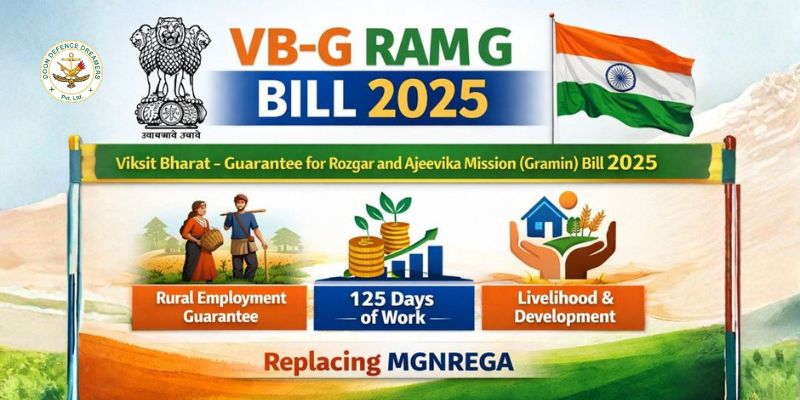
The full form of VB-G RAM G Bill 2025 is “Viksit Bharat Guarantee for Employment and Livelihood Mission – Rural.” This proposed legislation is designed to replace the Mahatma Gandhi National Rural Employment Guarantee Act, 2005, which has been in force for the past twenty years.
The core vision of VB-G RAM G Bill 2025 is deeply inspired by the Prime Minister’s long-term national roadmap of “Viksit Bharat 2047.” While MGNREGA primarily focused on providing unskilled manual work to rural households, the new bill reimagines rural employment as a comprehensive development mission rather than a short-term relief program.
Under this new framework, employment is no longer seen merely as a wage-support mechanism. Instead, it is intended to be a tool for building durable infrastructure, enhancing rural productivity, and strengthening economic self-reliance at the village level.
The government’s stated objective is to ensure that every unit of labour invested in rural areas contributes to long-lasting national assets—whether in agriculture, water management, connectivity, or local industries. In essence, VB-G RAM G Bill 2025 seeks to integrate rural labour into the broader process of national development.
From Survival to Nation-Building: A Paradigm Shift
MGNREGA was introduced at a time when rural India faced severe employment insecurity, agrarian distress, and seasonal migration. Its primary purpose was to guarantee livelihood security through 100 days of wage employment per year for every rural household demanding work.
VB-G RAM G Bill 2025 proposes a fundamental shift in this approach. Rather than focusing solely on income support, it aims to make rural workers partners in building India’s physical and economic infrastructure.
The bill envisions rural India not as a reservoir of surplus labour but as a dynamic contributor to national growth. Through planned and productive work, villages are expected to emerge as hubs of sustainable development, capable of generating long-term livelihoods for future generations.
MGNREGA vs VB-G RAM G Bill 2025: Key Differences and Major Changes
The proposed VB-G RAM G Bill 2025 introduces several structural and philosophical changes compared to MGNREGA. These differences have the potential to significantly alter the direction of rural employment policy.
1. Increase in Guaranteed Employment Days
Under MGNREGA, rural households are entitled to 100 days of guaranteed employment in a financial year. The new bill proposes to increase this limit to 125 days, offering an additional 25 days of income security.
This enhancement is expected to provide greater financial stability to rural families, especially those dependent on seasonal agricultural work.
2. From Rights-Based Employment to Empowerment-Oriented Work
MGNREGA was fundamentally a rights-based legislation, emphasizing the “right to work.” While this principle remains important, VB-G RAM G Bill 2025 seeks to go further by linking employment with empowerment, skill development, and productivity.
The focus shifts away from repetitive, low-impact activities toward projects that generate tangible and lasting economic value.
3. Project-Based Development Approach
Unlike MGNREGA, where work was often fragmented into small, disconnected tasks, the new bill emphasizes a project-based model. Under this system, development activities will be planned and executed as integrated projects, ensuring coherence and long-term impact.
This approach aims to ensure that village-level development follows a clear roadmap rather than isolated interventions.
Focus on Rural Infrastructure and Productivity
One of the defining features of VB-G RAM G Bill 2025 is its strong emphasis on productivity. The government believes that employment alone is insufficient unless it leads to meaningful outcomes.
1. Creation of Durable Assets
The bill prioritizes the construction of durable and productive assets in sectors such as:
-
Agriculture and irrigation
-
Water conservation and watershed management
-
Livestock and allied activities
-
Local infrastructure supporting rural enterprises
These assets are expected to enhance rural incomes and reduce long-term dependence on government support.
2. Convergence with Other Rural Schemes
VB-G RAM G Bill 2025 promotes convergence with existing rural development programs. For example, a water conservation project under this bill may be linked with irrigation schemes and agricultural productivity initiatives.
This integrated approach ensures efficient use of public funds and maximizes developmental impact.
3. National Rural Infrastructure Stack
The bill envisions the creation of a National Rural Infrastructure Stack, combining both physical and digital infrastructure. This includes improved connectivity, data-driven planning, and technology-enabled monitoring to modernize rural governance.
Women’s Participation and Social Impact
One of the most significant achievements of MGNREGA has been the increasing participation of women in the rural workforce. Over the years, the program has emerged as a powerful instrument of women’s economic empowerment.
According to available data:
-
Women’s participation stood at 48% in 2014
-
By 2024–25, it had increased to 58%
VB-G RAM G Bill 2025 aims to strengthen this trend further by ensuring that women have access to productive, dignified, and locally available employment opportunities.
When women earn income directly, it has a multiplier effect on household welfare—improving nutrition, education, healthcare, and overall family well-being. The new bill recognizes this impact and seeks to institutionalize women’s participation as a cornerstone of rural development.
Implementation Challenges and Unemployment Allowance
The success of any legislation depends not only on its intent but also on its implementation on the ground. VB-G RAM G Bill 2025 incorporates several mechanisms to ensure transparency and accountability.
1. Unemployment Allowance
As with MGNREGA, the new bill retains the provision of unemployment allowance. If work is not provided within 15 days of application, the government is obligated to pay compensation to the worker.
This clause serves as a critical safeguard, ensuring that the guarantee of employment remains legally enforceable.
2. Curbing Corruption Through Technology
To address long-standing issues of corruption and inefficiency, the bill emphasizes:
-
Digitization of records
-
Geo-tagging of assets
-
Direct Benefit Transfer (DBT) to workers’ bank accounts
These measures are designed to improve transparency, maintain quality standards, and prevent misuse of funds.
Doon Defence Dreamers on VB-G RAM G Bill 2025
At Doon Defence Dreamers, widely regarded as one of the best NDA coaching institutes in Dehradun, understanding national policies like the VB-G RAM G Bill 2025 is an essential part of holistic defence exam preparation. As future officers of the Indian Armed Forces, NDA aspirants must develop a clear grasp of rural development, employment policies, and nation-building initiatives that shape India’s internal security and socio-economic stability.
Through structured current affairs analysis, expert faculty guidance, and exam-oriented discussions, Doon Defence Dreamers ensures that students not only prepare for written examinations but also build the analytical perspective required for SSB interviews. By linking contemporary legislation such as the VB-G RAM G Bill 2025 with the broader vision of Viksit Bharat, Doon Defence Dreamers continues to prepare confident, aware, and responsible leaders for the nation.
Success Highlights of Doon Defence Dreamers:
-
Consistent selection records in NDA, CDS, AFCAT, and SSB interviews.
-
Expert faculty with defence experience and focused teaching methodology.
-
Comprehensive study material and regular mock tests to enhance conceptual clarity.
-
Personalized mentorship and physical training support for all aspirants.
Conclusion
The VB-G RAM G Bill 2025 represents far more than a mere change in nomenclature. It reflects a fundamental rethinking of rural employment policy in India. By increasing guaranteed workdays, emphasizing productive infrastructure, integrating multiple schemes, and strengthening women’s participation, the bill seeks to address the limitations of MGNREGA while adapting to contemporary development needs.
If enacted and implemented effectively, VB-G RAM G Bill 2025 could:
-
Reduce rural poverty
-
Curb distress migration
-
Create self-reliant villages
-
Lay the foundation for sustainable rural growth
Ultimately, the bill aspires to transform rural employment from a safety net into a platform for long-term economic empowerment, making it a crucial milestone on India’s journey toward becoming a Viksit Bharat by 2047.
FAQs
1. What is the VB-G RAM G Bill 2025?
The VB-G RAM G Bill 2025, officially called the Viksit Bharat Guarantee for Employment and Livelihood Mission – Rural, is a proposed legislation aimed at replacing MGNREGA. It seeks to transform rural employment from a welfare-based system into a development-oriented mission linked with productivity, infrastructure creation, and nation-building.
2. How is VB-G RAM G Bill 2025 different from MGNREGA?
While MGNREGA focuses on providing 100 days of wage employment as a social safety net, the VB-G RAM G Bill 2025 emphasizes project-based, productive work, creation of durable rural assets, skill development, and integration with other development schemes. It also proposes 125 days of guaranteed employment, compared to 100 days under MGNREGA.
3. Why is the government planning to replace MGNREGA?
The government aims to align rural employment with the long-term vision of Viksit Bharat 2047. Instead of treating employment as a temporary relief during distress, the VB-G RAM G Bill 2025 intends to make rural labour a driver of sustainable development, economic self-reliance, and infrastructure growth.
4. Will workers receive unemployment allowance under VB-G RAM G Bill 2025?
Yes. Similar to MGNREGA, the proposed bill retains the provision of unemployment allowance. If employment is not provided within 15 days of application, eligible workers will receive compensation, ensuring that the employment guarantee remains legally enforceable.
5. How will VB-G RAM G Bill 2025 impact rural women?
The bill aims to further strengthen women’s participation in the rural workforce by providing dignified, locally available, and productive employment. Increased female participation is expected to improve household income, nutrition, education, and overall social welfare, making women central to rural development efforts.