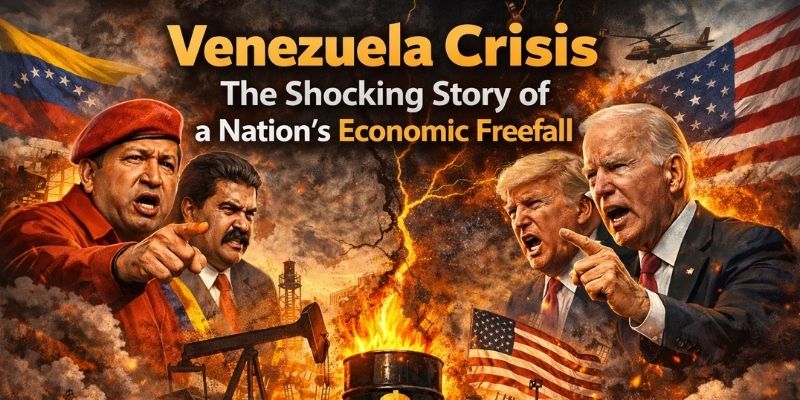
Venezuela’s economic collapse stands as one of modern history’s most dramatic financial disasters. The nation’s living standards fell by a staggering 74% between 2013 and 2023. This marks the fifth largest decline in living standards in modern economic records. The country’s gross domestic product shrank by roughly three-quarters between 2014 and 2021. This massive decline triggered widespread humanitarian suffering throughout the nation.
The economic freefall created a nightmare scenario of hyperinflation that devastated Venezuela’s economy. Annual inflation reached an astronomical 130,000 percent in 2018. This pushed millions of citizens into poverty. The national Living Conditions Survey revealed shocking numbers by 2021 – 95% of Venezuelans lived in poverty based on income. Even more concerning, 77% fell under extreme poverty—the highest recorded figure in the country’s history. The crisis left 9.3 million Venezuelans moderately to severely food insecure, affecting one-third of the population.
The numbers tell only part of the story in what has become the worst economic crisis in Venezuela’s history and the most severe crisis any country has faced during peacetime since the mid-20th century. The human cost has been catastrophic. By 2017, hunger became so severe that almost 75% of the population lost an average of over 8 kg (over 19 lbs). The situation forced an estimated 7.7 million people to flee the country since the Venezuela Crisis began. In this piece, we’ll get into how a once-prosperous oil-rich nation fell into economic chaos. We’ll explore the political factors that accelerated the collapse and think about what the future might hold for Venezuela Crisis.
The Rise of Venezuela’s Oil Economy
Oil discovery changed Venezuela’s fate completely. A nation that once relied on farming became Latin America’s richest country. This dramatic change brought incredible wealth but also set up problems that would surface years later.
How oil shaped Venezuela’s early prosperity
Venezuela’s trip as an oil power started in 1914 when experts found the Mene Grande oil field. The real breakthrough came in 1922 as the Barroso No. 2 well in La Rosa field burst open and spewed 100,000 barrels of oil daily. Local people called this the “black fountain,” which marked Venezuela’s emergence as a major oil producer.
Venezuela became the world’s biggest oil exporter by the 1930s and held this position until the 1970s. The country’s growth during these years was remarkable. Venezuela’s per capita GDP grew 3.8% yearly between 1920 and 1982, making it Latin America’s fastest-growing economy.
Oil wealth reshaped Venezuelan society completely. Foreign oil companies built modern towns with schools, hospitals, and places for recreation. Government spending on massive infrastructure brought new highways, bridges, and dams. Education became widely available, and a strong middle class emerged that enjoyed a lifestyle similar to developed nations.
Dependence on oil exports and Dutch disease
In spite of this prosperity, serious problems lay beneath the surface. Venezuela grew too dependent on oil, which by the 1970s made up more than 80% of what the country earned from exports and over 50% of government money. This heavy reliance left the economy at the mercy of oil prices.
The 1970s oil boom, when prices shot up four times after the 1973 OPEC embargo, brought both chances and risks. Venezuela’s currency, the bolivar, grew substantially stronger. This made imports cheaper but hurt local industries that couldn’t keep up with foreign goods. This economic effect, known as “Dutch disease,” damaged farming and manufacturing sectors.
The oil wealth didn’t benefit everyone equally. Political elites and urban middle class saw most gains, while many Venezuelans stayed poor. These differences created social tensions that later fueled populist movements.
The role of PDVSA and nationalization
President Carlos Andrés Pérez nationalized Venezuela’s oil industry in 1976 and created Petróleos de Venezuela, S.A. (PDVSA). People saw this as a win for economic independence at first. PDVSA grew into a professional company with technical skills matching major international oil firms. The company expanded worldwide and bought refineries in the United States and Europe, notably Citgo.
PDVSA worked quite independently from the government through the 1980s and early 1990s. The company put profits back into increasing production and developing technology. This independence helped PDVSA handle the 1980s oil price crash better than other national oil companies.
PDVSA’s relationship with the government remained tricky. Critics said it worked like a “state within a state” and cared more about company profits than national growth. Corruption and poor management slowly crept in, though nowhere near the levels seen in later years.
Oil wealth failed to build lasting development. Instead, it encouraged a mindset where everyone expected the state to share oil money. Politicians used these resources to build support networks rather than diversify the economy or save for tough times.
This overdependence on oil and weak institutions laid the groundwork for the economic crisis that would later overwhelm the country. Hugo Chávez took power in 1999 and inherited both PDVSA’s huge potential and the deep problems that had built up over decades.
Chávez’s Economic Vision and Its Consequences
Hugo Chávez took office in 1999 and inherited a nation ready for change. This former military officer ran his campaign with promises to fight corruption, reduce poverty, and share Venezuela’s oil wealth more fairly. His “Bolivarian Revolution” wanted to build a socialist state that would put ordinary citizens’ needs ahead of corporate interests and the traditional elite.
Bolivarian missions and social spending
Chávez’s economic vision centered on the “Bolivarian missions” – social programs that addressed poverty, healthcare, education, and housing needs. These programs showed early promise, especially as oil prices went up through most of the 2000s.
The main missions included:
- Mission Barrio Adentro, which brought thousands of Cuban doctors to poor neighborhoods
- Mission Robinson, a literacy program that claimed to teach millions to read and write
- Mission Mercal, which set up state-run supermarkets with subsidized food
Oil revenues funded these social programs, and poverty rates dropped significantly between 2003 and 2007. Higher education enrollment more than doubled under Chávez. Healthcare became available in underserved communities, and many previously overlooked Venezuelans felt politically included for the first time.
In spite of that, these achievements came at a high price. Social spending often bypassed existing institutions and created parallel structures that weakened established systems. Many programs also focused on quick fixes rather than long-term solutions, which led to problems later.
Price controls and subsidies
Chávez put extensive price controls and subsidies in place to make essential goods affordable. Gas prices dropped so low it was almost free – less than a penny per gallon. The government also heavily subsidized electricity, water, and basic food items.
Low-income voters loved these policies. Many Venezuelans could now afford goods and services that were previously out of reach. The government pointed to these measures as proof that socialism could help ordinary citizens.
The controls damaged the economy in fundamental ways. Price caps often fell below what it cost to make products, which caused widespread shortages as businesses couldn’t make a profit. Black markets popped up for basic goods, with prices nowhere near official rates. The cheap gas also led to widespread smuggling into Colombia, where fuel sold for much higher prices.
These subsidies put too much strain on the budget. The government couldn’t maintain these programs without hurting other economic priorities, even during times of high oil prices.
Early signs of economic imbalance
Warning signs of economic trouble started showing up during Chávez’s second term. The government spent more on consumption than investment, which led to crumbling infrastructure. PDVSA, once highly efficient, saw its production drop as Chávez used its money for social spending and fired thousands of experienced workers after a 2002-2003 strike.
Foreign investment dried up after Chávez nationalized companies in telecommunications, electricity, cement, steel, and food production. The government took control of more than 1,000 companies between 2007 and 2012, often without fair payment. This drove many multinational corporations out of Venezuela, taking their technical expertise and management skills with them.
Currency controls from 2003 created multiple exchange rates to stop money from leaving the country. This system turned into a hotbed of corruption, as people with political connections could buy dollars at the official rate and sell them at much higher black market prices.
Oil prices stayed high through most of his presidency, but Chávez didn’t save the extra money or broaden the economy beyond oil. Public debt grew even as oil revenues hit record highs. Inflation kept climbing, hinting at the hyperinflation crisis that would later hit the country.
Venezuela’s economy was already shaky by Chávez’s death in 2013. The mix of excessive social spending, distorted prices, falling oil production, and mounting debt had created weaknesses that would soon turn into a full-blown Venezuela Crisis.
Maduro’s Rule and the Acceleration of Collapse
Nicolás Maduro took control after Chávez’s death in March 2013. Venezuela’s economy was already showing warning signs when Maduro, Chávez’s handpicked successor, stepped in. What happened next turned economic challenges into a humanitarian catastrophe that nobody could have predicted.
Continuation of Chávez’s policies
Maduro chose to double down on his predecessor’s economic approach instead of making changes. He managed to keep extensive price controls and subsidies even when oil prices crashed from over $100 per barrel in 2014 to below $30 by early 2016. Government revenues took a massive hit, but Maduro kept spending money the country didn’t have.
The politicization of PDVSA, Venezuela’s state oil company, became a vital concern under Maduro’s watch. Oil production fell from about 2.5 million barrels per day in 2013 to just 1.34 million barrels in 2018. We saw this drop mainly because of poor management, lack of investment, and skilled workers leaving the country.
The government’s takeover of private companies didn’t slow down. Venezuelan officials seized more than 1,400 private companies of all sizes between 2007 and 2016. These once-productive businesses became inefficient or shut down completely after the government took control.
Currency devaluation and inflation spiral
The economy went downhill faster as foreign reserves started running out. The government cut the bolívar’s value by 32% against the dollar in February 2013. This change made imports more expensive in a country that relied heavily on foreign goods and kicked off an unstoppable inflation spiral.
The inflation numbers tell a frightening story:
- 2015: Inflation jumped to 180.9%
- 2016: It reached 800%
- 2018: Venezuela hit hyperinflation territory with rates over 130,000%
- 2019: Inflation peaked at an almost unbelievable 10 million percent
The government’s attempts to fix things made everything worse. Maduro’s team introduced five different currencies between 2014 and 2019 and kept removing zeros from the bolívar. These surface-level changes didn’t address the mechanisms that were breaking the economy.
Venezuelan people could only watch as their savings disappeared. Many had to carry bags of cash to buy basic items. Others gave up on the national currency and turned to dollars, trading goods, or even cryptocurrency.
Political repression and loss of investor confidence
Maduro’s government became more controlling as the economy fell apart. They created a new Constituent Assembly in 2017 that pushed aside the opposition-controlled National Assembly. Security forces then started cracking down on protests, killing hundreds and arresting thousands.
This mix of political chaos and economic mismanagement scared away investors. Foreign direct investment, which had already dropped under Chávez, disappeared almost completely under Maduro. Venezuela ended up with the world’s highest country risk premium by 2017.
Government officials don’t deal very well with criticism. They blamed the country’s problems on an “economic war” that they claimed the United States and local “speculators” were waging. Instead of making needed changes, they stuck to failed policies and went after business owners who couldn’t meet impossible price controls.
The whole ordeal of policy stubbornness, currency collapse, and authoritarian rule led to what economists call the worst economic collapse in modern history for a country not at war.
The Human Cost of Economic Freefall
Venezuela’s collapse tells a story that goes deeper than economic statistics. Millions of everyday citizens face profound suffering in what has become a humanitarian catastrophe that touches every part of Venezuelan life. Economic mismanagement has spiraled into a crisis affecting everyone.
Food and medicine shortages
Venezuelan markets that once bustled with activity now show empty shelves. About 4 million people—15% of Venezuela’s population—need urgent food assistance, while 40% don’t get enough to eat. A basic food basket costs more than INR 42,190 ($507), which puts proper nutrition out of reach for most families.
Venezuelan parents must make heartbreaking choices each day:
- Skip meals so children can eat
- Put children to bed early to avoid hunger pangs
- Replace protein with cheaper, less nutritious carbohydrates
Rev. Gilberto García, who runs a soup kitchen at his Catholic church, says “It’s becoming more difficult every day for people to access food of a certain quality. People eat, but they usually eat carbohydrates. And that’s how people survive”.
The lack of food has taken its toll. During 2017, 64% of Venezuelans lost weight—averaging 25 pounds per person. Children suffer the worst effects, with one NGO reporting that 12% of children they examined between 2017-2019 showed signs of wasting.
Collapse of healthcare and education
Venezuela’s healthcare system has fallen from its position as a regional model into crisis. Private pharmacies lack 85% of essential medicines, while 76% of public hospitals can’t provide basic medicines that should be readily available. Medical facilities now treat soap, disinfectants, and clean water as precious commodities.
This breakdown has devastating results. Between 2015 and 2016, maternal mortality jumped 65%, while infant mortality rose 30%. Diseases that Venezuela had once eliminated have returned. Malaria cases shot up 900% between 2007 and 2017.
The education system shows similar decay. The ICJ describes “dilapidated school infrastructure, teacher shortages, high dropout rates, and generally poor-quality education”. By 2023, 40% of students aged three to 17 attended school sporadically, while three million people—34% of children and young adults between ages three and 24—stopped attending school completely.
Student performance reflects this decline. Recent tests show Venezuelan students scoring just 7.51 out of 20 in Mathematics and 7.84 out of 20 in Verbal Skills—nowhere near the passing mark of 10.
Mass emigration and refugee crisis
These harsh conditions have forced millions to leave their homes. By 2023, about 7.9 million Venezuelans had fled their country, creating Latin America’s largest forced displacement crisis.
Colombia now hosts 2.8 million refugees and migrants, but the Venezuela Crisis affects the entire region. Many people walk thousands of miles or risk dangerous sea crossings. Children traveling alone face high risks of trafficking, sexual exploitation, and abuse.
Life gets harder for those who stay as qualified professionals leave. Back in 2016, 88% of medical students at four major Venezuelan universities planned to leave after graduation, which made the healthcare crisis worse. Schools struggle too, losing 72% of their teachers.
Venezuela’s economic collapse has created a humanitarian disaster that affects every part of daily life. Empty plates, medicine shortages, abandoned classrooms, and broken communities tell the story of a nation in crisis.
The Role of Sanctions and International Pressure
Venezuela’s economic story has a new chapter – international sanctions. These sanctions add another layer to the country’s ongoing crisis.
U.S. and EU sanctions on oil and officials
The U.S. took action first. President Obama started with individual sanctions against regime officials in 2015. These measures froze assets and canceled visas but kept oil trade flowing. The EU picked up on this in November 2017 with an arms embargo and similar targeted actions against specific people.
Everything changed in 2019. President Trump brought in broader economic sanctions that hit Venezuela’s oil sector hard. PDVSA, the state oil company, lost access to U.S. financial markets. The sanctions froze about INR 590.66 billion of its U.S. assets. By January 2019, PDVSA couldn’t get paid for oil exports to the U.S. American companies couldn’t send essential diluents to Venezuela either.
The EU has frozen assets and banned travel for 69 people. The Atlantic Council’s sanctions tracker shows the U.S. has sanctioned 209 individuals and Canada 123, as of March 2025.
Effect on Venezuela’s economy and oil exports
The oil industry took a massive hit. Oil exports dropped from 950,000 barrels per day to about 500,000 barrels per day. December 2025 saw exports fall to 17.6 million barrels from November’s 27.2 million. China’s shipments fell dramatically – from 8.9 million to just 2 million barrels.
Oil production also suffered. December 2025’s average was 963,000 barrels per day – 158,000 less than November. Storage became a big problem. Venezuela filled over 45% of its 48-million-barrel onshore capacity and started using tankers as floating storage.
The situation got worse. President Trump ordered a “total and complete blockade” of sanctioned oil tankers going to and from Venezuela. This brought exports down to zero.
Debate over sanctions vs. internal mismanagement
People still argue about what caused Venezuela’s economic collapse – sanctions or poor management. The EU says its “targeted restrictive measures” help push for “a negotiated and democratic solution” without hurting Venezuelan people.
Critics point to a different story. Venezuela’s economy was already falling apart before major sanctions kicked in. The country faced hyperinflation over 130,000 percent and lost 19.6 percent of its GDP in 2018 – before oil sanctions hit.
Some experts noticed something unexpected. The sanctions forced the regime to lift many strict economic controls just to survive. This created what some called an “anarchic market” that actually made things better for a short while.
The sanctions debate is part of a bigger question about Venezuela’s future. You can see them as needed pressure or harmful interference, but they’re now a key part of the country’s complex economic reality.
Attempts at Recovery and the 2024 Election Crisis
Venezuela has attempted modest economic recovery through pragmatic policy changes amid ongoing political turmoil in recent times.
Partial dollarization and economic liberalization
The Maduro government abandoned some Chavista policies in 2019 when faced with economic collapse. They relaxed price and currency controls. The officials accepted widespread dollarization, which Maduro called an “escape valve” for economic recovery. This partial liberalization led to brief improvement—the economy grew 15% in 2023. The benefits remained uneven though. Venezuela’s poverty rate stood at 82% by 2023, with 53% of people living in extreme poverty.
The disputed 2024 election and political unrest
Venezuela plunged into deeper crisis during the July 2024 presidential election. The government’s decision to bar popular opposition figure María Corina Machado from running led diplomat Edmundo González to represent the opposition. The government-controlled National Electoral Council declared Maduro victorious, despite “strong evidence” showing González won by a wide margin.
The aftermath turned brutal. The authorities launched “Operation Tun Tun” that resulted in over 2,000 arrests and 22 deaths during violent crackdowns. Human rights organizations documented systemic abuses, including killings, enforced disappearances, and torture.
Future prospects for reform and stability
Venezuela’s path forward faces formidable challenges. The economic revival remains fragile, and meaningful rebound depends on currency reform and oil recovery. Political normalization could take several years. Some recent developments provide cautious optimism despite continued uncertainty.
Conclusion
Venezuela’s economic collapse shows what happens when mismanagement, rigid ideology, and external pressures collide. The country’s heavy dependence on oil, along with Chavez’s unsustainable policies, left the economy vulnerable. Maduro’s administration made things worse, and what started as ambitious social reforms ended up becoming one of modern history’s worst economic disasters.
The Venezuela Crisis goes way beyond the reach and influence of mere numbers. Families face impossible choices about food, medicine, and survival every day. Their children don’t get enough food or proper education. Diseases once eliminated have returned because communities don’t even have simple healthcare resources. The fact that almost 8 million Venezuelans have fled their country tells the real story of their desperate situation.
The partial dollarization and economic liberalization have brought some relief, but these steps don’t deal very well with Venezuela’s core problems. The contested 2024 election has only made political tensions worse, making recovery even harder. It also doesn’t help that international sanctions, whatever their purpose, have made an already devastating situation more complex.
Venezuela needs more than just economic reforms to get back on its feet. The country must transform its political system and rebuild its broken institutions. All the same, real recovery will take decades and needs both internal healing and support from other countries. Venezuela’s story warns us how quickly a country can fall apart when its government fails and democratic institutions crumble.
Frequently Asked Questions (FAQs)
1. What were the main reasons behind Venezuela’s economic collapse?
Venezuela’s collapse was driven by heavy dependence on oil, poor economic management, price controls, excessive subsidies, widespread nationalization, corruption, and weak institutions. These internal issues were later worsened by falling oil prices, political repression, and international sanctions.
2. Did Hugo Chávez’s policies help or hurt Venezuela’s economy?
Chávez’s policies initially reduced poverty through social programs funded by oil revenues. However, long-term damage occurred due to unsustainable spending, price controls, weakened institutions, and failure to diversify the economy, which made Venezuela extremely vulnerable to future shocks.
3. How did Nicolás Maduro’s rule worsen the crisis?
Maduro continued Chávez-era policies despite collapsing oil revenues. Mismanagement of PDVSA, unchecked money printing, currency devaluations, and political repression led to hyperinflation, shortages, mass unemployment, and a severe humanitarian crisis.
4. What role did international sanctions play in Venezuela’s downfall?
Sanctions significantly reduced oil exports and access to foreign markets, worsening the crisis. However, Venezuela’s economy was already collapsing before major sanctions were imposed, suggesting that internal mismanagement was the primary cause, with sanctions acting as an aggravating factor.
5. Is Venezuela showing signs of recovery today?
There are limited signs of short-term stabilization due to partial dollarization and relaxed controls, but poverty remains extremely high. Political instability, weak institutions, and disputed elections mean that meaningful and long-term recovery is still highly uncertain.