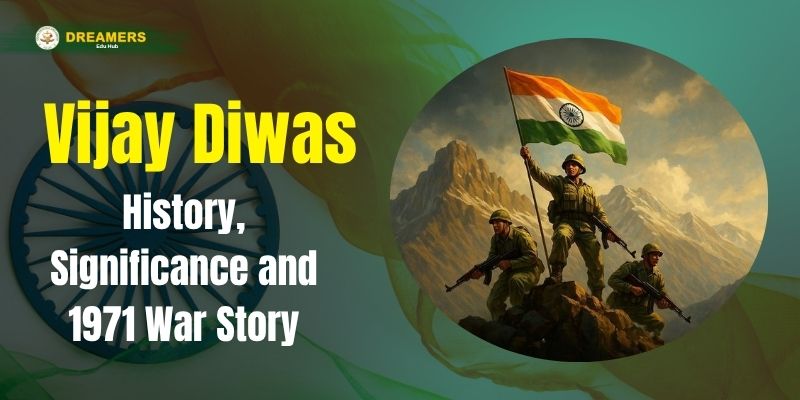
Vijay Diwas is the day India remembers its historic military victory over Pakistan in the 1971 war. On this day, the Indian Armed Forces, along with the people of what is now Bangladesh, achieved a decisive win that led to the liberation of East Pakistan and the birth of Bangladesh.
In simple words, Vijay Diwas is a national day of victory, gratitude and respect. It honours the courage, sacrifice and professionalism of the Indian Army, Navy and Air Force, as well as the Mukti Bahini fighters who stood up against injustice and oppression.
Why 16 December Is Celebrated as Vijay Diwas
Vijay Diwas is observed every year on 16 December because on 16 December 1971, the commander of Pakistani forces in East Pakistan, Lt Gen A.A.K. Niazi, formally surrendered to Lt Gen J.S. Aurora of the Indian Army in Dhaka.
This surrender, involving around 93,000 Pakistani troops, is considered one of the largest military surrenders since the Second World War. The event ended the Indo–Pakistan War of 1971 on the eastern front and made way for the creation of Bangladesh. For India, this historic victory is remembered as Vijay Diwas, a symbol of military excellence and moral responsibility.
Historical Background: The 1971 Indo–Pakistan War
Political Situation Before the 1971 War
The road to Vijay Diwas began with political tensions in East Pakistan (present-day Bangladesh). In 1970, the Awami League led by Sheikh Mujibur Rahman won a clear majority in Pakistan’s national elections, mainly due to support from East Pakistan. However, power was not transferred, and tensions between the West Pakistan leadership and the Bengali population increased.
A brutal military crackdown, known as Operation Searchlight, was launched in March 1971 against Bengali civilians, students and intellectuals. Large-scale atrocities and a humanitarian crisis followed, sending millions of refugees into India. These events pushed India to support the Bangladesh liberation struggle, which later combined with direct conflict during the 1971 war and eventually led to Vijay Diwas.
Key Events of the 1971 War
The 1971 war formally began on 3 December 1971, when Pakistan launched pre-emptive air strikes on Indian air bases. India responded by declaring war and engaging on both the eastern and western fronts.
On the eastern side, Indian forces and the Mukti Bahini moved rapidly towards Dhaka. In just 13 days, Indian troops gained a clear advantage. On 16 December 1971, the Pakistani Eastern Command surrendered in Dhaka, leading directly to the victory celebrated as Vijay Diwas. On the western front, India also gained territory before the final ceasefire.
Timeline of Key Events Leading to Vijay Diwas
| Date | Event | Importance for Vijay Diwas |
|---|---|---|
| 25 March 1971 | Operation Searchlight in East Pakistan | Humanitarian crisis and start of Liberation War |
| 3 December 1971 | Pakistan’s air strikes on Indian airfields | Start of full-scale Indo–Pakistan War |
| 3–16 December 1971 | Indian operations in East and West | Rapid advance towards Dhaka and strong defence in the West |
| 16 December 1971 | Surrender of Pakistani forces in Dhaka | Victory marked as Vijay Diwas |
Creation of Bangladesh and India’s Role
The surrender on 16 December 1971 not only marked Vijay Diwas for India but also the birth of Bangladesh. East Pakistan officially became an independent country after a long struggle that combined internal resistance and external support.
India’s role was two-fold: a humanitarian response to millions of refugees and a strategic decision to support the Bengali freedom movement. Vijay Diwas therefore represents not just a military victory but also a moment when India helped a neighbouring region gain freedom from oppression, while also safeguarding its own security and values.
Why Vijay Diwas Is Important for India?
Honouring the Sacrifice of Soldiers and Veterans
At the heart of Vijay Diwas is respect for the soldiers, sailors, air warriors and Mukti Bahini fighters who risked and, in many cases, gave their lives. Thousands of Indian soldiers were killed or wounded during the 1971 conflict.
Vijay Diwas is a national moment to remember their bravery, discipline and selfless service. War widows, veterans and families of martyrs are honoured in different ceremonies. The day becomes a reminder that the freedoms enjoyed today are built on the sacrifices of earlier generations.
Impact on India’s Defence and National Security
The success remembered on Vijay Diwas also changed how the world looked at India’s defence capabilities. The 1971 victory showed the strength of joint planning between the Army, Navy and Air Force, and the importance of strong leadership at political and military levels.
In later years, the experience of 1971 helped India improve doctrines, training and coordination. Vijay Diwas therefore serves as a case study in effective strategy, intelligence, logistics and cooperation between the armed forces and civil leadership.
Vijay Diwas and the Idea of National Unity and Pride
Vijay Diwas carries an emotional meaning as well. The 1971 victory created a sense of unity across India, cutting across regions, languages and communities. Citizens felt proud that the country stood up against injustice and also managed a complex war with clarity and resolve.
Every year, Vijay Diwas renews this feeling of unity and pride. It encourages citizens to see national security not only in terms of weapons and borders, but also as a shared responsibility based on solidarity, justice and respect for human life.
How Vijay Diwas Is Observed Across the Country?
Official Ceremonies, Wreath Laying and Parades
On Vijay Diwas, the Government of India and the Armed Forces organise ceremonies at war memorials such as the National War Memorial in New Delhi and various regimental memorials across the country. Senior leaders, service chiefs and veterans lay wreaths to honour the fallen.
Special events are also held at the Eastern Command headquarters in Kolkata, which played a key role in operations on the eastern front. These ceremonies include military bands, guard of honour, and remembrance services for those who fought in 1971.
Events in Schools, Colleges and Defence Institutions
Educational institutions mark Vijay Diwas with activities like:
-
Talks by veterans and defence officers
-
Documentary screenings and exhibitions on the 1971 war
-
Essay writing, quiz and poster competitions on Vijay Diwas and national security
These programs help students understand the meaning behind Vijay Diwas, not just as a date but as a living story of courage and responsibility. Defence academies and training institutions also conduct seminars and war studies sessions based on 1971 operations.
Media, Documentaries and Social Media Tributes
Television channels, newspapers and online platforms run special coverage on Vijay Diwas. War documentaries, interviews with veterans and analysis of the 1971 campaign are broadcast to remind citizens of the details behind the victory.
On social media, hashtags related to Vijay Diwas trend across platforms. People share stories, photographs, patriotic messages and tributes to the armed forces. For many, Vijay Diwas becomes a moment to publicly express gratitude towards soldiers and their families.
Stories of Courage from the 1971 War
Brave Soldiers and Gallantry Award Winners
Vijay Diwas is closely linked with many remarkable stories of personal bravery. Officers and soldiers from different regiments of the Army, as well as personnel from the Navy and Air Force, showed extraordinary courage in combat. Several of them received the Param Vir Chakra, Maha Vir Chakra and Vir Chakra, India’s highest gallantry awards, for actions in the 1971 war.
These stories turn Vijay Diwas into more than an abstract concept; they show real individuals who chose duty over comfort, and courage over safety, often at a very young age.
Navy, Air Force and Army Operations in the War
Vijay Diwas recognises the coordinated effort of all three services:
-
The Indian Navy carried out bold operations like the attacks on Karachi harbour and the blockade in the East, cutting off supplies.
-
The Indian Air Force gained air superiority over East Pakistan in a short time and supported ground operations.
-
The Indian Army, working with the Mukti Bahini, advanced quickly, bypassing strongholds and reaching Dhaka faster than many expected.
These combined efforts created the conditions for the surrender that is remembered every Vijay Diwas.
Inspiring Anecdotes for the Young Generation
Many anecdotes from the 1971 war show intelligence, innovation and human values even in the middle of conflict. Accounts of officers protecting civilians, soldiers sharing food with refugees, or units improvising solutions in tough terrain all add depth to Vijay Diwas.
Such stories inspire young readers to see Vijay Diwas not only as a chapter in military history, but as an example of how courage and compassion can go together.
Lessons from Vijay Diwas for Today’s Generation
Respect for Armed Forces and Their Families
One of the main lessons of Vijay Diwas is respect for the armed forces and their families. The 1971 victory shows how discipline, training and sacrifice protect a nation’s freedom and dignity. Remembering this on Vijay Diwas encourages society to support veterans, war widows and serving personnel in meaningful ways.
Understanding Peace, Diplomacy and Responsibility
Vijay Diwas also teaches that war is always a serious and painful event, even when victory is achieved. The 1971 war came after failed political negotiations and growing humanitarian crisis. This background reminds policy-makers and citizens that strong diplomacy, early conflict resolution and respect for human rights are essential to prevent future wars.
At the same time, Vijay Diwas confirms that when aggression and mass atrocities occur, a firm response may be necessary to restore justice and protect lives.
Patriotism Beyond One Day: Duty, Discipline and Service
Finally, Vijay Diwas suggests a form of patriotism that goes beyond one day of celebration. The spirit behind Vijay Diwas lives in daily actions: honesty in work, discipline in behaviour, respect for laws, care for fellow citizens and willingness to serve the community.
When these values are practised across society, the victory remembered on Vijay Diwas continues in a new form. The day becomes not only a memory of 1971, but a guiding light for the present and the future.
Vijay Diwas with Doon Defence Dreamers: Remembering India’s Big Victory
On Vijay Diwas, Doon Defence Dreamers which is known as the best CDS coaching in Dehradun, celebrates not just a historic victory, but the spirit of every future officer sitting in its classrooms. The day usually begins with paying tribute to the martyrs of the 1971 war through a simple remembrance ceremony and a short talk on why 16 December is so important for India. Teachers and mentors share real war stories, the strategy of the 1971 Indo–Pak war, and the leadership of our armed forces so that NDA/CDS aspirants can learn from it. Motivational sessions, patriotic videos and discussions on “what it means to wear the uniform” help students connect emotionally with the sacrifices of soldiers. A two-minute silence is observed to honour the fallen heroes, and many students speak a few lines, pledging to serve the nation with the same courage. In this way, Vijay Diwas at Doon Defence Dreamers becomes a powerful mix of remembrance, respect and resolve for every defence aspirant.
Conclusion
Vijay Diwas, celebrated on 16 December, is a powerful reminder of India’s victory in the 1971 war, the birth of Bangladesh, and the courage of countless soldiers and civilians. From the surrender in Dhaka to the stories of bravery across land, sea and air, every part of this history adds meaning to Vijay Diwas. By learning from this day and honouring its spirit, each generation can strengthen national unity, respect for human life and commitment to peace.
Frequently Asked Questions (FAQs)
Q1. What is Vijay Diwas and why is it significant for India?
Vijay Diwas is the day India remembers its victory over Pakistan in the 1971 Indo–Pakistan War. On 16 December 1971, Pakistani forces in East Pakistan surrendered to the Indian Army, leading to the creation of Bangladesh. The day is significant because it honours the courage and sacrifice of soldiers and celebrates a historic example of military success and moral responsibility.
Q2. Why is Vijay Diwas observed on 16 December every year?
It is observed on 16 December because on this date in 1971 the Pakistani Eastern Command formally surrendered in Dhaka. The surrender of about 93,000 Pakistani troops ended the war on the eastern front. This clear and decisive victory made 16 December a permanent symbol of national pride and military achievement for India.
Q3. How is Vijay Diwas celebrated across India?
It is marked by wreath-laying ceremonies and remembrance events at war memorials, including the National War Memorial in New Delhi. The Armed Forces, government leaders and veterans take part in tributes to fallen soldiers. Schools, colleges and media houses also organise talks, documentaries, competitions and social media campaigns to spread awareness about the 1971 war and its importance.
Q4. What was the connection between Vijay Diwas and the creation of Bangladesh?
The victory commemorated as Vijay Diwas directly led to the liberation of East Pakistan and the formation of Bangladesh. The Indian Armed Forces, together with the Mukti Bahini, defeated Pakistani troops in just 13 days of intense fighting. This victory ended large-scale atrocities in the region and allowed the people of East Pakistan to establish an independent country.
Q5. What lessons does Vijay Diwas offer to today’s generation?
It teaches respect for the armed forces and recognition of the sacrifices made by soldiers and their families. It highlights the importance of strong defence, wise leadership and responsible diplomacy in protecting peace and human rights. The day also encourages a deeper form of patriotism, based on daily duty, discipline, service to society and unity across regions and communities.