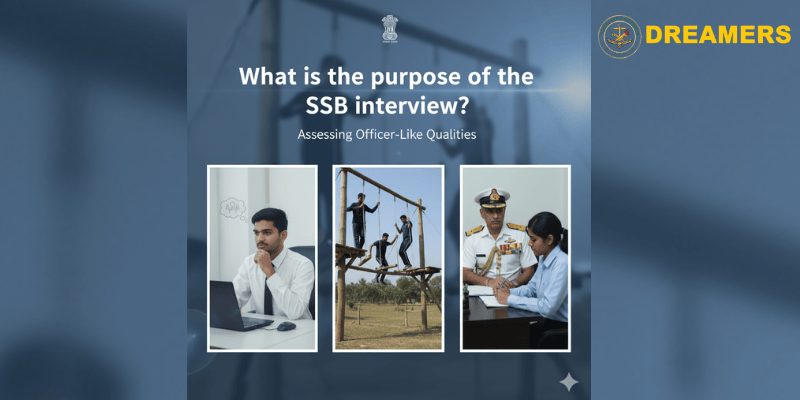
The Services Selection Board (SSB) is the assessment body of the Indian Armed Forces tasked with selecting candidates who are fit, capable, and suitable to become commissioned officers.
After a candidate clears the written entrance exam (e.g. NDA, CDS, AFCAT, etc.), the SSB interview is a rigorous, multi-day evaluation that examines much more than academic knowledge. Its central aim is to assess personality, character, leadership potential, psychological robustness, and officer-like qualities (OLQs) that are essential for military service.
In short: the SSB interview is the gateway where selection shifts from what you know to who you are and how you behave under varied pressures. Only those who demonstrate suitability across multiple dimensions are recommended for final selection.
Why is the SSB interview necessary? The rationale behind it
Here are the main reasons why the SSB interview is indispensable in the officer selection process:
-
Beyond academics
Bookish knowledge or success in written exams does not guarantee leadership, ethical behavior, resilience, or sound judgment. The SSB is designed to look beyond scores and evaluate whether a candidate has the temperament and potential to lead in complex, uncertain, and high-stress environments. -
Testing officer-like qualities (OLQs)
The concept of OLQs is central to the SSB. These are traits and competencies considered essential for a military officer, such as leadership, initiative, perseverance, decision-making, integrity, cooperation, communication, emotional stability, and more. -
Holistic, multi-dimensional evaluation
The SSB does not rely on a single test. It employs a variety of assessment methods — psychological tests, group tasks, personal interviews, obstacle courses, group planning exercises, etc. — to gather a rich, multifaceted view of a candidate’s personality and potential. -
Stress and adaptability under dynamic conditions
The military environment is rarely stable or predictable. Officers must perform under stress, make decisions under uncertainty, lead teams, handle conflicts, and adapt to evolving situations. The SSB tasks are intentionally designed to introduce stress, conflicting objectives, surprises, and time pressure, so candidates’ true behavior under pressure emerges. -
Consistency, integrity, and self-awareness
The SSB looks for authenticity and consistency in what a candidate says, how they act, and how they think. Discrepancies between words and actions or between different tests raise concerns. Also, self-awareness — knowing your strengths, weaknesses, values — is a key metric. -
Fair and standardized selection
Because the SSB uses standardized procedures across centers and multiple assessors (Interviewing Officer, Group Testing Officers, Psychologist), it helps maintain fairness and uniformity of assessment. Candidates from diverse backgrounds get measured on comparable criteria.
Hence, the SSB interview is not just an “oral interview” but a comprehensive personality and suitability test, rooted in officer-selection philosophy.
What exactly does the SSB interview evaluate? Key dimensions and constructs
To understand the “purpose” fully, it’s important to know what the SSB aims to evaluate in a candidate. Below are the major dimensions:
Officer Like Qualities (OLQs)
These are the core traits that SSB assessors look for in every candidate. While different sources may list slightly different sets, they broadly include:
-
Leadership & Initiative — ability to lead a team, take responsibility, propose solutions
-
Planning & Organizing Ability — structured thinking, prioritizing tasks
-
Communication Skills — clarity of ideas, confidence, listening
-
Courage & Conviction — moral courage, willingness to stand by one’s decisions
-
Social Adaptability / Cooperativeness — working with diverse people, empathy
-
Emotional Stability / Mental Health — resilience under stress
-
Determination & Perseverance — persistence in adversity
-
Self-awareness / Integrity — consistency, honesty, knowing one’s limitations
-
Problem-Solving & Decision Making — analytical thinking and action under constraints
-
Speed & Flexibility — adapting to changing conditions quickly
-
Balance — maintaining calm and judgment when under stress
The SSB process is built to test each candidate on these qualities in multiple settings and from multiple angles.
Psychological Attributes & Personality
Through psychological tests (TAT, WAT, SRT, SDT, etc.), the SSB probes into your deeper thought patterns, motivations, attitudes, preferences, and emotional responses. It looks for authenticity, consistency, positive thinking, and resolve.
Group Behavior and Teamwork
Group tasks (GTO tasks) such as group discussion, group planning, progressive task, command tasks, obstacle courses, lecturettes, final group task etc. assess how you work in a group, your influence, inclusiveness, ability to lead without dominating, cooperation, and coordination.
Physical and Mental Robustness
Certain tasks test physical stamina, agility, endurance and how mental focus holds when fatigued. The SSB is partially about mental strength in adversity. The way you respond when tired, pressured, or when things don’t go your way is closely observed.
Consistency & Integrity of Responses
A major purpose is to verify whether your claims, stories, attitudes, and performance are consistent across different tests and situations. If you present one persona in one test and a contradictory one in another, that raises red flags for assessors.
Motivation, Values & Commitment to Service
Being an officer is not just about career—it’s a service to the nation. So SSB probes your motivation, patriotism, sense of duty, and sincerity. They evaluate whether your desire to join is deep, realistic, and sustained, or superficial.
A breakdown of the SSB process (2025 onward) — how the evaluation arena is structured
The SSB interview generally lasts five days, and the evaluation proceeds through a well-defined progression.
Below is a high-level breakdown of how the five days are structured and how they serve the purpose of the interview:
Day 0 / Reporting (Preliminary)
-
Arrival, documentation check, issuing chest numbers, orientation.
-
No formal evaluation yet, but discipline, punctuality, and attitude begin to be noted.
Day 1 – Screening / Stage I
-
Officer Intelligence Rating (OIR) / Written Reasoning Tests: Verbal and non-verbal reasoning, logical aptitude under time constraints.
-
Picture Perception & Discussion Test (PPDT): Candidates see a blurred image (30s), jot down a story (4 min), and then narrate & discuss it in a group.
The screening is a cut-off phase; only those who pass proceed further.
Day 2 – Psychological Tests
-
TAT (Thematic Apperception Test) – write stories on shown images
-
WAT (Word Association Test) – immediate associations to words
-
SRT (Situation Reaction Test) – economic responses to real-life scenarios
-
SDT (Self Description Test) – how you see yourself & how others see you
These reveal your inside thinking, predispositions, values, and consistency. No “right” answer; honesty is valued most.
Days 3 & 4 – GTO Tasks & Personal Interview
These are the “action days”:
-
Group Tasks (GTO):
• Group discussions
• Group planning exercises
• Progressive Group Task (PGT)
• Half Group Task (HGT) or sometimes directed tasks
• Individual Obstacles
• Command Task (you act as a commander, choose members, execute)
• Final Group Task (FGT) -
Lecturette / Mini Talk: Given a topic, you speak for a few minutes, then field questions.
-
Personal Interview: Assessed by the Interviewing Officer. They explore your background, experiences, goals, failures, strengths/weaknesses, etc. They also evaluate your communication skills, maturity, clarity, and alignment with service values.
These days are critical because they demonstrate how you behave in group settings, under stress, while balancing physical and mental tasks.
Day 5 – Conference / Final Verdict
-
The assessors (Psychologist, GTO, Interviewing Officer) hold a conference where each candidate is discussed in detail.
-
Candidates might have a short interaction with the panel, may be asked follow-up questions or clarifications.
-
Final recommendations are made: Recommended / Not Recommended.
Thus, each stage builds on the prior ones, giving the assessors a holistic, cumulative view of a candidate’s potential.
What’s new / evolving in 2025 — trends in SSB evaluation
The SSB process is not static. Over time, assessors adjust tasks, trends, and emphasis to better align with modern military challenges and societal changes. Here are some observed or predicted changes around 2025:
-
More realistic & complex tasks: Tasks may simulate real-world challenges (disaster relief, operations, coordination under uncertainty) rather than purely abstract obstacles.
-
Higher emphasis on self-awareness: In psychological tests (especially SDT), assessors now expect deeper reflections on strengths, weaknesses, goals, and values — rote or template responses are less accepted.
-
Modern / socially relevant stimuli: WAT and TAT prompts increasingly include social issues, technological themes, leadership challenges, and ethical dilemmas (e.g. AI, climate crisis) to gauge views and values.
-
Group diversity & dynamic roles: Teams may be more heterogeneous; situations change mid-task, forcing candidates to adapt. The leadership model may favor empathy, inclusiveness, and flexibility.
-
Greater stress testing: Time constraints, surprise modifications, conflicting demands, resource constraints — more emphasis on handling pressure with composure.
These evolving trends sharpen the purpose of the SSB: not merely to test static personality traits, but to see how a candidate evolves, handles change, thinks under stress, and learns from feedback.
How the SSB interview fits into the larger selection system
To appreciate the purpose fully, you must see where SSB sits in the entire selection pipeline:
-
Written Exam / Entrance Test
Entry schemes (NDA, CDS, AFCAT, etc.) use written tests to filter candidates on academic and aptitude grounds. -
SSB Interview + Psychological / GTO / PI / Conference
The SSB is the qualifier for personality and suitability. It’s not just another exam — it’s the core gateway to officer status. -
Medical Examination & Fitness
Even if recommended in SSB, candidates must pass medical and physical fitness tests to be finally accepted. -
Merit List & Final Selection
In most cases, the final selection depends on a weighted combination of the written exam and SSB performance. For instance, for NDA, each carries 50% weightage.
Thus, the SSB is both evaluative and discriminatory: it weeds out candidates who may excel academically but lack officer qualities, while promoting those with balanced potential.
Challenges & misconceptions — what SSB is not, and pitfalls to avoid
To better understand the true purpose, it helps to clarify what the SSB does not aim for, and what common misunderstandings are:
-
It is not a knowledge test — Most of the tasks do not test factual knowledge or technical domain expertise. The focus is on thinking, behavior, personality.
-
It is not about rehearsed answers — Memorized or “coached” answers are often seen as inauthentic. Genuine responses, consistency, and self-awareness matter more.
-
It is not just about physical strength — Physical tasks matter, but they are tools to test mental resilience, leadership, and perseverance under strain.
-
It is not about dominating group discussions — Leadership is not about overpowering or monopolizing; it is also about inclusiveness, listening, guiding, facilitating.
-
It is not a single-day test — Because the evaluation spans multiple days and many tasks, one off-day or weak performance in one segment is mitigated by overall consistency and cumulative impression.
Many aspirants go wrong by preparing in silos (just practicing psychological tests or obstacle courses) without understanding that the SSB is about integration — how your thought, speech, and actions align across tasks.
SSB Interview Preparation at Doon Defence Dreamers
The SSB Interview Preparation at Doon Defence Dreamers is designed to give aspirants a complete edge in clearing one of the toughest selection processes for the Armed Forces. The academy offers a well-structured training program that covers every stage of the five-day SSB process — including psychological tests, group testing officer (GTO) tasks, personal interviews, and conference preparation. Under the mentorship of highly experienced trainers and retired defence officers, students receive practical guidance, mock interview sessions, and real-time practice for group discussions, lecturettes, and outdoor tasks. Along with academic and technical readiness, the program emphasizes personality development, communication skills, leadership qualities, and confidence-building exercises. By combining discipline with modern teaching techniques, Doon Defence Dreamers ensures that candidates develop genuine officer-like qualities and maximize their chances of success in the SSB interview.
In summary — the ultimate purpose of the SSB interview (2025 view)
Putting it all together, the purpose of the SSB interview is to:
-
Identify candidates with the innate and developed traits necessary for military leadership (the right mix of mental, emotional, social, and physical qualities).
-
Assess suitability beyond academics, because the demands of an officer’s role extend far beyond intellectual acumen.
-
Test behavior under stress, in groups, under uncertainty, and in changing environments — replicating conditions that officers often face.
-
Observe consistency, integrity, adaptation, responsibility, and self-awareness — not superficial traits but deep-seated qualities.
-
Provide a robust, fair, multi-dimensional selection system where the best suited candidates are recommended across diverse backgrounds.
-
Filter not just by success but by potential — to choose those who can grow, develop, and handle challenges ahead.
In 2025, with evolving challenges such as hybrid warfare, asymmetrical threats, technology-driven operations, and changing social dynamics, the SSB interview’s purpose becomes even more critical: to ensure that future officers are not just brave and intelligent, but resilient, adaptable, morally grounded, empathetic, and capable of leading in complexity.