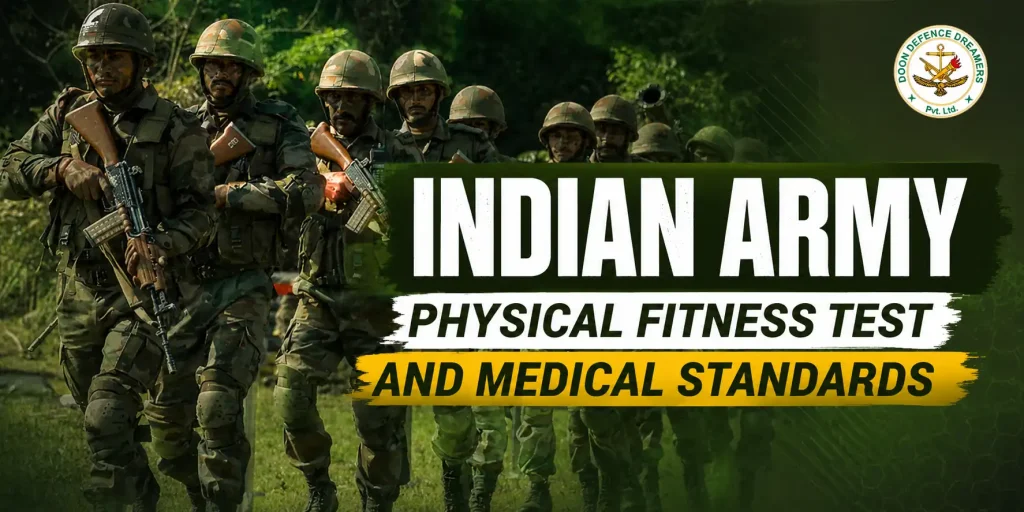
Joining the Indian Army is one of the most respected career choices a young person can make in India. It is a path filled with honour, discipline, and a lifelong sense of purpose. But before anyone can wear that uniform, they must prove that they are physically and medically fit to handle the demands of military life.
The Indian Army physical fitness test is a critical part of the recruitment process. It is designed to ensure that every soldier who joins the force is strong, healthy, and capable of performing under tough conditions. From running to push-ups to detailed medical checks, the fitness test covers every aspect of a candidate’s physical readiness.
Whether you are preparing for the NDA, CDS, Agniveer scheme, or any other Indian Army recruitment, understanding the physical fitness standards is the first and most important step.
Why Physical Fitness is a Core Requirement in the Indian Army?
The Indian Army operates in some of the most challenging terrains in the world from the freezing heights of Siachen to the dense jungles of the Northeast. Soldiers must be physically capable of carrying heavy loads, running long distances, and responding to emergencies at any time. This is why physical fitness is not just preferred it is mandatory.
The Indian Army physical fitness test serves as a filter to ensure only those who meet the required physical standards are selected. It is a fair and transparent assessment that gives every candidate an equal opportunity to prove their fitness.
Who Has to Appear for the Physical Fitness Test?
The physical fitness test is mandatory for all candidates applying to the Indian Army through any recruitment route. This includes:
- Agniveer (Soldier General Duty, Clerk, Tradesman, Technical)
- NDA and CDS candidates (before joining)
- Direct entry officers through the SSB process
- Technical and specialist entry schemes
When and Where the Test is Conducted?
The physical fitness test is usually conducted at Army Recruitment Offices (AROs) located across different states and districts. Recruitment rallies are announced by the Indian Army and candidates must register in advance. The test is typically held over one or two days at the rally venue.
Running Test: Distance, Time, and Scoring
Running is the most important component of the Indian Army physical fitness test. The standard running distance is 1.6 kilometres (approximately 1 mile). Candidates must complete this distance within a specific time to qualify and earn marks.
| Category | Distance | Time for Full Marks | Time for Qualifying |
|---|---|---|---|
| Group I | 1.6 km | Under 5 minutes 30 seconds | Under 5 minutes 45 seconds |
| Group II | 1.6 km | Under 5 minutes 45 seconds | Under 6 minutes |
How Marks are Awarded Based on Timing?
| Recruitment Category | Running Distance | Group I (Full Marks) | Group II (Qualifying) | Marks (Group I) | Marks (Group II) |
|---|---|---|---|---|---|
| Agniveer – Soldier General Duty (GD) | 1.6 km | Under 5 min 30 sec | 5 min 31 sec – 5 min 45 sec | 60 marks | 48 marks |
| Agniveer – Soldier Technical | 1.6 km | Under 5 min 30 sec | 5 min 31 sec – 5 min 45 sec | 60 marks | 48 marks |
| Agniveer – Soldier Clerk / SKT | 1.6 km | Under 5 min 30 sec | 5 min 31 sec – 5 min 45 sec | 60 marks | 48 marks |
| Agniveer – Soldier Tradesman | 1.6 km | Under 5 min 30 sec | 5 min 31 sec – 5 min 45 sec | 60 marks | 48 marks |
| NDA (After Written Exam – SSB Stage) | 2.4 km | Under 10 min 30 sec | Under 11 min | Based on SSB | Based on SSB |
| CDS – IMA / OTA / INA / AFA | 2.4 km | Under 10 min 30 sec | Under 11 min | Based on SSB | Based on SSB |
| Territorial Army | 1.6 km | Under 5 min 30 sec | 5 min 31 sec – 5 min 45 sec | 60 marks | 48 marks |
| JCO / NCO (Religious Teacher, Catering etc.) | 1.6 km | Under 5 min 30 sec | 5 min 31 sec – 5 min 45 sec | 60 marks | 48 marks |
Marks for running are awarded based on how quickly the candidate completes the 1.6 km distance. Finishing in Group I earns more marks than finishing in Group II. Candidates who do not finish within the Group II time limit are disqualified from the recruitment rally.
This scoring system encourages candidates to push their limits and aim for the best possible timing rather than just clearing the minimum cutoff.
Tips to Improve Your Running Performance
- Start training at least 3 to 4 months before the recruitment rally
- Run daily, beginning with shorter distances and gradually increasing
- Focus on maintaining a steady pace rather than sprinting and tiring out early
- Include interval training alternate between fast and slow running
- Wear proper running shoes to avoid injury
Push-ups and Other Physical Tasks
How Many Push-ups are Required and How They are Counted
After the running test, candidates are required to perform push-ups. The minimum number of push-ups required is 10 in a set time, but to score full marks, candidates need to perform more. Push-ups are counted only when done in the correct form — chest touching the ground, arms fully extended, and body in a straight line.
| Push-ups Completed | Marks Awarded |
|---|---|
| 10 push-ups | Minimum qualifying |
| 13 push-ups | Good score |
| 16+ push-ups | Maximum marks |
Other Physical Tasks Included in the Test
Depending on the recruitment category, candidates may also be required to perform:
- Sit-ups (Utthak Baithak) — Candidates must complete a set number of squats correctly
- 9 feet ditch jump — Candidates must jump across a 9-foot ditch without falling
- Beam (Pull-ups) — Required for some categories; minimum 6 pull-ups are expected
These tasks test different aspects of physical strength and agility, ensuring candidates are well-rounded in their fitness.
Common Mistakes Candidates Make During the Test
- Incomplete push-up form leading to repetitions not being counted
- Starting the run too fast and losing energy midway
- Not practising the 9-foot ditch jump beforehand
- Wearing uncomfortable or inappropriate footwear on the day of the test
Medical Standards for Indian Army Recruitment
Height, Weight, and Chest Measurements Required
Medical standards are an equally important part of the Indian Army physical fitness test process. Candidates must meet minimum physical measurements to be declared medically fit.
| Measurement | Standard Requirement |
|---|---|
| Height (General) | Minimum 170 cm |
| Height (Hilly Regions/Tribals) | Minimum 162–165 cm |
| Weight | Proportionate to height and age |
| Chest (Unexpanded) | Minimum 77 cm |
| Chest Expansion | Minimum 5 cm expansion required |
Eyesight and Hearing Standards
Eyesight is one of the most important medical requirements. For soldier-level entries, distant vision should be 6/6 in one eye and 6/9 in the other without glasses. Candidates with colour blindness are not eligible for most categories. Hearing must be normal in both ears with no signs of chronic ear disease.
Other Medical Conditions That Can Affect Eligibility
Several medical conditions can lead to rejection during the medical examination. These include flat feet, knock knees, varicose veins, skin diseases, dental problems, and any history of serious illness or surgery. Candidates are advised to get a thorough medical check-up before appearing for the recruitment rally to avoid last-minute surprises.
How to Prepare for the Indian Army Physical Fitness Test?
Preparation for the Indian Army physical fitness test requires consistency and discipline. A simple daily routine can make a huge difference over 3 to 6 months of training.
- Morning — 1.6 km run + stretching + push-ups and sit-ups
- Evening — Strength training, ditch jump practice, and pull-ups
- Weekly — One rest day for muscle recovery
Diet and Nutrition Tips for Physical Preparation
Physical training must be supported by the right diet. Candidates should focus on:
- High protein foods like eggs, dal, paneer, and chicken to build muscle
- Complex carbohydrates like rice, roti, and oats for energy
- Plenty of water to stay hydrated during training
- Avoiding junk food, fried snacks, and excessive sugar
For a candidate who is moderately active, 3 to 4 months of dedicated training is usually enough to meet the Indian Army physical fitness test standards comfortably. For those starting from scratch, 6 months of consistent preparation is recommended.
Common Reasons Candidates Fail the Fitness Test
Many candidates fail not because they are unfit, but because of avoidable mistakes. Running too fast at the start and burning out before the finish line is the most common error. Improper push-up form, skipping the ditch jump practice, and not building enough stamina are other common reasons for failure.
Medical Rejections and How to Avoid Them
Medical rejections often come as a shock to candidates who have trained hard but ignored their health. Issues like flat feet, poor eyesight, low chest measurement, and being underweight or overweight are common causes. Getting a pre-recruitment medical check-up helps identify and address these issues well in advance.
Mental Preparation and Staying Consistent
Physical preparation is only half the battle. Many candidates lose confidence on the day of the test due to nerves and pressure. Practising in groups, simulating rally conditions during training, and maintaining a positive mindset are just as important as physical readiness.
Physical Training at Doon Defence Dreamers
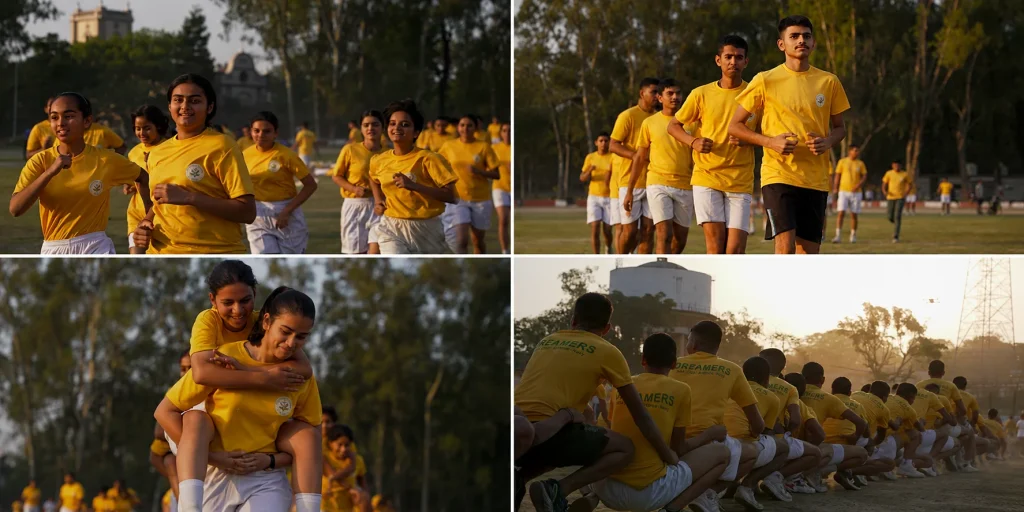
At Doon Defence Dreamers, physical fitness is taken just as seriously as academics. Every morning, students go through a structured physical training (PT) session that is designed to build stamina, strength, and discipline from day one. These sessions are conducted regularly so that students gradually develop a habit of physical activity because in the Indian Army, fitness is not just a requirement, it is a way of life. The goal is simple: by the time a student appears for recruitment, physical training should feel natural and not like a burden.
What makes these PT sessions truly valuable is that they are led by retired ex-Army mentors who bring years of real military experience to the ground. These mentors know exactly what the Army expects from a recruit and they train students accordingly with the same intensity, structure, and discipline followed in actual Army training. Their guidance goes beyond just exercises; they teach students the right posture, breathing techniques, and mental toughness needed to perform under pressure.
Final Thoughts
The Indian Army physical fitness test is tough, but it is absolutely achievable with the right preparation. Every push-up, every kilometre of running, and every medical check is designed to ensure that those who serve the nation are truly ready for it.
Start early, train consistently, eat well, and take your medical fitness seriously. The day you cross that finish line and hear your name in the selected list will make every drop of sweat worth it.
Key Takeaways
- The Indian Army physical fitness test is mandatory for all recruitment entries including Agniveer, NDA, and CDS.
- The running test covers 1.6 km — finishing under 5 minutes 30 seconds earns maximum marks.
- Push-ups, sit-ups, 9-foot ditch jump, and pull-ups are the key physical tasks tested during recruitment.
- Medical standards cover height, weight, chest, eyesight, hearing, and overall health — candidates must meet all requirements.
- Common medical disqualifiers include flat feet, colour blindness, low chest measurement, and skin or dental issues.
- A 3 to 6 month dedicated training routine covering running, strength, and diet is enough to prepare well.
- Avoiding common mistakes like improper form and poor pacing can significantly improve performance on the test day.
- Mental preparation and consistency are just as important as physical training for clearing the fitness test.
Frequently Asked Questions (FAQs)?
Q1. What is the minimum running time required to qualify in the Indian Army physical fitness test?
Candidates must complete the 1.6 km run within 6 minutes to qualify under Group II. However, to earn maximum marks, the run should be completed in under 5 minutes 30 seconds, which falls under Group I. Candidates who exceed the 6-minute limit are disqualified from the rally.
Q2. How many push-ups are needed to score full marks in the Indian Army recruitment?
Candidates need to complete a minimum of 10 push-ups to qualify. Performing 16 or more push-ups in the correct form typically earns maximum marks. The push-ups must be done properly — chest touching the ground and arms fully extended — for each repetition to be counted.
Q3. Can a candidate with spectacles appear for the Indian Army physical fitness test?
Candidates with corrected vision can appear for certain officer-level entries, but for soldier-level recruitment, candidates are generally required to have natural vision meeting the prescribed standards without the use of glasses or contact lenses. It is advisable to check the specific vision requirements for the category you are applying for.
Q4. What medical conditions can permanently disqualify a candidate from Indian Army recruitment?
Certain medical conditions such as flat feet, knock knees, colour blindness, varicose veins, chronic skin diseases, hearing impairment, and a history of serious illness or surgery can lead to permanent disqualification. Candidates are strongly advised to undergo a full medical check-up before attending a recruitment rally.
Q5. How early should a candidate start preparing for the Indian Army physical fitness test?
Ideally, candidates should start their physical preparation at least 4 to 6 months before the recruitment rally. This gives enough time to build running stamina, improve push-up count, work on body measurements if needed, and address any minor medical issues that may come up during a pre-check-up.