Selection for the Army, Navy or Air Force is not completed merely by clearing the written examination and SSB interview. Recommended candidates must also satisfy the prescribed health and physical requirements. Medical Boards in the Indian Armed Forces determine whether a candidate is physically and medically capable of undergoing demanding military training and performing service duties in different environments.
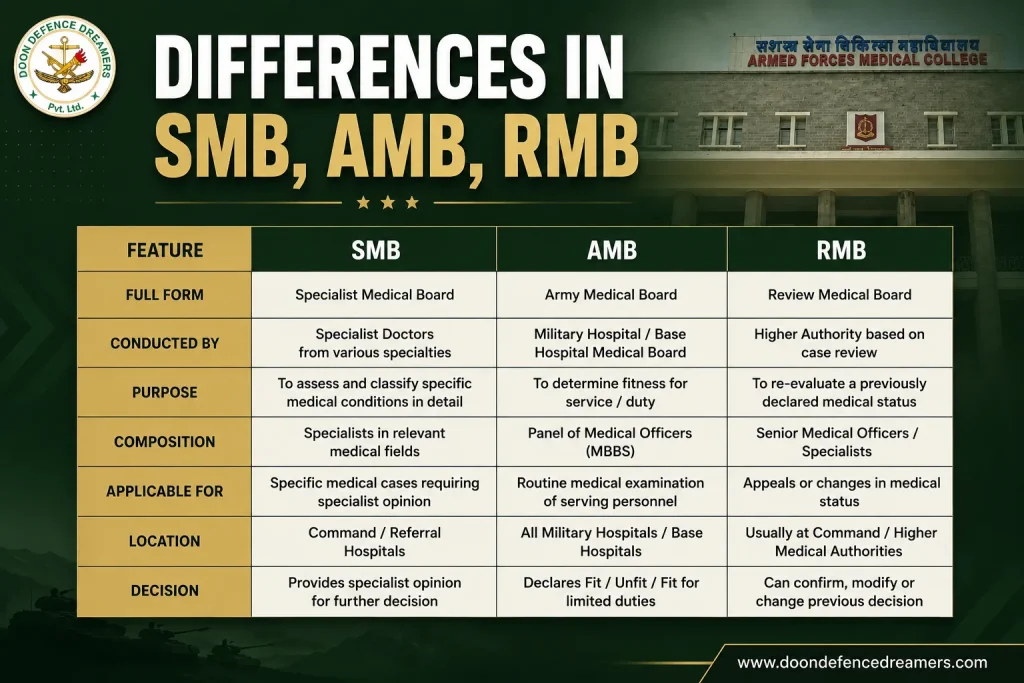
The procedure followed by Medical Boards in the Indian Armed Forces depends on whether the individual is a candidate awaiting recruitment or a serving member. For candidates, the usual stages include the Special Medical Board, Appeal Medical Board and, where permitted, Review Medical Board. Serving personnel may face categorisation, release, invaliding or reassessment boards.
Candidates should also understand the medical standards of Indian Armed Forces before reporting for selection. Physical preparation based on the Indian Army physical fitness test can improve general fitness, but it does not replace the official medical examination.
What is a Medical Board in the Indian Armed Forces?
A medical board is a formally constituted group of authorised medical officers that examines an individual and records an official opinion about fitness, disability or medical category. Medical Boards in the Indian Armed Forces help ensure that candidates and serving personnel are capable of performing their assigned duties without an unacceptable risk to themselves, their unit or military operations.
Purpose and Role of Medical Boards
The main purposes include:
- Determining fitness for recruitment and military training
- Identifying temporary or permanent medical conditions
- Recommending treatment, observation or reassessment
- Assigning or reviewing a medical category
- Assessing whether a disability is related to or aggravated by service
- Deciding suitability for continued military employment
- Recording health status before release, retirement or discharge
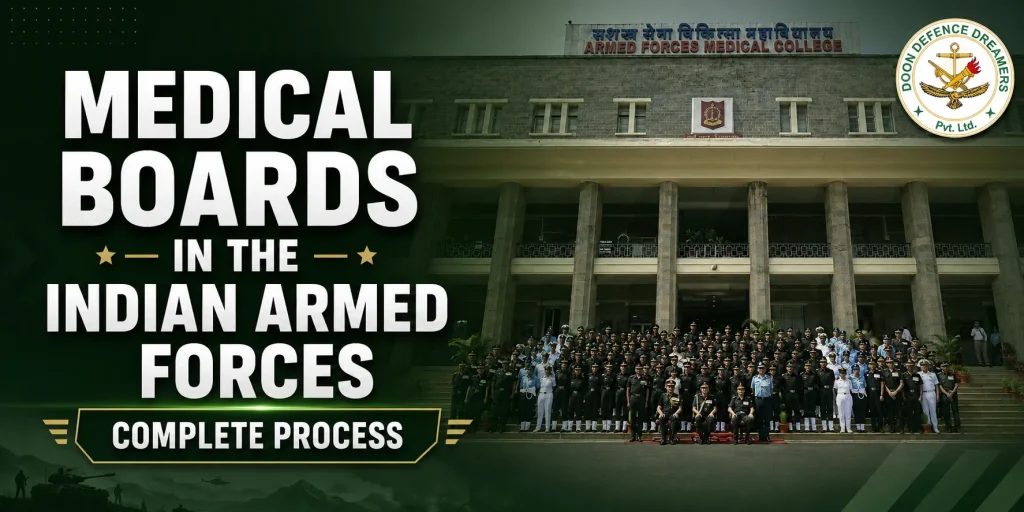
Medical Boards in the Indian Armed Forces are generally conducted at authorised Military Hospitals, Command Hospitals and other designated Armed Forces medical establishments. Depending on the entry and type of examination, specialist assessment may also take place at institutions such as the Armed Forces Medical College, Pune, or Army Hospital (Research and Referral), Delhi Cantonment.
The boards function under applicable service regulations, medical policies, administrative orders and Armed Forces Medical Services instructions.
Special Medical Board
The Special Medical Board, commonly called the SMB, is the initial detailed medical examination conducted for candidates recommended by the Services Selection Board.
Official Army call-up instructions state that an SSB-recommended candidate may be required to undergo an SMB over approximately four to five days. In exceptional cases, the process may take longer because of specialist investigations, additional tests or referrals.
When and Where is SMB Conducted?
The SMB is normally arranged after the candidate has been recommended by the SSB. It may be conducted at a Military Hospital connected with or located near the selection centre. The exact hospital and reporting instructions are communicated by the concerned authority.
Examinations Generally Involved
During Medical Boards in the Indian Armed Forces, candidates may be examined by different specialists, including:
- Medicine specialist
- Surgeon
- Ophthalmologist
- Ear, Nose and Throat specialist
- Dental officer
- Orthopaedic specialist, where required
- Other specialists based on the candidate’s condition or chosen branch
The examination may cover height, weight, chest measurements, vision, colour perception, hearing, dental health, blood pressure, heart, lungs, abdomen, spine, limbs, joints and general physical development. Blood tests, urine tests, radiological investigations and service-specific examinations may also be required.
Possible SMB Outcomes
| Medical finding | General meaning |
|---|---|
| Fit | Candidate satisfies the applicable medical standards |
| Temporary rejection or temporary unfitness | A condition may improve, heal or be corrected within the permitted period |
| Unfit | Candidate does not presently meet the required standard |
| Specialist observation | Further investigation or expert opinion is required |
A temporary rejection does not always mean final rejection. The candidate may be given time for treatment or recovery and asked to report for the appropriate appeal or reassessment process.
Appeal Medical Board
A candidate declared unfit by the initial board may, where allowed under the applicable entry instructions, seek an Appeal Medical Board or AMB. The purpose of the AMB is to independently reconsider the specific medical findings recorded during the initial examination.
For several Army officer entries, official instructions allow eligible candidates to report for an AMB within a maximum period of approximately 42 days from approval of the SMB result. Candidates must follow the deadline written in their own medical documents because the period and process can vary.
Eligibility For AMB
A candidate may generally seek an appeal when:
- The SMB has declared the candidate medically unfit
- The condition is appealable under the applicable rules
- The candidate submits consent or an appeal request on time
- The candidate reports to the designated hospital with the required documents
Documents Generally Required
The candidate may need:
- Medical board proceedings or unfitness certificate
- Temporary rejection slip, where applicable
- Appeal instructions issued by the hospital
- Identity and SSB-related documents
- Medical Receipt Order or prescribed payment receipt, if required
- Relevant investigation and treatment records
The term MRO may refer to a Military Receivable Order or another prescribed government payment document, depending on the instructions issued. Candidates should not make any payment without verifying the official requirement.
AMB Process and Outcome
An AMB usually concentrates on the condition for which the candidate was declared unfit. Some cases may be completed in a single day, while others may require investigations, specialist appointments or additional reporting.
Possible results are:
- Declared medically fit
- Unfit confirmed
- Additional observation or investigation advised
- Further action recommended according to service instructions
Therefore, Medical Boards in the Indian Armed Forces do not follow exactly the same duration in every case.
Review Medical Board
The Review Medical Board is a further review that may be considered after an adverse AMB decision. It is important to understand that an RMB is generally not an automatic right.
Official Army and Navy instructions indicate that a candidate declared unfit by an AMB may be required to submit a request for an RMB within 24 hours or one day of the AMB result. Approval remains at the discretion of the competent medical authority.
Grounds for Requesting an RMB
A request may be supported by:
- A possible error or inconsistency in the medical finding
- New and relevant medical evidence
- A difference in specialist opinion
- Evidence that the condition has been incorrectly assessed
- A genuine request for reconsideration under applicable policy
The application is processed through the recruiting and medical authorities concerned. Depending on the service and entry, the matter may be examined by the Recruiting Directorate and competent authorities under the Directorate General Armed Forces Medical Services.
An RMB may be held at a designated specialist centre. Army Hospital (Research and Referral), Delhi Cantonment, and AFMC Pune may be among the institutions used for specialised cases, but candidates should not assume that every RMB will be conducted at these locations. The final outcome may confirm the AMB decision or declare the candidate fit. The competent authority determines whether the request should be sanctioned and where the board will be conducted.
Medical Boards During Service
Medical Boards in the Indian Armed Forces remain relevant after recruitment because a person’s medical condition and employability can change during service.
Medical Categorisation Board
This board assesses a serving member’s health condition and recommends an appropriate medical category. It may also specify employment restrictions, treatment requirements and the period after which the condition should be reviewed.
Release Medical Board
A Release Medical Board may be conducted before retirement, discharge or release, particularly where a disability or low medical category has to be recorded. Its findings can become relevant to pensionary and disability benefits.
Invaliding Medical Board
An Invaliding Medical Board considers whether an individual has become permanently unsuitable for further military service on medical grounds. It evaluates the disability, functional limitations and suitability for continued employment.
Army Rules recognise that personnel found permanently unfit for military service by a medical board may be released according to the applicable provisions.
Re-survey or Reassessment Medical Board
A Re-survey Medical Board reassesses a disability after a prescribed period. It may determine whether the disability has improved, worsened or remained unchanged and whether its percentage or duration should be revised.
Appeal Procedure Against In-Service Medical Board Findings
A serving or retired member who disputes a medical-board finding should first use the departmental remedies available under the applicable service and pension rules.
The individual may submit a representation or statutory appeal supported by:
- Medical-board proceedings
- Service medical records
- Specialist reports
- Treatment documents
- Evidence connecting the condition with service circumstances
- Copies of earlier decisions and representations
When departmental remedies do not resolve the dispute, eligible service members, veterans or dependants may approach the Armed Forces Tribunal. Further legal remedies may be available according to the Armed Forces Tribunal Act and constitutional law. Direct access to a High Court or appeal before the Supreme Court depends on the nature of the case, jurisdiction and applicable legal procedure.
However, a medical condition developing during service does not automatically guarantee disability pension in every case. The reason for discharge, service rules, medical opinion, attributability, aggravation and evidence all remain important.
Conclusion
Medical Boards in the Indian Armed Forces protect both operational efficiency and the health of defence personnel. From the SMB conducted after SSB recommendation to the AMB and discretionary RMB, every stage has a defined purpose. During service, categorisation, release, invaliding and reassessment boards help determine employability, continued service and disability status.
Candidates and serving personnel should preserve every medical document, follow official timelines and rely on instructions issued by the relevant recruiting or service authority. A clear understanding of Medical Boards in the Indian Armed Forces can help individuals prepare properly, exercise available appeal rights and avoid mistakes caused by incomplete or unofficial information.
Key Takeaways
- Medical Boards in the Indian Armed Forces assess fitness at recruitment and throughout military service.
- The SMB is the first detailed medical examination for recommended candidates.
- An eligible candidate may appeal an adverse SMB finding through an AMB.
- An RMB is discretionary and must usually be requested immediately after the AMB result.
- In-service boards include categorisation, release, invaliding and reassessment boards.
- Candidates must follow the timelines and instructions issued specifically for their service and entry.
- Legal challenges involving service disability should be supported by complete medical and service records.
Frequently Asked Questions (FAQs)?
1. Is a candidate finally selected after clearing the SSB?
No. The candidate must also be declared medically fit and secure the required position in the final merit list. Recommendation by the SSB alone does not guarantee joining.
2. How long does a Special Medical Board take?
An SMB commonly takes around four to five days, but additional tests or specialist opinions may extend the process.
3. Can every medically unfit candidate appear before an AMB?
Appeal eligibility depends on the condition and the instructions applicable to the entry. The candidate must submit the appeal and report within the prescribed period.
4. Is a Review Medical Board automatically granted?
No. An RMB is generally granted at the discretion of the competent medical authority after examining the candidate’s request and supporting grounds.
5. Are medical-board findings important for disability pension?
Yes. Medical-board findings concerning the diagnosis, disability percentage, attributability, aggravation and duration can be important. However, pension entitlement is decided under the applicable rules and facts of each case.