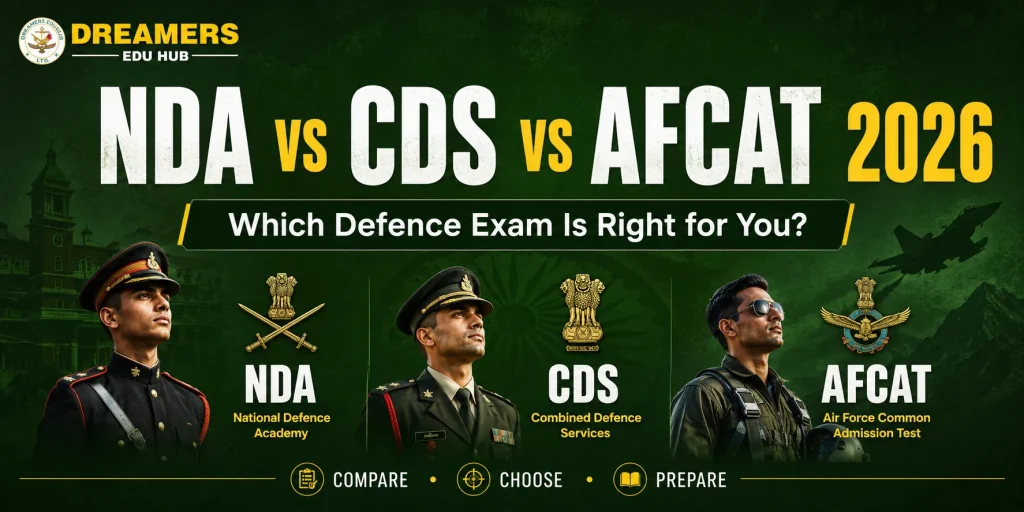
If you dream of becoming a commissioned officer in the Indian Armed Forces, you’ve probably typed “NDA vs CDS vs AFCAT” into Google at least once. It’s the most common confusion among defence aspirants in Dehradun and across India — and for good reason. All three exams lead to officer-rank careers in the Army, Navy, or Air Force, but they differ completely in eligibility, age limit, exam pattern, and the stage of life at which you can apply.
This guide breaks down every difference — with the latest 2026 notification details — so you can choose the right defence exam based on your current qualification, age, and career goals, instead of guessing or preparing for the wrong one.
NDA vs CDS vs AFCAT: Quick Comparison Table
| Parameter | NDA | CDS | AFCAT |
|---|---|---|---|
| Conducted by | UPSC | UPSC | Indian Air Force |
| Eligibility | Class 12th pass/appearing | Graduate | Graduate (60% marks for most branches) |
| Age Limit | 16.5 – 19.5 years | 19 – 25 years (varies by academy) | 20 – 26 years (varies by branch) |
| Marital Status | Unmarried only | Unmarried (IMA/INA/AFA); married allowed for OTA | Unmarried for Flying Branch; married allowed for Ground Duty |
| Training Academy | NDA, Khadakwasla (Pune) | IMA / INA / AFA / OTA | AFA, Dundigal (Hyderabad) |
| Training Duration | 3 years (NDA) + 1 year (respective academy) | 1–1.5 years | Approx. 1 year |
| Services Available | Army, Navy, Air Force | Army, Navy, Air Force | Air Force only |
| Exam Difficulty | High (school + early-age competition) | Moderate to high (graduate-level competition) | Moderate (aptitude & reasoning focused) |
| Best Suited For | Students who decide early, right after 12th | Graduates wanting Army/Navy/Air Force officer entry | Graduates targeting Air Force specifically |
What Is NDA (National Defence Academy)?
The NDA exam is conducted twice a year by UPSC and is the earliest entry point into the Indian Armed Forces. You can apply right after Class 12th — you don’t even need to wait for your results, as long as you’re appearing in the exam.
NDA Eligibility 2026
- Education: Class 12th pass or appearing (Physics and Maths compulsory for Air Force and Naval wings; Army wing accepts any stream)
- Age: Between 16.5 and 19.5 years on the date of joining the academy
- Marital Status: Unmarried only
- Gender: Both male and female candidates are eligible
NDA Exam Pattern
The written exam is divided into two papers — Mathematics (300 marks) and General Ability Test or GAT (600 marks), covering English, Physics, Chemistry, General Science, History, Geography, and Current Affairs. There’s a 1/3rd negative marking for every wrong answer. The written exam and SSB interview are weighted equally at 900 marks each, for a total of 1800 marks.
After clearing the written exam, candidates go through the SSB interview, followed by a medical exam, before the final merit list is released.
2026 update: From this year, the NDA syllabus is being aligned with the National Education Policy (NEP) 2020, with a sharper focus on conceptual and analytical ability rather than rote learning — something Dehradun-based aspirants preparing for NDA 1 or NDA 2 2026 should keep in mind while choosing study material.
Why choose NDA: If you’re certain about a defence career while still in school, NDA gives you the longest training period, the deepest grounding in military life, and entry into all three wings — Army, Navy, and Air Force.
What Is CDS (Combined Defence Services)?
The CDS exam, also conducted by UPSC, is meant for graduates who want to join as officers in the Army, Navy, or Air Force through IMA, INA, AFA, or OTA (Officers Training Academy).
CDS Eligibility 2026
- Education: Graduation from a recognized university — IMA and OTA accept any degree; INA requires a B.E./B.Tech in specified engineering branches; AFA requires a degree with Physics and Maths at the 10+2 level, or a B.E./B.Tech
- Age: Roughly 19–24 years for IMA, 19–22 for INA, 19–23/24 for AFA, and 19–25 for OTA (exact cut-off dates vary by notification cycle)
- Marital Status: Unmarried for IMA, INA, and AFA; OTA permits unmarried, widowed-without-child, and non-remarried divorced candidates of either gender
CDS Exam Pattern
For IMA, INA, and AFA, the paper includes English, General Knowledge, and Elementary Mathematics (10th-level Maths — noticeably easier than NDA’s syllabus). For OTA, there’s no Mathematics paper at all — just English and General Knowledge — making it a popular choice for non-Maths graduates.
Why choose CDS: If you’ve already completed graduation and still want to become a defence officer, CDS is your direct route. It also offers more flexibility in academic background compared to NDA — and women candidates can apply through OTA.
What Is AFCAT (Air Force Common Admission Test)?
AFCAT is conducted exclusively by the Indian Air Force, twice a year, for both technical and non-technical graduates who want to join as officers specifically in the Air Force — through the Flying Branch, Technical Branch, or Ground Duty (Non-Technical) Branch.
AFCAT Eligibility 2026
- Flying Branch: Graduate (any discipline, minimum 60% marks) with Physics and Maths at 50% each at the 10+2 level, or a B.E./B.Tech degree
- Ground Duty (Technical): Engineering degree in specific branches (Mechanical, Electronics, Computer Science, etc.) with at least 60% marks
- Ground Duty (Non-Technical): Graduate with minimum 60% marks
- Age: Flying Branch — 20 to 24 years (extendable to 26 with a valid DGCA-issued Commercial Pilot Licence); Ground Duty (Technical & Non-Technical) — 20 to 26 years
- Marital Status: Unmarried for the Flying Branch; married candidates above 25 can apply for Ground Duty roles
AFCAT Exam Pattern
The paper tests English, General Awareness, Numerical Ability, and Verbal & Non-Verbal Reasoning — it’s an aptitude-based exam, not a Maths-heavy one like NDA.
Why choose AFCAT: If your goal is specifically the Air Force — flying, technical, or ground roles — and you’re a graduate, AFCAT is the most direct and Air Force-focused route available.
NDA vs CDS vs AFCAT: Key Differences That Actually Matter
1. Stage of Life NDA picks you right after school. CDS and AFCAT are for graduates. If you’re still in Class 11 or 12 in Dehradun (or anywhere else) and sure about a defence career, NDA is the natural starting point — you don’t need to “wait” for graduation.
2. Choice of Services NDA and CDS open doors to Army, Navy, and Air Force. AFCAT is Air Force only. If you have a specific interest in aviation or Air Force technology, AFCAT is the focused choice.
3. Difficulty Level NDA is widely considered the toughest because the Mathematics syllabus is at the Class 11–12 level and competition includes lakhs of young aspirants. CDS Maths (for IMA/INA/AFA) is comparatively easier — Class 10 level — and OTA skips Maths entirely. AFCAT replaces Maths with reasoning and aptitude, which many graduates find more manageable.
4. Training Duration & Officer Seniority NDA cadets train the longest (3 years at NDA + 1 year at the respective service academy), which often gives them a seniority and leadership-grooming edge over later entries. CDS and AFCAT training durations are comparatively shorter, around 1 to 1.5 years.
5. Salary & Career Growth Once commissioned, pay scales and career growth are largely similar across NDA, CDS, and AFCAT entries — the real difference is in entry age and total years of service, not the starting salary.
So, Which One Should You Choose?
- Choose NDA if you’re in Class 11/12, certain about a defence career, and want the earliest possible entry with the most thorough training.
- Choose CDS if you’ve already graduated (or are in your final year) and want flexibility to apply for Army, Navy, or Air Force as an officer.
- Choose AFCAT if you’re a graduate with a specific, focused interest in the Air Force — whether flying, technical, or ground duty roles.
Important: You are not restricted to choosing just one. Many graduates appear for both CDS and AFCAT in the same year to maximize their chances, since there’s significant overlap in the English and General Knowledge sections. However, if you’re still in school, focus your full preparation on NDA first — trying to prep for all three at once usually results in shallow preparation for each.
FAQs: NDA vs CDS vs AFCAT
Can a 12th-pass student apply for CDS or AFCAT? No. Only NDA accepts Class 12th pass or appearing candidates. Both CDS and AFCAT require graduation (or final-year status, with proof of degree before joining).
Which exam is the toughest — NDA, CDS, or AFCAT? NDA is generally considered the toughest due to its higher-level Mathematics syllabus and intense competition from younger aspirants. CDS is moderate, and AFCAT leans more on aptitude and reasoning than core subject difficulty.
Can girls apply for NDA, CDS, and AFCAT? Yes. Female candidates are eligible for NDA (all wings), CDS (through OTA), and AFCAT (Flying and Ground Duty branches), subject to the same age and educational criteria as male candidates.
Is Mathematics compulsory in all three exams? No. Maths is compulsory for NDA and for IMA/INA/AFA entries in CDS. There is no Mathematics paper for OTA in CDS, and AFCAT replaces Maths with a Numerical Ability and Reasoning section.
Can I prepare for NDA, CDS, and AFCAT at the same time? If you’re a Class 12 student, focus only on NDA — CDS and AFCAT aren’t available to you yet anyway. If you’re a graduate, preparing for both CDS and AFCAT together is common since there’s significant overlap in General Knowledge and English sections.
Get Personalized Guidance for Your Defence Exam Journey
Choosing between NDA, CDS, and AFCAT isn’t just about eligibility on paper — it’s about matching the right exam to your current academic stage, age, and long-term career goals. The wrong choice can cost you a precious attempt.
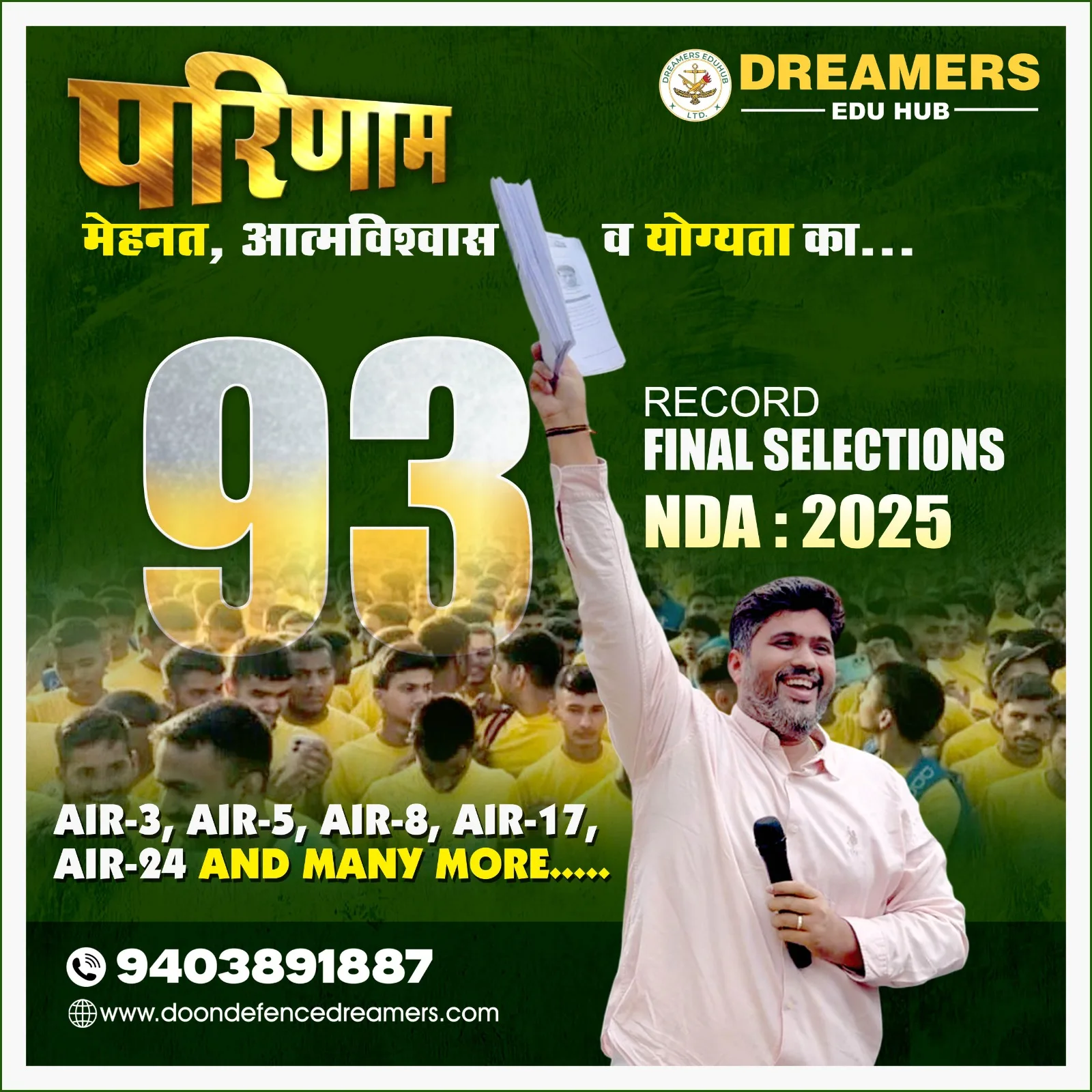
At Doon Defence Dreamers in Dehradun, we don’t just coach for one exam — we guide aspirants in choosing the right path first, then provide structured preparation for NDA, CDS, AFCAT, and SSB under one roof, backed by a track record of 93 final selections and 710+ written qualifiers in NDA 2025.
Still unsure which exam fits you best? Talk to our admission counsellors — Dehradun’s trusted destination for defence exam preparation.
Doon Defence Dreamers Ltd (Dreamers Edu Hub) — Best NDA Coaching in Dehradun. Call: +91-9429691488 / +91-9429691072
Note on accuracy: Age limits and cut-off dates shift slightly with every UPSC/IAF notification cycle (NDA 1 vs NDA 2, CDS 1 vs CDS 2, AFCAT 1 vs AFCAT 2). The ranges above reflect 2026 notifications; always cross-check exact birth-date windows against the live UPSC (upsc.gov.in) or IAF (afcat.cdac.in) notification before applying.